
Sports Apparel Market Overview
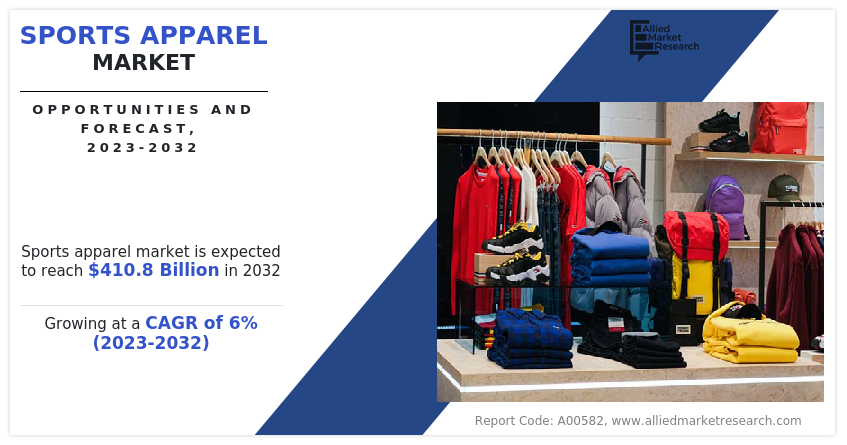
The global sports apparel market size was valued at USD 230.6 billion in 2022, and is projected to reach USD $410.8 billion by 2032, growing at a CAGR of 6% from 2023 to 2032.Sports apparel refers to specialized clothing and accessories designed for various sports & physical activities. It is specifically crafted to enhance performance, and provide comfort to athletes & fitness enthusiasts. It encompasses a wide range of garments such as jerseys, shorts, t-shirts, leggings, shoes, socks, and hats. These garments are often made from lightweight, breathable, and moisture-wicking materials that help regulate body temperature and keep athletes dry during intense physical exertion. In addition, sports apparel may feature technologies such as compression, stretchability, and ergonomic designs to optimize movement and support muscles. Alongside functional aspects, sports apparel simultaneously serves as a form of self-expression, showcasing team colors, logos, and personal style. Whether ’it is for professional athletes, amateurs, or fitness enthusiasts, sports apparel plays a crucial role in promoting comfort, performance, and overall sporting experience.
Market Size & Forecast
- 2022 Market Size: USD 230.6 Billion
- 2032 Projected Market Size: USD 410.8 Billion
- Compound Annual Growth Rate (CAGR) (2023–2032): 6.0%
The sports apparel market demand has experienced remarkable growth in recent years, driven by a combination of factors such as change in consumer preferences, and rise in the trend of athleisure wear. One of the key growth drivers in the sports apparel market is increase in focus on health & fitness. As individuals become more health-conscious and strive for an active lifestyle, the demand for sports apparel has surged. Consumers are actively seeking comfortable & performance-enhancing clothing that allows them to engage in various fitness activities.
Rise of athleisure trend has been another significant growth driver that has blurred the lines between athletic apparel and everyday fashion, enabling consumers to seamlessly transition from workouts to casual wear. In addition, technological advancements have played a crucial role in transforming the sports apparel industry. Innovative materials and technologies such as moisture-wicking fabrics, compression technology, temperature regulation, and antimicrobial properties have revolutionized performance & comfort associated with sports apparel. These features have become increasingly important to consumers, driving the demand for sports apparel with enhanced functionality. In recent years, influencer marketing and brand collaborations have become instrumental in promoting sports apparel brands. By partnering with social media influencers, athletes, and celebrities, brands can leverage their reach & credibility to enhance brand visibility & desirability among consumers. These collaborations help create a strong brand image and connect with target audiences on a more personal level.
In addition, the industry faces intense competition from both established players and emerging brands. Thus, to stay competitive, sports apparel companies need to continuously innovate, invest in R&D, and offer unique products that meet evolving consumer demands.
Despite the challenges, there are numerous growth opportunities in the sports apparel market. For instance, e-commerce has emerged as a significant avenue for growth, allowing brands to reach a wider customer base and provide a convenient shopping experience. With increase in popularity of virtual fitness platforms, there is simultaneously a growing market for specialized sports apparel designed for specific activities such as yoga, cycling, and running. Furthermore, sustainability has become a critical focus for both consumers and brands as a result of which, there is rise in demand for eco-friendly and ethically produced sports apparel. Companies that embrace sustainability in their manufacturing processes and offer environmentally conscious products have the opportunity to differentiate themselves and attract conscious consumers.
The sports apparel market forecast is segmented on the basis of end user, distribution channel, and region. By end user, it is classified into children, men, and women. As per distribution channel, it is classified into e-commerce, supermarket/hypermarket, brand outlets, and discount stores. Region wise, it is analyzed across North America (U.S., Canada, and Mexico), Europe (Germany, France, UK, Italy, Spain, and rest of Europe), Asia-Pacific (China, Japan, India, Australia, and rest of Asia-Pacific), and LAMEA (Brazil, South Africa, UAE, and rest of LAMEA).
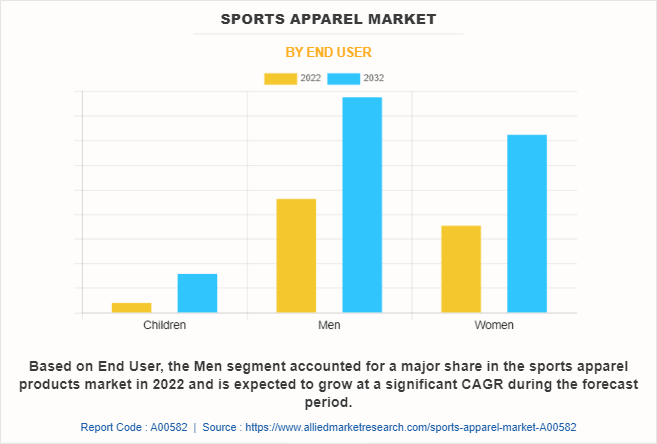
By end user, the men segment accounted for a major Sports Apparel Market Share in 2022 and is expected to grow at a significant CAGR during the forecast period. This growth is attributed to increase in participation in sports and fitness activities by men across different age groups and demographics. Moreover, men are becoming more health-conscious, seeking active lifestyles, and investing in sports apparel that aligns with their fitness goals.
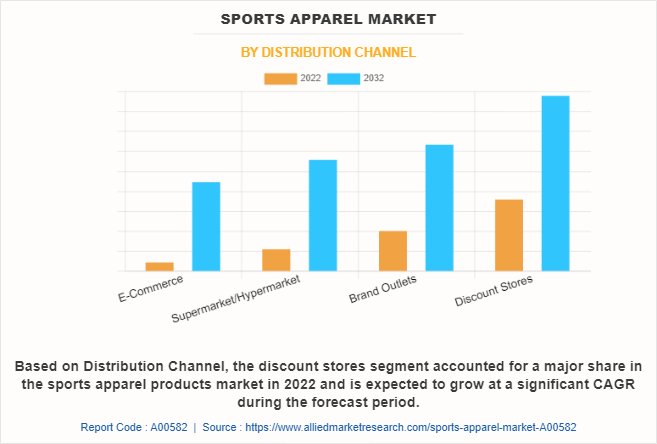
As per distribution channel, the discount stores segment accounted for a major share in the market in 2022 and is expected to grow at a significant CAGR during the forecast period. This growth is attributed to factors such as price sensitivity, need for budget-friendly options, availability of a variety of products, and expansion of discount retail chains. These factors collectively contribute to increase in popularity and presence of discount stores in the sports apparel industry.
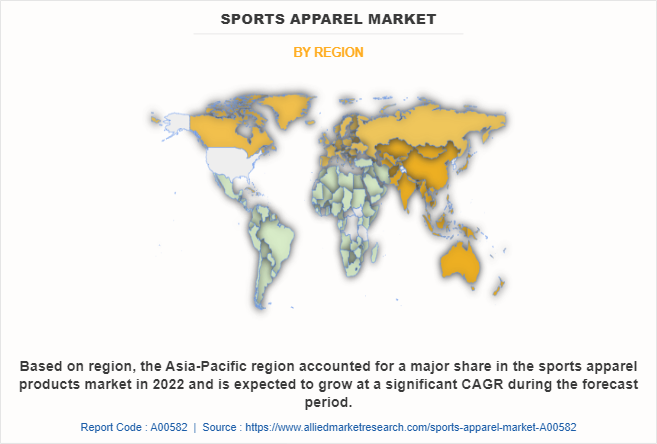
Region wise, Asia-Pacific accounted for a major share in the market in 2022 and is expected to grow at a significant CAGR during the forecast period. The market in Asia-Pacific has a huge growth potential due to growth in purchasing power of consumers and increase in the middle-class population. Apart from this, rise in marketing initiatives such as heavy marketing campaigns and celebrity endorsements further fuels the sports apparel market growth in the region. Market players should offer quality products to customers at affordable prices to expand their customer base and gain a strong footprint in the market. Moreover, they need to establish retail stores to expand their outreach and increase market share.
Competitive Landscape
The major players operating in the market focus on key market strategies, such as mergers, product launch, acquisitions, collaborations, and partnerships. Further, they focus on strengthening their market reach to maintain their goodwill in the ever-competitive market. Some of the key players in the sports apparel market report include Adidas AG, Nike, Inc., Puma SE, Under Armour, Inc., Ralph Lauren Corporation, Umbro Ltd., Fila, Inc, Lululemon Athletica Incorporation, New Balance Athletic Shoe, Inc., and Columbia Sportswear Company.
How Do Different Product Types or Categories Compare in Performance?
Different types of sports apparel vary in terms of performance, functionality, and consumer appeal, depending on the activity they are designed for. Activewear such as leggings, shorts, and t-shirts is typically made from lightweight, moisture-wicking fabrics that provide comfort and breathability during general workouts or casual exercise. Compression garments, including tights, sleeves, and tops, are designed to support muscles, improve circulation, and reduce fatigue, making them ideal for high-intensity training and professional athletes. Footwear, including running shoes, training shoes, and specialized sports shoes, plays a critical role in performance by providing cushioning, stability, and traction specific to each sport. Performance socks, gloves, and hats enhance comfort, reduce injury risk, and regulate temperature.
In contrast, athleisure apparel prioritizes style and versatility over intense performance, blending fashion with moderate functionality for daily wear. While all categories aim to combine comfort and utility, specialized items like compression gear and sport-specific footwear generally offer higher performance benefits, whereas everyday activewear and athleisure focus on accessibility, style, and multi-purpose usability, appealing to a broader consumer base.
What Makes the U.S./Europe/Asia-Pacific a Key Market for Industry Players?
The U.S., Europe, and Asia-Pacific are critical markets for sports apparel due to strong consumer demand, economic factors, and evolving lifestyle trends. In the U.S., a health-conscious population, high disposable income, and a well-established fitness culture drive consistent demand for performance-oriented and athleisure apparel. Influencer marketing, celebrity endorsements, and strong brand presence further amplify consumer engagement in this market.
Europe represents a mature market with high awareness of quality, sustainability, and innovation. Consumers increasingly seek eco-friendly, ethically produced, and technologically advanced sports apparel, prompting brands to offer high-performance and sustainable products. The popularity of outdoor activities, sports clubs, and fitness programs also supports steady demand.
Asia-Pacific is a rapidly growing market, fueled by rising purchasing power, an expanding middle-class population, and increasing urbanization. The region’s young, active demographic is highly receptive to global trends, including athleisure and fitness-focused clothing. Marketing initiatives, retail expansion, and e-commerce adoption further boost accessibility and sales. For industry players, these regions collectively provide a mix of established demand, emerging opportunities, and growth potential, making them strategic priorities for investment and expansion.
Why Is Demand Increasing in This Market?
Demand in the sports apparel market has been rising steadily due to a combination of lifestyle, fashion, and technological factors. One of the primary drivers is the growing focus on health, fitness, and active lifestyles, as more consumers prioritize physical well-being and seek apparel that supports exercise and performance. The global rise of athleisure has further boosted demand, blending athletic functionality with everyday fashion and enabling consumers to wear sports apparel both during workouts and in casual settings.
Technological innovations in materials, such as moisture-wicking fabrics, compression technology, temperature regulation, and antimicrobial properties, have enhanced comfort, performance, and appeal, making sports apparel more versatile and desirable. Influencer marketing, celebrity endorsements, and brand collaborations have also increased visibility and desirability among consumers, creating stronger brand connections. Additionally, the shift to online shopping and e-commerce platforms has made sports apparel more accessible to a wider audience, while growing interest in specialized activities like yoga, running, and cycling has created demand for activity-specific apparel. Sustainability trends are also influencing purchases, with consumers seeking eco-friendly and ethically produced products.
What Technological Innovations Are Creating New Growth Opportunities?
Technological innovations are transforming the sports apparel market, creating significant growth opportunities by enhancing both performance and consumer appeal. Advanced fabric technologies, such as moisture-wicking, breathable, and quick-dry materials, help regulate body temperature and keep athletes comfortable during intense physical activity. Compression and stretchable fabrics support muscles, improve circulation, and enable a full range of motion, making apparel more functional for fitness enthusiasts and professional athletes alike. Innovations in temperature regulation, such as thermoregulating fibers, allow clothing to adapt to different environmental conditions, enhancing comfort and usability. Antimicrobial and odor-resistant treatments further improve hygiene and wearability, particularly for active consumers who engage in frequent workouts.
Wearable technology integration is another area creating new opportunities, with smart garments that monitor heart rate, movement, and performance metrics becoming increasingly popular. In addition, 3D knitting and seamless manufacturing techniques allow for customized, ergonomic designs that fit the body more precisely, reducing chafing and improving overall performance. Sustainable material innovations, including recycled fabrics and bio-based fibers, are also attracting environmentally conscious consumers. Collectively, these technological advancements enable brands to offer high-performance, comfortable, and eco-friendly products, driving growth and differentiating them in a highly competitive market.
How Is Artificial Intelligence Transforming This Market?
Artificial Intelligence (AI) is transforming the sports apparel market by enhancing product development, personalization, and consumer engagement. Brands are leveraging AI-driven analytics to predict trends, optimize inventory, and design apparel that meets evolving consumer preferences. AI-powered tools enable personalized shopping experiences, recommending products based on individual behavior, size, and style preferences, which increases customer satisfaction and loyalty. In manufacturing, AI supports smart production processes, including automated cutting, 3D knitting, and quality control, improving efficiency and reducing waste. Additionally, AI is being used to develop performance-enhancing apparel, analyzing biomechanics and movement data to create garments that optimize comfort, support, and muscle performance. Virtual fitting rooms and augmented reality applications, powered by AI, allow consumers to try on products digitally, bridging the gap between online and in-store experiences. Collectively, these applications make sports apparel more innovative, tailored, and efficient, driving growth and differentiation in a competitive market.
How Intense Is Market Competition and What Defines Competitive Advantage?
The sports apparel market is highly competitive, with established global brands, emerging local players, and direct-to-consumer startups all vying for market share. Competition is driven by product innovation, pricing strategies, marketing campaigns, and brand loyalty. Established brands benefit from strong recognition, wide distribution networks, and extensive resources for research and development, while new entrants often compete by offering niche products, unique designs, or disruptive e-commerce models.
Competitive advantage in this market is defined by several key factors. Product differentiation through technological innovation, such as moisture-wicking fabrics, compression wear, or smart apparel, allows brands to stand out. Quality, comfort, and performance are critical to retaining consumers, while brand image, marketing strategies, and celebrity or influencer endorsements help enhance visibility and desirability. Speed to market, supply chain efficiency, and omnichannel presence, including retail stores and e-commerce, also contribute to maintaining an edge. Additionally, incorporating sustainability and ethical practices is increasingly important, allowing brands to appeal to socially and environmentally conscious consumers and strengthen long-term loyalty.
What Are the Major Risks and Challenges Facing the Market?
The sports apparel market faces several risks and challenges that can impact growth. Intense competition from established brands and new entrants puts pressure on pricing, innovation, and brand loyalty. Rapidly changing consumer preferences and fashion trends require constant product updates, increasing development costs. Supply chain disruptions, rising raw material prices, and dependence on global manufacturing can affect production and profitability. Counterfeit products and brand imitation also pose significant risks. Additionally, growing consumer demand for sustainable and ethically produced apparel requires investment in eco-friendly materials and processes. Companies failing to adapt to these trends may lose market relevance.
Key Benefits For Stakeholders
This report provides a quantitative analysis of the market segments, current trends, estimations, and dynamics of the sports apparel market analysis from 2022 to 2032 to identify the prevailing sports apparel market opportunities.
The market research is offered along with information related to key drivers, restraints, and opportunities.
Porter's five forces analysis highlights the potency of buyers and suppliers to enable stakeholders make profit-oriented business decisions and strengthen their supplier-buyer network.
In-depth analysis of the sports apparel market segmentation assists to determine the prevailing market opportunities.
Major countries in each region are mapped according to their revenue contribution to the global market.
Market player positioning facilitates benchmarking and provides a clear understanding of the present position of the market players.
The report includes the analysis of the regional as well as global sports apparel market trends, key players, market segments, application areas, and market growth strategies.
Sports Apparel Market Report Highlights
| Aspects | Details |
 Market Size By 2032 | USD 410.8 billion |
 Growth Rate | CAGR of 6% |
 Forecast period | 2022 - 2032 |
 Report Pages | 333 |
 By End User |
|
 By Distribution Channel |
|
 By Region |
|
 Key Market Players | Under Armour, Inc., Puma SE, Columbia Sportswear Company, Nike, Inc., New Balance Athletics, Inc., Ralph Lauren Corporation, Iconix International, Fila Holdings Corp., lululemon athletica inc, Adidas AG |
Analyst Review
According to the insights of the CXOs, the global sports apparel market is expected to witness robust growth during the forecast period. This is attributed to Increase in Awareness Related to Health & Fitness. Increase in awareness related to health & fitness is a significant driver fueling the growth of the sports apparel market. With more people prioritizing physical fitness & well-being, there has been surge in sports participation and fitness activities. This trend has resulted in rise in demand for sports apparel as individuals seek comfortable & functional clothing for their workouts. According to the Physical Activity Council's 2022 Participation Report, over 54.9% of Americans aged six and older participated in individual or team sports in 2020. With a heightened focus on health & fitness, individuals are demanding sports apparel that suits their respective needs.
However, the sports apparel market is vulnerable to counterfeit products, which can negatively impact brand reputation and consumer trust. Counterfeit items often lack the quality, performance features, and durability associated with genuine sports apparel. Brands need to implement robust measures to combat counterfeiting and protect their market share.
The sports apparel market size was valued at $230.6 billion in 2022 and is expected to reach $410.8 billion by 2032
The global Sports Apparel market is projected to grow at a compound annual growth rate of 6% from 2023 to 2032 $410.8 billion by 2032
The report offers a comprehensive analysis of the key players such as Adidas AG, Nike, Inc., Puma SE, Under Armour, Inc., Ralph Lauren Corporation, Umbro Ltd., Fila, Inc, Lululemon Athletica Incorporation, New Balance Athletic Shoe, Inc., and Columbia Sportswear Company.
Region wise, Asia-Pacific accounted for a major share in the market
One of the key growth drivers in the sports apparel market is increase in focus on health & fitness.
Loading Table Of Content...
Loading Research Methodology...