
3D Ultrasound Market Research, 2033
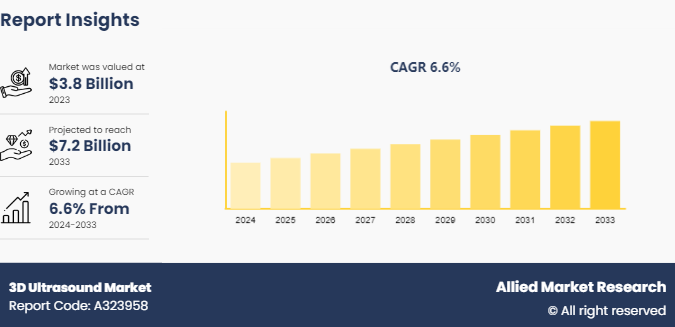
The global 3D ultrasound market size was valued at $3.8 billion in 2023, and is projected to reach $7.2 billion by 2033, growing at a CAGR of 6.6% from 2024 to 2033. The major factors for the 3D ultrasound market include technological advancements leading to enhanced imaging quality, increasing demand for minimally invasive diagnostic procedures, and the rising prevalence of chronic diseases necessitating advanced diagnostic tools.
Market Introduction and Definition
3D ultrasound is a medical imaging technique that uses sound waves to create three-dimensional images of the inside of the body. Unlike traditional 2D ultrasound, which provides flat, two-dimensional images, 3D ultrasound captures multiple angles to form a detailed, volumetric representation. This advanced imaging method is commonly used in obstetrics to visualize the fetus, allowing for better assessment of fetal development, anatomy, and potential abnormalities. It is also utilized in cardiology, oncology, and other medical fields to enhance diagnostic accuracy. The ability to view structures in three dimensions improves the precision of medical evaluations and treatment planning.
Key Takeaways
The 3D ultrasound market share study covers 20 countries. The research includes a segment analysis of each country in terms of value for the projected period.
More than 1, 500 product literatures, industry releases, annual reports, and other such documents of major 3D ultrasound industry participants along with authentic industry journals, trade associations' releases, and government websites have been reviewed for generating high-value industry insights.
The study integrated high-quality data, professional opinions and analysis, and critical independent perspectives. The research approach is intended to provide a balanced view of global markets and to assist stakeholders in making educated decisions in order to achieve their most ambitious growth objectives.
Key Market Dynamics
Increasing prevalence of chronic diseases such as cardiovascular diseases, cancer, and liver diseases and expanding applications of 3D systems in cardiology and oncology are the major factors which drives the 3D ultrasound market growth. Chronic conditions such as cardiovascular diseases, cancer, and musculoskeletal disorders require frequent monitoring and diagnostic imaging, creating demand for advanced diagnostic tools such as 3D ultrasound. The ability of 3D ultrasound to offer non-invasive, real-time imaging with minimal patient discomfort makes it particularly suitable for routine screenings, disease monitoring, and interventional procedures. As healthcare systems strive to manage the growing prevalence of chronic diseases, led to rise in the adoption of 3D ultrasound systems thereby propels growth during the 3D ultrasound market forecast period.
In addition, rapid advancement in ultrasound technology such as modern 3D ultrasound machines which offer superior image quality, higher resolution, and greater depth perception compared to traditional 2D systems which boost the market growth. Innovations such as real-time imaging, improved transducer technology, and enhanced image processing software have made 3D ultrasounds more reliable and easier to use. These advancements not only improve diagnostic accuracy but also broaden the scope of ultrasound applications, making them invaluable tools in various medical fields.
However, the initial investment required for 3D ultrasound machines is significantly higher compared to 2D ultrasound systems. This can be a barrier for small and mid-sized healthcare facilities which limiting the market growth. Moreover, advances in technology such as improved image resolution and real-time 3D imaging capabilities, are enhancing diagnostic accuracy and expanding clinical applications across obstetrics, gynecology, cardiology, and musculoskeletal imaging which provide a 3D ultrasound market opportunity.
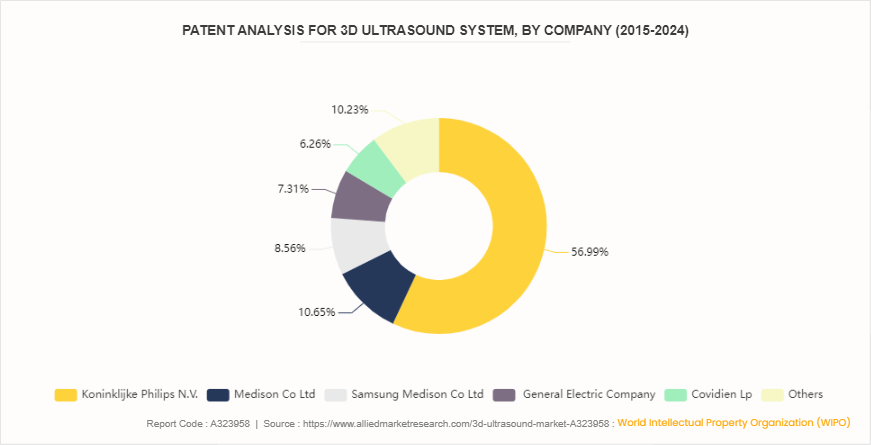
Patent Analysis for 3D Ultrasound System, by Company (2015-2024)
According to the World Intellectual Property Organization (WIPO) patent analysis report from 2015 to 2024 highlights Koninklijke Philips N.V. as the leading innovator in 3D ultrasound technology, holding 57.0% of the total patents analyzed. Following Philips are Medison Co Ltd with 10.6%, Samsung Medison Co Ltd with 8.6%, and General Electric Company with 7.3%. Covidien Lp and other companies collectively account for the remaining 25.1%. This dominance emphasize Philips' significant investment and innovation in advancing 3D ultrasound systems, which contributing to their strong market presence. Philips' extensive patent portfolio suggests a robust commitment to technological advancement and intellectual property protection in the medical imaging sector. Medison and Samsung Medison's substantial patent shares also highlight their contributions to 3D ultrasound technology, potentially driving competitive innovation and market differentiation. Overall, this patent distribution reflects the ongoing evolution and competitiveness within the 3D ultrasound market, where technological innovation plays a crucial role in enhancing diagnostic capabilities, patient outcomes, and market competitiveness among these key industry players.
Market Segmentation
The 3D ultrasound market is segmented into portability, application, end user, and region. On the basis of the portability, the market is bifurcated into trolley/cart-based and compact/handheld. By application, the market is classified into general imaging, cardiology, obstetrics and gynecology, urology, and others. By end user, the market is divided into hospitals, diagnostic imaging centers, and others. By region, it is analyzed across North America, Europe, Asia-Pacific, and LAMEA.
Regional/Country Market Outlook
North America dominated the 3D ultrasound market share, driven by well-established healthcare infrastructures, high healthcare spending, and the early adoption of advanced medical technologies. However, the Asia-Pacific region is expected to experience significant growth in the coming years owing to factors such as increasing healthcare expenditure, improving healthcare infrastructure, and a growing geriatric population prone to various age-related conditions. In addition, the rising awareness of preventive healthcare and early disease detection, coupled with the increasing affordability of 3D ultrasound systems, is expected to drive market growth across emerging economies.
According to American Medical Association, the health spending in the U.S. increased by 4.1% in 2022 ($4.4 trillion) . Rise in healthcare expenditures, there is a corresponding increase in investment in advanced medical technologies, including 3D ultrasound systems which is contributes towards the market growth.
Industry Trends
In January 2023, the U.S.FDA approved ultrasound to treat essential tremor (ET) on the second side of the brain. This regulatory broadens the application scope of focused ultrasound technology, highlighting its therapeutic potential and increasing its adoption among healthcare providers and patients. As more patients become eligible for this non-invasive, targeted treatment, demand for advanced 3D ultrasound systems, which are critical for precise imaging and treatment planning, is expected to surge.
According to the ClinicalTrials.gov, in 2023, the University of Ulm sponsored a study to evaluation the impact of use of 3D ultrasound in brain tumor surgery on extend of resection. Positive outcomes from the study can enhance the credibility and adoption of 3D ultrasound, driving demand among neurosurgeons and healthcare institutions which is expected to drive the 3D ultrasound market size.
Competitive Landscape
The major players operating in the 3D ultrasound market include 3Shape A/S, GE Healthcare, Koninklijke Philips N.V., Canon Medical Systems Corporation, FUJIFILM VisualSonics, Inc., Siemens, ESAOTE SPA, Shenzhen Mindray Bio-Medical Electronics Co., Ltd, Samsung Healthcare, CHISON Medical Technologies Co., Ltd., and Hologic Inc. Other players in 3D ultrasound market includes Delphinus Medical Technologies, Inc. and so on.
Recent Key Strategies and Developments in 3D Ultrasound Industry
In May 2024, Samsung Medison, a global medical equipment company and Samsung Electronics announced that it has signed an agreement to acquire 100% of the shares of Sonio SAS, a fetal ultrasound AI software company.
In February 2023, Samsung Introduced Premium Women’s Health Ultrasound. Redefining women’s health imaging, Samsung’s HERA W10 Elite, the premier model of the HERA platform, aims to step up as a visionary leader of Obstetrics and Gynecology applications.
In February 2023, Mindray Medical International Limited, leading developers and providers of advanced medical devices and solutions announced the launch of the first wireless handheld ultrasound system, the TE Air. TE Air is designed specifically to meet the demand of global healthcare professionals for a higher-quality portable ultrasound device that is easy to use in multiple medical environments and delivers crisp point-of-care ultrasound (POCUS) imaging.
In January 2021, Hologic, Inc. announced the availability in Europe of 3D ultrasound imaging on the SuperSonic MACH 30 and 20 ultrasound systems. This innovation gives clinicians access to high-resolution B-mode and ShearWave PLUS elastography 3D volumes, providing additional insights and enhancing diagnostic certainty.
Key Sources Referred
- National Center for Biotechnology and Information (NCBI)
- Centers for Medicare & Medicaid Services (CMS)
- National Health Service (NHS)
- Australian Government Department of Health and Aged Care
- Government of Canada's Health and Wellness
- Ministry of Health and Family Welfare (MoHFW)
- National Health Mission (NHM)
- Centers for Disease Control and Prevention (CDC)
- Food and Drug Administration (FDA)
- National Institutes of Health (NIH)
- World Health Organization (WHO)
Key Benefits for Stakeholders
- This report provides a quantitative analysis of the market segments, current trends, estimations, and dynamics of the 3D ultrasound market analysis from 2024 to 2033 to identify the prevailing 3D ultrasound market opportunities.
- The market research is offered along with information related to key drivers, restraints, and opportunities.
- Porter's five forces analysis highlights the potency of buyers and suppliers to enable stakeholders make profit-oriented business decisions and strengthen their supplier-buyer network.
- In-depth analysis of the 3D ultrasound market segmentation assists to determine the prevailing market opportunities.
- Major countries in each region are mapped according to their revenue contribution to the global market.
- Market player positioning facilitates benchmarking and provides a clear understanding of the present position of the market players.
- The report includes the analysis of the regional as well as global 3D ultrasound market trends, key players, market segments, application areas, and market growth strategies.
3D Ultrasound Market Report Highlights
| Aspects | Details |
 Market Size By 2033 | USD 7.2 Billion |
 Growth Rate | CAGR of 6.6% |
 Forecast period | 2024 - 2033 |
 Report Pages | 228 |
 By Portability |
|
 By Application |
|
 By End User |
|
 By Region |
|
 Key Market Players | Hologic, Inc. , GE Healthcare, FUJIFILM VisualSonics, Inc., Canon Medical Systems Corporation, Koninklijke Philips N.V., CHISON Medical Technologies Co., Ltd. , Siemens, Samsung Healthcare, ESAOTE SPA, Shenzhen Mindray Bio-Medical Electronics Co., Ltd |
The total market value of 3D ulltrasound market is $3.8 billion in 2023.
The market value of 3D ultrasound market in 2033 is $7.2 billion.
North America accounted for largest share in 2023, owing to advanced healthcare infrastructure, high adoption rates of medical technologies, and substantial investments in research and development within the healthcare sector.
The leading application of the 3D ultrasound market is in obstetrics and gynecology, where it is extensively used for prenatal imaging, assessing fetal development, and detecting anomalies.
The upcoming trends in the global 3D ultrasound market include the integration of artificial intelligence for advanced image processing and diagnostic accuracy, expanding applications in orthopedics and musculoskeletal imaging, and the development of portable and handheld ultrasound devices for point-of-care diagnostics.
The 3D ultrasound market refers to the global industry focused on ultrasound imaging technologies that provide three-dimensional visualizations of internal body structures. It encompasses devices and systems used for medical diagnostics across various specialties, including obstetrics, gynecology.
Loading Table Of Content...