
Ambulatory Surgery Center Market Research, 2033
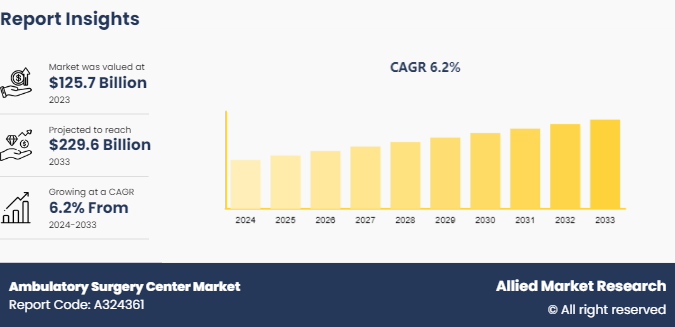
The global ambulatory surgery center market size was valued at $125.7 billion in 2023, and is projected to reach $229.6 billion by 2033, growing at a CAGR of 6.2% from 2024 to 2033. Technological advancements present a significant driver for the ambulatory surgery center market. Innovations in medical technology, such as minimally invasive surgical techniques, advanced imaging, and robotic-assisted surgeries, have expanded the range of procedures that can be safely performed in an outpatient setting.
Market Introduction and Definition
An ambulatory surgery center offers efficient, cost-effective, and high-quality surgical services in a focused outpatient setting. Over the past two decades, ambulatory surgery centers have become an important component of modern healthcare systems, particularly in developed markets such as the United States and parts of Europe.
Ambulatory surgery centers specialize in orthopedics, ophthalmology, pain management, and ear, nose, and throat procedures. Cataract removal, arthroscopy, colonoscopy, hernia repair, and other cosmetic procedures are performed at ambulatory surgery centers. Advancements in anesthesia, surgical techniques, and post-operative care increase the possibility of safe performance of many procedures outside traditional hospital settings.
Operational efficiency is one of major factors that drives the growth of the ambulatory surgical centers. These centers focus on scheduled procedures, which makes way for streamlined workflows, shorter waiting times, and improved patient throughput. Thus, patients experience faster admission and discharge processes, reduced exposure to hospital-acquired infections, and personalized care.
Ambulatory surgical centers are healthcare facilities focused on providing same-day surgical care, including diagnostic and preventive procedures, without the need for hospital admission. These centers offer a convenient, cost-effective alternative to traditional hospital-based surgeries. Ambulatory surgery centers are equipped with advanced medical technology and staffed by specialized surgical teams, ensuring high-quality care. Common procedures performed in ambulatory surgery centers include orthopedic surgeries, endoscopies, ophthalmic surgeries, and cosmetic procedures. They enhance patient experience by reducing wait times and lowering infection risks associated with hospital stays. Ambulatory surgery centers play a crucial role in the healthcare system by improving accessibility and efficiency in surgical care delivery.
Cost efficiency is another significant benefit. Procedures performed at ambulatory surgery centers cost less than those conducted in hospital outpatient departments. Ambulatory surgery centers represent a cost-containment strategy without compromising quality. Some centers are physician-owned, while others operate through joint ventures between physicians and hospital systems. Strategic partnerships between hospitals and ambulatory surgery centers are also common, allowing hospitals to extend outpatient services while focusing inpatient resources on complex cases.
Quality and safety standards are strictly regulated in the ambulatory surgical center. In many countries, these centers need to meet accreditation requirements set by national health authorities. These standards cover infection control, anesthesia safety, and patient outcomes. Technology plays an important role in ambulatory surgery center operations. Digital health records, minimally invasive surgical equipment, and robotic-assisted surgery systems enhance precision and patient safety. Further, telehealth solutions are increasingly used for pre-operative consultations and post-operative follow-ups, further improving convenience.
Key Takeaways
- The ambulatory surgery center market share study covers 20 countries. The research includes a segment analysis of each country in terms of value ($Billion) for the projected period 2024-2033.
- More than 1, 500 product literatures, industry releases, annual reports, and other such documents of major Ambulatory Surgery Center industry participants along with authentic industry journals, trade associations' releases, and government websites have been reviewed for generating high-value industry insights.
- The study integrated high-quality data, professional opinions and analysis, and critical independent perspectives. The research approach is intended to provide a balanced view of global markets and to assist stakeholders in making educated decisions in order to achieve their most ambitious growth objectives.
Key Market Dynamics
Drivers
The growth of ambulatory surgery centers is linked to different trends in the healthcare sector. Rise in demand for cost-effective healthcare services also fosters the growth of the ambulatory surgery center market. Ambulatory surgery center offers lower procedural costs compared to hospital outpatient departments, making them attractive for payers seeking to reduce healthcare spending. Technological advancements also support ambulatory surgery center expansion. Improvements in minimally invasive surgical techniques, better anesthesia protocols, and advanced medical devices have made it possible to perform complex procedures safely in outpatient settings. These innovations reduce recovery times and minimize complications, enabling same-day discharge.
Another major driver is the shift toward value-based care. Healthcare systems are increasingly focused on improving outcomes while controlling costs. ambulatory surgery centers align well with this model due to their efficiency, predictable scheduling, and strong patient satisfaction rates. Many insurers actively encourage the use of ambulatory surgery centers through reimbursement policies and incentives.
Restraints
Regulatory compliance and accreditation requirements can be complex and costly. Facilities must adhere to strict standards related to patient safety, staffing, and infrastructure, which can increase operational expenses. Limited scope of procedures is another factor that limits the ambulatory surgery center market growth. Ambulatory surgery centers are suitable only for specific types of surgeries and generally cannot manage high-risk patients with multiple comorbidities. Complex cases still require hospital-based care, limiting the potential patient base. Workforce shortages, particularly in specialized nursing and anesthesia professionals, can also impact ambulatory surgery center operations. Staffing challenges may limit expansion or affect service capacity.
Opportunities
The ambulatory surgery center market presents significant opportunities for expansion and innovation. Procedures once limited to inpatient hospitals are increasingly being adapted for ambulatory surgery center environments. This is anticipated to boost the growth of the market. Strategic partnerships and consolidation also offer growth potential. Hospitals, physicians, and private equity investors are forming joint ventures to expand ambulatory surgery center networks and improve operational efficiency. Moreover, integration of electronic health records, telehealth services, and advanced analytics can enhance operational efficiency, patient engagement, and outcome tracking.
What Is the Current Market Size and How Is the Market Expected to Grow?
The ambulatory surgery center market is a large and expanding segment of the global healthcare industry. The increase in shift of surgical care from traditional hospital inpatient settings to outpatient ambulatory surgery centers boosts the growth of the market. Ambulatory surgery centers provide same-day surgical care for a wide range of procedures, including orthopedic, ophthalmologic, gastrointestinal, and pain management surgeries, making them cost-effective and convenient alternatives to hospital-based surgery. The growth is consistent across major regions, with North America holding the largest share due to strong healthcare infrastructure, favorable reimbursement policies, and a high prevalence of outpatient procedures. Ambulatory surgery centers in the U.S. play an important role, with over 40% of surgical procedures shifting to ambulatory settings in recent years. Technological advancements in minimally invasive procedures, imaging, and anesthesia also contribute to the expansion of the ambulatory surgery center market.
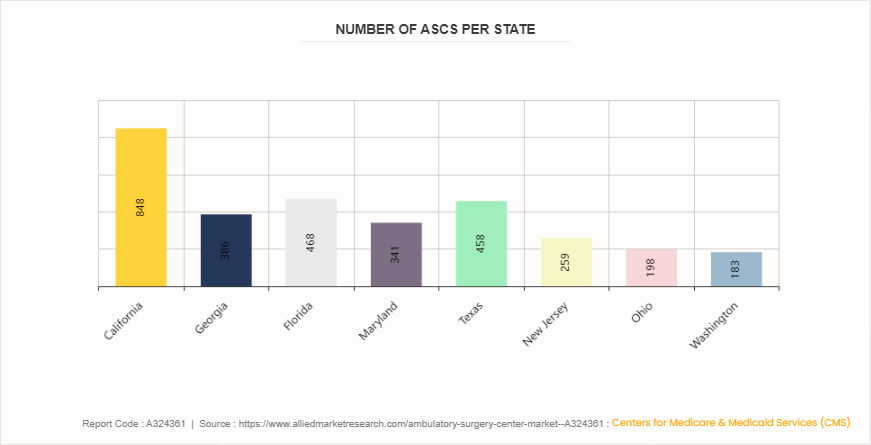
Number of ASCs per State for Ambulatory Surgery Center Market
According to Centers for Medicare & Medicaid Services (CMS) , December 2022. The data illustrates the number of ambulatory surgical centers in various U.S. states. California leads with 848 ambulatory surgical centers, indicating a significant presence of outpatient surgical facilities. Florida follows with 468 ambulatory surgical centers, and Texas has 458, highlighting these states' substantial investment in accessible surgical care. Georgia has 386 ambulatory surgical centers, while Maryland has 341, both indicating robust infrastructure for same-day surgeries. New Jersey, Ohio, and Washington have 259, 198, and 183 ambulatory surgical centers, respectively, showing a moderate but vital availability of ambulatory surgical centers. These numbers reflect regional differences in healthcare infrastructure and the growing trend towards cost-effective, outpatient surgical solutions.
Market Segmentation
The ambulatory surgery center market share is segmented into center type, application, modality and region. On the basis of center type, the market is categorized into single specialty centers, and multispecialty centers. On the basis of application, the market is segmented gastroenterology, ophthalmology, orthopedics, neurology, and others. On the basis of modality, the ambulatory surgery center market is segmented into hospital based ambulatory surgical center, and freestanding ambulatory surgical center. Region wise, it is analyzed across North America, Europe, Asia-Pacific, and LAMEA.
Regional/Country Market Outlook
The ambulatory surgery center market size shows diverse regional and country-specific growth trends. In the United States, the market is highly developed, driven by cost-efficiency, technological advancements, and favorable insurance policies. Europe, particularly in countries like Germany and the UK, is witnessing steady growth due to increasing healthcare expenditures and a shift towards outpatient care. In the Asia-Pacific region, countries like China and India are emerging markets, fueled by growing healthcare infrastructure, rising medical tourism, and an expanding middle-class population. Overall, regional variations reflect differing healthcare systems, economic conditions, and regulatory environments, influencing the adoption and expansion of ambulatory surgery centers globally.
- In July 2022, Centura Mercy Hospital, the health care leader, announce it is partnering with local physicians to expand its commitment to high-quality care through the construction of a new ambulatory surgery center (ASC) in Durango, Colorado.
Industry Trends
- In February 2022, EMU Health, a multi-specialty outpatient medical facility in the Glendale section of Queens, celebrated its first total knee replacement surgery in an outpatient setting. The surgery was performed at EMU Health’s ambulatory surgery center by Dr. Ivan Madrid, a leading orthopedic surgeon who specializes in joint replacement surgery.
- In June 2023, according to ASC Data, the number of single-specialty ambulatory surgical centers in the U.S. were 3, 082 in number.
How Is Artificial Intelligence Transforming This Market?
Artificial intelligence is gradually transforming the ambulatory surgery center market by improving clinical decision-making, operational efficiency, and patient outcomes. As outpatient procedures continue to grow globally, ambulatory surgery centers are adopting AI-driven tools to manage higher patient volumes while maintaining quality and safety standards. One of the most important applications of AI in ambulatory surgery centers is clinical decision support. Artificial intelligence algorithms can analyze patient data, including medical history, lab results, and imaging reports, to help surgeons and anesthesiologists assess procedural risks. This is particularly valuable in outpatient settings, where patient selection is critical to ensure safe same-day discharge. Predictive analytics tools help identify patients at higher risk of complications, allowing providers to adjust treatment plans accordingly.
Artificial intelligence is also enhancing preoperative and postoperative care management. Machine learning models can predict recovery timelines, recommend personalized rehabilitation plans, and flag early warning signs of complications. For example, AI-enabled remote monitoring tools can track vital signs and alert providers if abnormal patterns are detected after discharge. This reduces readmission rates and supports better patient follow-up. In addition, AI improves scheduling and resource management within ambulatory surgery centers. Intelligent scheduling systems analyze historical procedure data, surgeon availability, and room turnover times to optimize operating room utilization. This reduces delays, increases case throughput, and improves overall profitability. Efficient scheduling is particularly important in ambulatory surgery centers, where revenue depends heavily on procedure volume.
Competitive Landscape
The major players operating in the ambulatory surgery center market include CHSPSC, LLC., Edward-Elmhurst Health, Envision Healthcare Corporation, Healthway Medical Group, Nexus Day Surgery Centre, Pediatrix Medical Group, Prospect Medical Holdings, Inc., SurgCenter, Surgery Partners, and TH Medical. Other players in the ambulatory surgery center market include UNITEDHEALTH GROUP, Holding Dermapharm, Eifelhöhen-Klinik AG, and so on.
Recent Key Strategies and Developments
- In December 2023, MDsave, the leading healthcare services platform connecting providers, employers, and patients to transparent and transactable healthcare, announces its partnership with Fountain Point Surgery Center. Fountain Point Surgery Center is a multi-specialty ambulatory surgical facility in Norfolk, Nebraska that provides the highest quality care to patients in a professional setting that is comfortable, efficient, and cost-effective.
- In October 2021, United Surgical Partners International (USPI) announced partnership with Compass Surgical Partners for USPI for buying Compass Surgical Partner's management and ownership stakes in nine ambulatory surgery centers (ASCs) . This collaboration aims to expand USPI's ASC network and enhance their operational capabilities in healthcare services.
Key Sources Referred
- World Health Organization (WHO)
- Centers for Medicare & Medicaid Services (CMS)
- National Health Service (NHS)
- Accreditation Association for Ambulatory Health Care (AAAHC)
- National Health Mission (NHM)
- Centers for Disease Control and Prevention (CDC)
- Food and Drug Administration (FDA)
- National Institutes of Health (NIH)
- Mental Health Foundation
Key Benefits for Stakeholders
- This report provides a quantitative analysis of the market segments, current trends, estimations, and dynamics of the ambulatory surgery center market analysis from 2024 to 2033 to identify the prevailing ambulatory surgery center market opportunity.
- The ambulatory surgery center market research is offered along with information related to key drivers, restraints, and opportunities.
- Porter's five forces analysis highlights the potency of buyers and suppliers to enable stakeholders make profit-oriented business decisions and strengthen their supplier-buyer network.
- In-depth analysis of the ambulatory surgery center industry segmentation assists to determine the prevailing ambulatory surgery center market opportunities.
- Major countries in each region are mapped according to their revenue contribution to the global ambulatory surgery center market.
- Market player positioning facilitates benchmarking and provides a clear understanding of the present position of the ambulatory surgery center market players.
The report includes the analysis of the regional as well as global ambulatory surgery center market trends, key players, market segments, application areas, and market growth strategies.
Ambulatory Surgery Center Market , by Center Type Report Highlights
| Aspects | Details |
 Market Size By 2033 | USD 229.6 Billion |
 Growth Rate | CAGR of 6.2% |
 Forecast period | 2024 - 2033 |
 Report Pages | 216 |
 By Center Type |
|
 By Application |
|
 By Modality |
|
 By Region |
|
 Key Market Players | CHSPSC, LLC, TH Medical, Healthway Medical Group, Prospect Medical Holdings, Inc., Nexus Day Surgery Centre, Surgery Partners, Edward-Elmhurst Health, Envision Healthcare Corporation, SurgCenter, Pediatrix Medical Group |
The total market value of Ambulatory Surgery Center Market is $125.7 billion in 2023.
The forecast period for Ambulatory Surgery Center Market is 2024 to 2033
The market value of Ambulatory Surgery Center Market in 2033 is $229.4 billion
The base year is 2023 in Ambulatory Surgery Center Market .
Top companies such as Edward-Elmhurst Health, Envision Healthcare Corporation, Healthway Medical Group, Nexus Day Surgery Centre, held a high market position in 2023. These key players held a high market postion owing to the strong geographical foothold in North America, Europe, Asia-Pacific, LAMEA.
The single specialty center segment is the most influencing segment in Ambulatory Surgery Center Market.
Loading Table Of Content...