
Area Rugs Market Overview
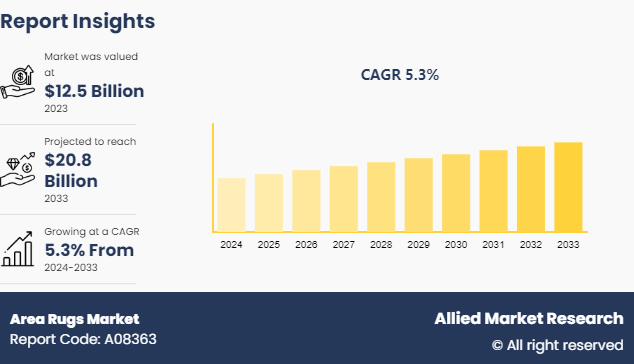
The global area rugs market was valued at $12.5 billion in 2023, and is projected to reach $20.8 billion by 2033, growing at a CAGR of 5.3% from 2024 to 2033. Area rugs are decorative and functional floor coverings typically made from materials such as wool, cotton, synthetic fibers, or natural materials such as jute or sisal. They are designed to cover a portion of the floor, enhancing the aesthetic appeal of a room while also providing warmth, sound absorption, and protection for underlying flooring. The area rugs market growth is driven by several factors, including rising consumer interest in home décor, an increasing focus on interior aesthetics, and the growing trend of customization in interior design. In addition, the ever-increasing real estate sector, particularly in residential and commercial spaces, along with the rising disposable income of consumers, has increased the demand for premium and designer rugs. Eco-friendly and sustainable rug materials have also gained traction, appealing to environmentally conscious buyers. Online retailing and e-commerce platforms have made these products more accessible, further boosting area rugs market demand.
Market Size & Forecast
- 2023 Market Size: USD 12.5 billion
- 2033 Projected Market Size: USD 20.8 billion
- Compound Annual Growth Rate (CAGR) (2024–2033): 5.3%
Key Takeaways
The area rugs market study covers 20 countries. The research includes a segment analysis of each country in terms of value ($Billion) for the projected period 2024-2033.
More than 1, 500 product literatures, industry releases, annual reports, and other such documents of major area rugs industry participants along with authentic industry journals, trade associations' releases, and government websites have been reviewed for generating high-value industry insights.
The study integrated high-quality data, professional opinions and analysis, and critical independent perspectives. The research approach is intended to provide a balanced view of global markets and to assist stakeholders in making educated decisions in order to achieve their most ambitious growth objectives.
Key Market Dynamics
Drivers
Steady growth in residential construction is one of the major factors that boosts the growth of the area rugs market. Consumers focus on investments in home décor products with rise in disposable incomes. Also, they prefer to enhance living spaces owing to increase in urbanization. Area rugs offer an affordable and flexible way to refresh interiors. This drives the demand for area rugs in the market. There is a shift in consumer preference toward aesthetic personalization. Modern consumers seek interior styles that reflect individual tastes. This makes way experimentation with colors and textures. Area rugs enable homeowners to update décor with minimal effort. This fuels the growth of the area rugs industry landscape.
Further, advancements in technology also contributes toward market expansion. Improvements in weaving techniques, digital printing, and stain-resistant treatments help enhance product quality while maintaining competitive pricing. The availability of durable synthetic options increases consumer base, which fosters the market growth.
Restraints
Intense competition and price sensitivity limit the growth of the area rugs market. The availability of low-cost imports increases competitive pressure on domestic manufacturers. In addition, fluctuations in raw material prices help impact production costs and pricing stability.
Opportunities
Sustainability is a major trend that is anticipated to be opportunistic for the growth of the market. Manufacturers prioritize eco-friendly materials, ethical sourcing, and recyclable packaging. This attracts environmentally conscious consumers. This fosters the growth of the market. Further, customization and digital integration also offer promising opportunities. Virtual room visualization tools and augmented reality features enhance online shopping experiences, increasing consumer confidence in purchasing decisions. Personalized designs and made-to-order sizing cater to niche demands and premium market segments. Thus, the area rugs market is poised to experience growth during the forecast period.
Which segment holds the largest market share and why?
By product type, the synthetic fibers segment holds the largest market share. This is attributed to affordability and design versatility offered by synthetic drugs. These materials can be manufactured in different colors, patterns, and textures. This helps manufacturers and retailers to cater to consumer preferences. Synthetic rugs are also known for their durability and low maintenance requirements. By end user, the residential segment holds the largest market share. This is attributed to focus on interior décor and personalization of living spaces by home owners.
Parent Market Analysis of Global Area Rugs Market
The carpet market was valued at $63.4 Billion in 2023, out of which the area rugs market was valued at $12.5 Billion in 2023. The main focus of the carpet industry is on innovation in design, material quality, and sustainability, which positively influences the area rugs market. Advancements in manufacturing technology have enabled the production of more durable, aesthetically pleasing, and eco-friendly rugs at competitive prices. The industry's shift toward using sustainable materials like recycled fibers and organic wool aligns with consumer preferences for environmentally conscious products, boosting demand. In addition, the emphasis on diverse styles and customization options allows the area rugs market to cater to a broader range of consumer tastes, driving further growth in this segment.
Parent Market Analysis, 2023
Market Name | Market Size ($Billion) |
Carpet Market | 63.4 |
Area Rugs Market | 12.5 |
Market Segmentation
The area rugs market is segmented into material, end user, distribution channel, and region. On the basis of product type, the market is divided into synthetic fibers, natural fibers, and blended fibers. As per end user, the market is segregated into residential and commercial. Based on the distribution channel, the market is divided into hypermarkets/supermarkets, specialty stores, and online channels. Region wise, the market is analyzed across North America, Europe, Asia-Pacific, and LAMEA.
Which segment is expected to grow at the fastest rate?
By product type, the natural fibers segment is projected to grow at the fastest rate during the forecast period. Natural fiber area rugs are environmental sustainable, biodegradable, and deliver a premium feel, which drives the market growth. By end user, the commercial segment is projected to grow at the fastest rate during the forecast period. This is attributed to shift in trend of refurbishing office spaces with aesthetic and functional flooring solutions.
How is artificial intelligence transforming this market?
Artificial intelligence is used for design generation. Companies use AI tools to generate new rug patterns that match consumer preferences. AI tools analyze datasets to produce visual concepts that designers can refine. This fosters the product development cycle and makes rug collections creative. AI is also used for trend prediction. Retailers and manufacturers use AI to analyze sales patterns to predict the popularity of rug styles and sizes.
AI also helps enhance the shopping experience for the user. It provides personalized recommendations to the buyer depending on the style preferences and previous purchases. These personalized experiences attract consumers. This feature also helps the buyers discover products that match their tastes. AI also helps detect defects or weaving flaws accurately. This reduces production waste and ensures that higher quality products reach the market.
Regional/Country Market Outlook
In Asia-Pacific, rapid urbanization, a growing middle class, and rising disposable incomes are fueling demand for stylish and affordable home décor, including area rugs. The region's increasing focus on modern interiors and the expansion of e-commerce channels offer significant growth opportunities for both local and international manufacturers.
North America sees strong demand for premium and eco-friendly area rugs, with consumers prioritizing sustainability and natural materials such as wool, jute, and recycled fibers. The trend toward open concept living spaces and interior customization also drives rug sales in this region. Europe, known for its preference for high-quality, artisan-crafted rugs, is witnessing growing demand for both luxury and sustainable products. The rise of minimalist and Scandinavian-inspired interiors is spurring demand for neutral-toned, natural fiber rugs. Across all three regions, the market dynamics are shaped by the increasing importance of online retail, rising consumer awareness of sustainability, and the desire for unique, customizable home décor products, which are creating growth opportunities for manufacturers and retailers.
What technological innovations are creating new growth opportunities?
One key innovation is digital printing technology. By enabling high?definition designs and intricate patterns with precision, digital printing expands creative possibilities and supports customized product lines. Shorter runs and bespoke orders become economically viable, attracting consumers seeking unique décor solutions. Another important growth driver is augmented reality (AR) and virtual visualization tools. AR lets customers virtually place rugs in their own spaces before purchasing. This enhances confidence in online purchases, reduces return rates, and expands the addressable market by making the online rug shopping experience more interactive and reliable. Smart textiles represent an emerging innovation with growth potential. Rugs with features such as thermal regulation, sensor?based feedback, or smart home integration are attracting interest in premium and smart home segments. While still niche, these products illustrate how traditional rugs can evolve into connected lifestyle products.
Industry Trends:
- Customers are increasingly looking for bespoke and personalized area rugs that suit their own style and decorating preferences. This trend is bolstered by the proliferation of internet platforms that provide personalized rug patterns.
- Area rugs that fulfil various purposes, such as comfort, durability, and simplicity of care, are gaining popularity. Stain protection and easy-to-clean fabrics are popular features.
- Modern and modern area rugs with geometrical and abstract designs are gaining popularity because they reflect current home décor trends that emphasize strong, creative patterns.
Competitive Landscape
The major players operating in the area rugs market include Mohawk Industries, Inc., Shaw Industries Group, Inc., Tarkett S.A, The Dixie Group Inc., Milliken & Company, Tai Ping Carpets International Limited, Interface Inc., Oriental Weavers Carpet Co., Victoria Plc, and Lowe's Companies Inc.
Other players in the area rugs market Bukhara Carpets, Justina Blakeney x Loloi, The Dixie Group, The Natural Carpet Company, Milliken & Company, Balta Industries, Brington Agnella, Bella Dura, Haroun Ian Rugs International, and others.
Key Benefits For Stakeholders
- This report provides a quantitative analysis of the market segments, current trends, estimations, and dynamics of the area rugs market analysis from 2024 to 2033 to identify the prevailing area rugs market opportunities.
- The market research is offered along with information related to key drivers, restraints, and opportunities.
- Porter's five forces analysis highlights the potency of buyers and suppliers to enable stakeholders make profit-oriented business decisions and strengthen their supplier-buyer network.
- In-depth analysis of the area rugs market segmentation assists to determine the prevailing market opportunities.
- Major countries in each region are mapped according to their revenue contribution to the global market.
- Market player positioning facilitates benchmarking and provides a clear understanding of the present position of the market players.
- The report includes the analysis of the regional as well as global area rugs market trends, key players, market segments, application areas, and market growth strategies.
What are the key factors driving and restraining market growth?
Driving factors include rise in global interest in home décor, expansion of real estate and commercial construction, and increase in integration of area rugs into modern interior design trends. Area rugs are valued for their ability to define spaces in open?plan homes, add visual warmth, and serve as focal décor pieces. Growth in online retail channels also enables broader product access and convenience for consumers. Another key driver is sustainability demand. Consumers are increasingly seeking eco?friendly and natural?material rugs, such as those made from wool, jute, or recycled fibers. This trend is prompting manufacturers to innovate with sustainable materials and production methods, expanding the market’s appeal.
Restraints include volatility in raw material prices, which affects production costs and pricing stability for manufacturers. Fluctuating costs for fibers such as wool, cotton, or synthetic polymers can lead to supply chain uncertainties and higher retail prices, potentially limiting demand in price?sensitive markets. Another restraint arises from competition with alternative flooring options, such as tiles, hardwood, or laminate, which are easier to maintain and may be preferred for certain modern décor styles. In addition, some consumers may perceive area rugs as high?maintenance or unsuitable for allergy?sensitive environments, which can dampen adoption.
How is the market performing compared to previous years?
Compared to previous years, the area rugs market has shown consistent growth, supported by sustained demand for home décor and interior enhancement solutions. The performance of the market is driven by the expansion of e?commerce platforms, which allow consumers to browse a broad range of rug styles, materials, and price points online. Online retail growth has significantly broadened market reach, enabling smaller rug brands and customized offerings to compete more effectively with traditional retail channels. Additionally, innovations in manufacturing technology have improved product quality and design diversity. These improvements have bolstered consumer confidence and encouraged higher spending on decorative flooring solutions compared to earlier years, when rug options were more limited in style and accessibility.
What is the market growth forecast and CAGR outlook?
The forecast outlook for the area rugs market is positive and growth?oriented. This forecast reflects continued demand increases across global regions, driven by interior décor trends, sustainability preferences, and broader consumer spending on home furnishings. The CAGR outlook suggests that the market will experience moderate growth year after year, with rising adoption in both established developed markets and fast?growing emerging economies. Key regional opportunities include strong demand in North America for premium and eco?friendly area rugs, expanding adoption in Europe driven by design trends, and rapid growth in the Asia?Pacific region due to rising disposable incomes and urbanization. Overall, the market outlook remains robust, with clear indicators of long?term growth potential supported by evolving consumer preferences and ongoing product innovation.
Area Rugs Market Report Highlights
| Aspects | Details |
 Market Size By 2033 | USD 20.8 Billion |
 Growth Rate | CAGR of 5.3% |
 Forecast period | 2024 - 2033 |
 Report Pages | 230 |
 By Product Type |
|
 By End User |
|
 By Distribution Channel |
|
 By Region |
|
 Key Market Players | Victoria Plc, Lowe's Companies Inc., Milliken & Company, Tai Ping Carpets International Limited, Mohawk Industries, Inc., The Dixie Group Inc., Tarkett S.A, Interface Inc., Shaw Industries Group, Inc., Oriental Weavers Carpet Co. |
The global area rugs market was valued at $12.5 billion in 2023 and is estimated to reach $20.8 billion by 2033.
The area rugs market registered a CAGR of 5.3% from 2024 to 2033.
North America sees strong demand for premium and eco-friendly area rugs, with consumers prioritizing sustainability and natural materials such as wool, jute, and recycled fibers. The trend toward open concept living spaces and interior customization also drives rug sales in this region.
The top companies that hold the market share in the area rugs market include Mohawk Industries, Inc., Shaw Industries Group, Inc., Tarkett S.A, The Dixie Group Inc., and others.
Steady growth in residential construction is one of the major factors that boosts the growth of the area rugs market.
Loading Table Of Content...