
Biocompatible Coating Market Research, 2033
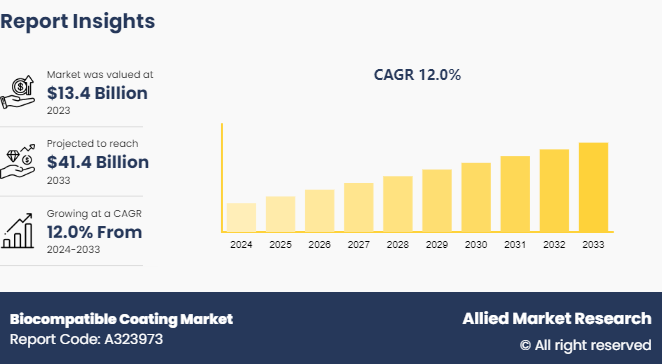
The global biocompatible coating market size was valued at $13.4 billion in 2023, and is projected to reach $41.4 billion by 2033, growing at a CAGR of 12% from 2024 to 2033. Increasing demand for implantable medical devices and rising surgical procedures are key growth drivers. Advancements in surface modification technologies and growing focus on infection prevention and improved device performance further support market expansion worldwide.
What is Biocompatible Coating?
Biocompatible coating refers to specialized surface treatments applied to medical devices and implants to ensure compatibility with biological tissues while minimizing adverse reactions. These coatings enhance the performance, durability, and safety of devices by reducing inflammation, preventing infection, and improving tissue integration. They are widely used on orthopedic implants, cardiovascular stents, catheters, dental implants, and surgical instruments to promote better clinical outcomes.
Biocompatible coatings are primarily utilized to improve implant acceptance within the human body. For instance, antimicrobial and hydrophilic coatings reduce the risk of hospital-acquired infections and thrombosis, while drug-eluting coatings enable controlled medication release at targeted sites. This supports faster healing and reduces complications.
In addition, these coatings enhance device longevity and mechanical performance by improving wear resistance and minimizing corrosion. Healthcare manufacturers adopt advanced surface modification technologies such as plasma spraying, chemical vapor deposition, and polymer coatings to achieve superior functionality.
Furthermore, increasing demand for minimally invasive procedures and long-term implantable devices is expanding the application scope of biocompatible coatings. Continuous innovation in biomaterials and nanotechnology is further strengthening their role in improving patient safety, treatment effectiveness, and overall quality of care.
Market Size & Future Outlook
- 2023 Market Size: $13.4 billion
- 2033 Projected Market Size: $41.4 billion
- CAGR (2024-2033): 12%
- North America: Largest market in 2023
- Asia Pacific: Fastest growing market
Key Takeaways
- The biocompatible coating market study covers 20 countries. The research includes a segment analysis of each country in terms of value ($Billion) for the projected period 2024-2033.
- More than 1, 500 product literatures, industry releases, annual reports, and other such documents of major biocompatible coating industry participants along with authentic industry journals, trade associations' releases, and government websites have been reviewed for generating high-value industry insights.
- The study integrated high-quality data, professional opinions and analysis, and critical independent perspectives. The research approach is intended to provide a balanced view of global markets and to assist stakeholders in making educated decisions in order to achieve their most ambitious growth objectives.
Key Market Dynamics
The biocompatible coating market is witnessing steady growth driven by advancements in medical device technologies, increasing surgical procedures, and rising demand for long-term implantable devices. However, challenges related to regulatory compliance, high development costs, and technical limitations restrain market expansion. At the same time, innovation in biomaterials and expanding healthcare infrastructure create new growth opportunities.
Drivers
The growing number of orthopedic, cardiovascular, and dental implant procedures significantly drives demand for biocompatible coatings. As the global aging population increases, the prevalence of chronic diseases such as cardiovascular disorders and joint degeneration rises, leading to higher adoption of implantable medical devices. Biocompatible coatings enhance device performance by reducing friction, preventing corrosion, and minimizing immune responses, thereby improving patient safety and implanting longevity.
There is also an increasing focus on infection prevention in healthcare settings. Antimicrobial and hydrophilic coatings help reduce hospital-acquired infections and device-related complications. Furthermore, technological advancements in surface modification techniques, including plasma spraying, chemical vapor deposition, and nanocoatings, improve coating durability and functionality. The shift toward minimally invasive procedures and advanced surgical techniques further supports biocompatible coating market growth, as these procedures require high-performance coated instruments and devices.
Restraints
Biocompatible coatings must comply with stringent regulatory standards to ensure patient safety and effectiveness. Regulatory approval processes can be lengthy and complex, delaying product launches and increasing compliance costs. Additionally, the development and application of advanced coatings involve significant research and manufacturing expenses, which may limit adoption among small and mid-sized medical device manufacturers.
Technical challenges also pose constraints. Achieving long-term stability, uniform coating adhesion, and resistance to wear under physiological conditions can be complex. In some cases, coating degradation or delamination may compromise device performance. Limited reimbursement policies in certain regions and pricing pressures in the healthcare sector further restrict biocompatible coating market expansion.
Opportunities
Continuous innovation in biomaterials, nanotechnology, and drug-eluting coatings presents strong growth opportunities. Advanced coatings that enable controlled drug release, improved osseointegration, and enhanced hemocompatibility are gaining attention. The increasing demand for next-generation cardiovascular stents, orthopedic implants, and neurovascular devices creates new application areas.
Emerging markets with expanding healthcare infrastructure and rising medical tourism also provide growth potential. Additionally, increasing investments in research and development and collaborations between medical device manufacturers and material science companies are expected to accelerate innovation. The integration of smart coatings with sensing capabilities may further expand applications, supporting improved clinical outcomes and long-term patient care.
How Is Artificial Intelligence Transforming This Market?
Artificial intelligence is playing an increasingly important role in the biocompatible coating market by accelerating material innovation and improving coating performance. AI-powered simulation tools analyze vast datasets related to material properties, biological responses, and surface interactions to design coatings with enhanced compatibility and durability. These systems can predict how specific coatings will react within the human body, reducing trial-and-error in research and shortening development cycles.
In manufacturing, AI supports quality control by monitoring coating thickness, adhesion strength, and uniformity in real time. Advanced algorithms detect microscopic defects and inconsistencies, ensuring high precision and regulatory compliance. This improves product reliability and reduces material waste.
AI also assists in the development of drug-eluting and antimicrobial coatings by modeling controlled drug release patterns and microbial resistance behavior. Such predictive insights enable the creation of safer and more effective implantable devices.
Furthermore, AI-driven data analytics helps manufacturers understand clinical performance trends and post-market feedback. By integrating real-world evidence into product refinement, AI enhances innovation, operational efficiency, and patient safety, strengthening the long-term growth potential of the biocompatible coating market.
Biocompatible Coating Market Segmentation Overview
The biocompatible coating industry is segmented into type, material, end-user and region. On the basis of type, the biocompatible coating market is divided into antimicrobial, hydrophilic, and others. Based on material, the market is divided into polymer, ceramic, metal and others. As per end user, the market is divided into healthcare, medical device and others. Region wise, the biocompatible coating market is analyzed across North America, Europe, Asia-Pacific, and LAMEA.
What Technological Innovations Are Creating New Growth Opportunities?
One major innovation in the biocompatible coating market is the development of nanotechnology-based coatings that enhance surface functionality at the molecular level. These advanced coatings improve antimicrobial resistance, reduce friction, and promote better tissue integration. Drug-eluting coatings are also gaining traction, enabling controlled and localized drug delivery from implant surfaces, which improves healing and reduces post-surgical complications.
Another key advancement is the use of plasma surface modification and advanced polymer technologies to enhance coating adhesion, durability, and corrosion resistance. These technologies extend the lifespan of medical implants and improve overall device performance.
In addition, smart and bioactive coatings capable of responding to physiological changes are emerging as next-generation solutions. These innovations support safer implants, improved clinical outcomes, and expanded applications across cardiovascular, orthopedic, and dental devices, creating strong growth opportunities during the forecast period.
Regional/Country Market Outlook
The North America has largest biocompatible coating market share and is driven by several key factors that contribute to its growth and prominence in the healthcare sector. Technological advancements and robust research and development activities propel innovation in biocompatible coating. For instance, key players in the region are increasingly focusing on developing coatings that enhance the biocompatibility and performance of medical implants, such as cardiac stents and orthopedic implants, thereby improving patient outcomes and reducing complications.
Moreover, stringent regulatory standards and a well-established healthcare infrastructure ensure that biocompatible coating adhere to high safety and quality standards. Regulatory bodies like the FDA (Food and Drug Administration) in the United States play a crucial role in approving new coating for medical devices, fostering a conducive environment for growth during biocompatible coating market forecast.
Furthermore, the increasing prevalence of chronic diseases and aging populations in North America drives the demand for advanced medical technologies, including biocompatible coating. These coating are essential in enhancing the biocompatibility of devices used in treatments ranging from cardiovascular interventions to neurostimulation therapies.
Industry Trends
- Continuous research is improving the biocompatibility of coatings, enhancing their interaction with biological systems and reducing adverse reactions.
- Biocompatible coatings are increasingly used in medical devices, implants, and drug delivery systems, driven by the demand for safer and more effective healthcare solutions.
- Innovations such as nanotechnology and biomimetic materials are expanding the capabilities of biocompatible coatings, offering tailored solutions for specific medical needs.
Where Are the Most Attractive Investment Opportunities in the Biocompatible Coating Market?
The steady expansion of the biocompatible coating market presents several attractive investment opportunities across materials, technologies, and applications. Advanced polymer coatings represent a key investment area, as they enhance flexibility, reduce friction, and improve compatibility with human tissue. These coatings are widely used in cardiovascular catheters, guidewires, and minimally invasive surgical devices. In addition, antimicrobial and hydrophilic coatings are gaining strong traction due to increasing concerns regarding hospital-acquired infections and device-related complications.
Drug-eluting coatings offer another high-growth segment. These coatings enable controlled drug release directly at the implant site, improving therapeutic outcomes and reducing systemic side effects. Growing demand for next-generation cardiovascular stents, orthopedic implants, and neurovascular devices further strengthens investment potential in this segment.
Nanotechnology-based coatings are also emerging as a promising area, as they enhance osseointegration, corrosion resistance, and wear performance. Companies investing in plasma surface modification, chemical vapor deposition, and advanced thin-film technologies are likely to benefit from rising demand for durable and high-performance implantable devices.
From an end-user perspective, medical device manufacturers represent a major investment focus. Increasing partnerships between coating providers and device manufacturers support customized solutions and long-term supply agreements. Emerging markets in Asia-Pacific and Latin America offer additional opportunities due to expanding healthcare infrastructure and rising surgical volumes.
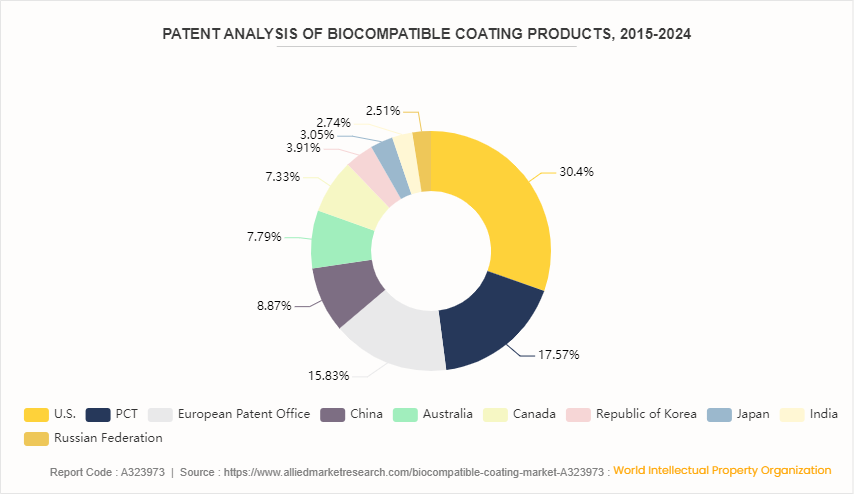
Patent Analysis, By Country, 2016–2024
In the global biocompatible coating market, leading medical technology and materials science companies demonstrate strong patent activity, reflecting continuous innovation. Major players such as DSM Biomedical, SurModics, Inc., AST Products, Inc., Biocoat Incorporated, and Harland Medical Systems hold significant patent portfolios related to hydrophilic, antimicrobial, and drug-eluting coatings. Their innovations focus on improving coating adhesion, durability, and biological performance.
These companies actively invest in research and development to address evolving regulatory standards and clinical demands. Strong patent pipelines indicate sustained technological advancement and competitive positioning, making this market attractive for long-term strategic investments.
Competitive Landscape
The major biocompatible coating market share players operating in the market include DSM Biomedical, Surmodics, Inc., BASF SE, Covalon Technologies Ltd., Harland Medical Systems, Biocoat, Inc., BioInteractions Ltd., AST Products, Inc., PPG Industries, Precision Coating Company, Inc. Other players in biocompatible coating market include Animal Cell Therapies, Inc., Medrego, AniCell Biotech, and so on.
What are the Recent Key Strategies and Developments
- In February 2023, BioInteractions, a leading UK biomaterial technology company, launched its expanded Product Pathway Partnership service incorporating bespoke coatings, optimized application and tooling, testing, regulatory support and commercial production, at the world’s largest medical design and manufacturing event, MD&M West. The company, which is responsible for creating and developing the ground-breaking coating technology for medical devices TridAnt, as well as the widely proven Astute and Assist solutions, is announcing this new service aimed at advancing organizations ability to navigate the complicated medical device market quicker and more efficiently.
- In March 2022, DSM Biomedical and Svelte Medical Systems collaboration fueled development of DISCREET Bioresorbable Coating Technology used with IDS®and DIRECT RX Bioresorbable Coated Drug-Eluting Stent (DES) Systems.
- In March 2024, SurModics, Inc. launched a next?generation antimicrobial and thromboresistant coating designed to improve tissue integration and reduce infection risks in cardiovascular and orthopedic implants, reflecting ongoing product enhancement efforts.
- As of 2025, Biocoat, Inc. expanded manufacturing capabilities and introduced robust hydrophilic coatings under its Hydak® platform, targeting cardiovascular and ophthalmic applications with enhanced performance.
Key Sources Referred
- Centers for Disease Control and Prevention
- World Health Organization
- National Center for Biotechnology Information
- The Lancet
- National Perinatal Epidemiology and Statistics Unit (NPESU)
- Science Direct
- Health Resources and Services Administration (HRSA)
- Department of Health and Human Services (HHS)
- National Institutes of Health (NIH)?
Key Benefits For Stakeholders
- This report provides a quantitative analysis of the biocompatible coating market segments, current trends, estimations, and dynamics of the biocompatible coating market analysis from 2023 to 2035 to identify the prevailing biocompatible coating market opportunities.
- The market research is offered along with information related to key drivers, restraints, and opportunities.
- Porter's five forces analysis highlights the potency of buyers and suppliers to enable stakeholders make profit-oriented business decisions and strengthen their supplier-buyer network.
- In-depth analysis of the biocompatible coating market segmentation assists to determine the prevailing market opportunities.
- Major countries in each region are mapped according to their revenue contribution to the global biocompatible coating market statistics.
- Market player positioning facilitates benchmarking and provides a clear understanding of the present position of the market players.
- The report includes the analysis of the regional as well as global biocompatible coating market trends, key players, market segments, application areas, and market growth strategies.
Biocompatible Coating Market Report Highlights
| Aspects | Details |
 Market Size By 2033 | USD 41.4 Billion |
 Growth Rate | CAGR of 12% |
 Forecast period | 2024 - 2033 |
 Report Pages | 260 |
 By Type |
|
 By Material |
|
 By End User |
|
 By Region |
|
 Key Market Players | Precision Coating Company, Inc., Harland Medical Systems, LLC, AST Products, Inc., BioInteractions Ltd., PPG Industries, Biocoat, Inc., DSM Biomedical B.V., Covalon Technologies Ltd., Surmodics, Inc., BASF SE |
The biocompatible coating market is driven by increased demand in medical implants and devices for reduced rejection rates, alongside advancements in nanotechnology enhancing coating effectiveness.
Biocompatible coatings are specialized surface treatments applied to medical devices, implants, and other biomedical materials to enhance their compatibility with biological systems.
The DSM Biomedical, Surmodics, Inc., BASF SE, Covalon Technologies Ltd., Harland Medical Systems, Biocoat, Inc. held a high market position in 2023.
The base year is 2023 in biocompatible coating market.
The forecast period for biocompatible coating market is 2024 to 2033.
The market value of biocompatible coating market in 2033 is $41.4 billion.
The total market value of biocompatible coating market is $13.37 billion in 2023.
Loading Table Of Content...