
Breast Lesion Localization Methods Market Research, 2033
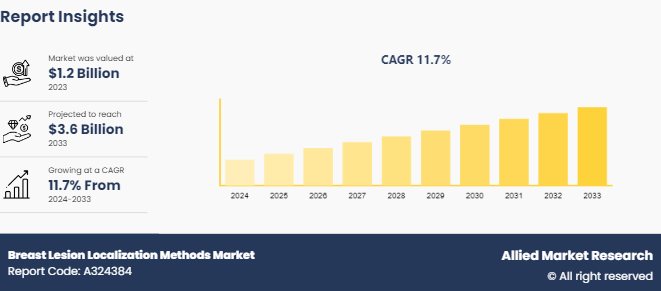
The global breast lesion localization methods market was valued at $1.2 billion in 2023, and is projected to reach $3.6 billion by 2033, growing at a CAGR of 11.7% from 2024 to 2033. Growing emphasis on early breast cancer detection, increasing adoption of minimally invasive procedures, advancements in imaging technologies, and rising awareness through screening programs are the major factors that drive the growth of the breast lesion localization methods market.
Market Introduction and Definition
The breast lesion localization methods market encompasses medical devices and technologies used to accurately identify and mark suspicious or non-palpable breast lesions prior to surgical excision. These procedures are essential in breast-conserving surgeries, particularly lumpectomies, where surgeons must precisely remove cancerous tissue while preserving as much healthy breast tissue as possible. Localization techniques are typically performed after imaging modalities such as mammography, ultrasound, or MRI detect abnormalities. These methods reduce re-excision rates, shorten surgical time, improve cosmetic outcomes, and enhance overall treatment accuracy by guiding surgeons to the exact position of a lesion.
The growing global burden of breast cancer, combined with expanded screening programs and advances in diagnostic imaging, is significantly driving demand for effective localization techniques. Traditional wire-guided localization methods, long considered the standard approach, are increasingly being complemented or replaced by advanced alternatives such as radioisotope seed localization, magnetic tracers, radar reflectors, and radiofrequency identification (RFID) systems. These next-generation technologies improve patient comfort, enable flexible scheduling, and optimize hospital workflows, positioning the market for sustained growth between 2024 and 2033.
Key Takeaways
- The breast lesion localization methods market share analysis spans more than 20 countries, offering a comprehensive evaluation of regional and country-level performance. The study provides detailed segment-wise analysis for each country in terms of market value over the forecast period, enabling stakeholders to identify high-growth regions and investment opportunities.
- To ensure robust and reliable insights, over 1,500 product brochures, company reports, press releases, regulatory filings, clinical publications, industry journals, trade association documents, and government sources were extensively reviewed. This multi-source validation approach enhances the credibility and depth of the market intelligence presented.
- The research framework integrates high-quality quantitative data, expert industry opinions, clinical perspectives, and independent analytical viewpoints. By combining statistical modeling with strategic assessment, the study delivers a balanced and objective outlook on the global market. The methodology is specifically designed to support stakeholders in making informed, data-driven decisions and to help organizations achieve their long-term growth and expansion objectives.
Key Market Dynamics
The breast lesion localization methods market is shaped by a combination of clinical demand, technological innovation, regulatory frameworks, and healthcare infrastructure development. Rising disease burden and evolving surgical standards are influencing both adoption patterns and investment strategies across regions.
Drivers
The breast lesion localization methods market is primarily driven by the rising global incidence of breast cancer. Increasing life expectancy, urbanization, lifestyle-related risk factors, and expanding awareness initiatives have led to higher screening participation and improved detection rates. As a result, a growing number of breast cancers are being diagnosed at early stages, when tumors are often small and non-palpable. These lesions cannot be identified through physical examination alone and therefore require accurate preoperative localization to guide surgical excision. This trend directly fuels demand for reliable and precise localization devices.
Another major driver is the global shift toward breast-conserving surgery (BCS) as the preferred treatment for early-stage breast cancer. Surgeons increasingly aim to achieve clear surgical margins while preserving as much healthy tissue as possible to improve cosmetic outcomes and reduce psychological impact. Advanced localization systems enhance intraoperative precision, reduce positive margin rates, and minimize the need for repeat surgeries. In addition, technological advancements such as magnetic seed localization, radar-based reflectors, and RFID-enabled systems are accelerating adoption. These wireless and often radiation-free solutions offer greater scheduling flexibility, improved patient comfort, and streamlined hospital workflows compared to traditional wire-guided techniques. Improvements in ultrasound and digital mammography guidance further enhance targeting accuracy and procedural efficiency.
Restraints
Despite strong growth drivers, the market faces several constraints. Advanced localization technologies are significantly more expensive than conventional wire localization methods. Hospitals and diagnostic centers must invest in detection consoles, disposable markers or seeds, compatible imaging systems, and specialized training for clinical staff. In cost-sensitive healthcare systems, particularly in developing regions, these financial considerations may delay widespread adoption. Additionally, radioisotope-based localization techniques require compliance with stringent regulatory and nuclear safety standards. Facilities lacking nuclear medicine infrastructure may face logistical and licensing challenges. Integration of new localization technologies into existing radiology and surgical workflows can also create temporary operational inefficiencies during transition phases.
Opportunities
Significant growth opportunities are emerging as radiation-free and minimally invasive technologies gain broader clinical acceptance. Magnetic and radar-based systems simplify regulatory requirements and enhance safety, making them attractive alternatives to isotope-based methods. Expanding oncology infrastructure in emerging economies is opening new markets for advanced localization devices. Furthermore, integration of artificial intelligence into breast imaging is improving detection accuracy, increasing the volume of early-stage lesions requiring localization. The rise of outpatient and ambulatory surgical centers also supports demand for flexible, efficient localization systems that enable optimized scheduling and same-day discharge pathways.
Market Segmentation
The breast lesion localization methods industry is segmented into localization method, technology, lesion type, end user and region. By localization method, the market is divided into wire localization, radioisotope localization, magnetic tracers’ localization, and other. By technology, the market is divided into mammography-guided localization and ultrasound-guided localization. By lesion type, the market is divided into non-palpable lesions and palpable lesions. By end user, the market is divided into specialty clinics, hospitals, diagnostic centers, and other. Region wise, the market is analyzed across North America, Europe, Asia-Pacific, and LAMEA.
The breast lesion localization methods market shows varied growth across different segments. By localization method, wire localization remains widely used due to affordability, while magnetic tracers and radar/RFID systems are gaining traction for being wireless and radiation-free. Radioisotope methods are adopted mainly in advanced healthcare settings with nuclear infrastructure. By technology, ultrasound-guided localization is growing faster than mammography-guided methods due to real-time imaging benefits. Non-palpable lesions dominate the lesion type segment, driven by early screening detection. Hospitals lead the end-user segment, followed by specialty clinics and diagnostic centers, reflecting high surgical volumes and integrated imaging capabilities.
Regional/Country Market Outlook
North America dominates the breast lesion localization methods market, driven by high breast cancer incidence, advanced screening programs, favorable reimbursement policies, and rapid adoption of wireless and radiation-free technologies. Europe follows closely, supported by organized public healthcare systems, strong regulatory frameworks, and growing replacement of traditional wire localization with advanced systems. Asia-Pacific is projected to witness the fastest growth due to rising cancer prevalence in China and India, expanding healthcare infrastructure, and increasing awareness of early detection. The LAMEA region is gradually emerging, with Brazil, the UAE, and Saudi Arabia investing in oncology services, while Africa shows long-term growth potential.
Countries with the Highest Breast Cancer Incidence
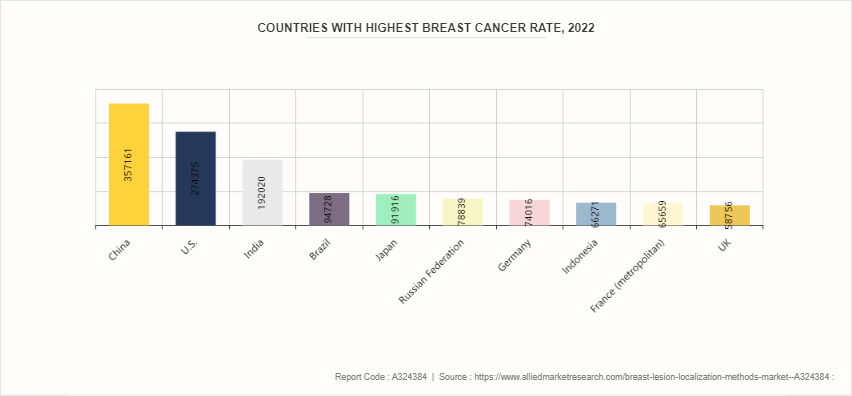
In 2022, China reported the highest number of breast cancer cases at 357,161, followed by the United States with 274,375 cases and India with 192,020 cases. Brazil (94,728), Japan (91,916), the Russian Federation (78,839), Germany (74,016), Indonesia (66,271), France (65,659), and the United Kingdom (58,756) also ranked among the top ten countries with the highest incidence.
The substantial disease burden across these nations is expected to drive demand for advanced diagnostic and surgical solutions, including breast lesion localization methods. As case numbers increase, the need for accurate preoperative localization becomes critical to support precise tumor removal, reduce repeat surgeries, and improve overall clinical outcomes.
Who Are the Primary End Users Driving Market Adoption?
Hospitals are the leading end users of breast lesion localization technologies, particularly comprehensive cancer centers and tertiary care institutions that perform high volumes of breast-conserving surgeries. These facilities prioritize advanced localization systems that help reduce re-excision rates, improve surgical precision, and enhance overall operating room efficiency.
Specialty oncology clinics are also emerging as significant adopters, especially of wireless and magnetic localization technologies, as they focus on improving patient comfort and optimizing scheduling flexibility.
Diagnostic imaging centers play a vital role in early detection and preoperative lesion marking, often acting as the first point of contact in the treatment pathway. As these centers upgrade digital mammography and ultrasound platforms, compatibility with advanced localization systems increasingly influences procurement decisions.
What Are the Latest Industry Trends in the Breast Lesion Localization Methods Market?
The market is witnessing a clear shift from traditional wire-guided localization toward wireless, minimally invasive, and radiation-free technologies such as magnetic seeds, radar reflectors, and RFID-based systems. These solutions allow flexible scheduling, improved patient comfort, and streamlined surgical workflows. There is also growing adoption of outpatient and ambulatory surgical models, encouraging demand for efficient, same-day localization procedures. Integration of localization systems with advanced imaging platforms and digital operating room technologies is another emerging trend. Additionally, healthcare providers are prioritizing technologies that reduce re-excision rates and improve cosmetic outcomes, supporting steady innovation and competitive differentiation.
How Is Artificial Intelligence Impacting the Breast Lesion Localization Methods Market?
Artificial intelligence (AI) is enhancing the market primarily through improved breast imaging and diagnostic accuracy. AI-powered mammography and ultrasound systems assist radiologists in detecting smaller and more complex lesions at earlier stages, increasing the number of non-palpable lesions requiring precise localization. Machine learning algorithms also help reduce false positives and improve workflow efficiency in imaging centers. Furthermore, AI integration with surgical planning tools supports better preoperative mapping and margin assessment. As AI continues to advance predictive analytics and image interpretation, it indirectly drives demand for more accurate, efficient, and technology-integrated localization solutions across hospitals and specialty clinics.
What Innovations Are Shaping the Breast Lesion Localization Methods Market?
Innovation in the breast lesion localization methods market is centered on improving surgical precision, patient comfort, and workflow efficiency. One of the most significant advancements is the development of wireless and radiation-free localization systems, including magnetic seed, radar-based reflector, and RFID-enabled technologies. These systems eliminate the need for traditional guidewires and radioactive materials, allowing markers to be placed days before surgery and improving scheduling flexibility for both patients and clinicians.
Another key innovation involves miniaturization and enhanced detectability of localization markers, enabling more accurate targeting of small, early-stage, and non-palpable lesions. Companies are also focusing on improving signal detection probes with greater depth sensitivity and real-time feedback, which supports surgeons in achieving clear margins and reducing re-excision rates.
Industry Trends
- According to a 2021 article by National Cancer Institute, in U.S. 75.9% of women aged 50-74 years had a mammogram within the past 2 years (2019-2021)
- According to the 2024 article by National Breast Cancer Foundation, Inc., 1 in 8 women in the U.S. will be diagnosed with breast cancer in her lifetime.
- According to European Union, in 2021, the top three countries with the highest breast lesion localization methods rates for women aged 50 to 69 years are Denmark (83.0%) , Finland (82.2%) , and Sweden (80.0%) .
- According to 2024 article by American Cancer Society, breast cancer is the most common cancer in India, accounting for 28.2% of all female cancers
Competitive Landscape
The breast lesion localization methods market features a mix of global medical device leaders and specialized innovators. Key companies operating in this space include Becton, Dickinson and Company, Hologic, Inc., Cook Group, Merit Medical Systems, Sterylab S.r.l., C. R. Bard, Inc., Leica Biosystems, Argon Medical Devices, Endomag, and Cianna Medical. Additional participants include B. Braun Melsungen AG, iCAD, Inc., and MOLLI Surgical.
These companies focus on innovation, regulatory approvals, geographic expansion, and strategic partnerships with hospitals and oncology networks. Product portfolio diversification, investment in clinical trials, and acquisition of niche technology firms are common strategies aimed at strengthening competitive positioning.
Recent Development in the Breast Lesion Localization Methods Industry
- In 2024, Becton, Dickinson and Company (BD) focused on expanding its interventional and breast tissue marker portfolio, including leadership changes to strengthen innovation and market reach.
- In April 2024, Hologic, Inc. signed an agreement and completed the acquisition of Endomagnetics Ltd (Endomag) in July 2024 to add wireless magnetic localization and lymphatic tracing technologies to its breast surgery portfolio, enhancing its women’s health solutions.
- In February 2024, Merit Medical Systems received expanded FDA 510(k) clearance for its SCOUT MD Surgical Guidance System, broadening its radar localization offerings.
Key Sources Referred
- National Library of Medicine
- Center of Disease Control and Prevention
- U.S. Cancer Statistics
- European Union
- World Cancer Research Fund Organization
- National Breast Cancer Foundation, Inc
- American Cancer Society
Key Benefits for Stakeholders
- Provides a comprehensive quantitative analysis of market segments, current trends, forecasts, and dynamics of the breast lesion localization methods market from 2024 to 2033 to identify emerging growth opportunities.
- Offers detailed insights into key market drivers, restraints, and opportunities influencing industry expansion.
- Includes Porter’s Five Forces analysis to evaluate competitive intensity and the bargaining power of buyers and suppliers, enabling informed, profit-oriented business decisions.
- Delivers in-depth segmentation analysis to highlight attractive investment pockets and evolving demand trends.
- Maps major countries across regions based on their revenue contribution to the global market for effective geographic benchmarking.
- Presents market player positioning analysis to facilitate competitive benchmarking and strategic planning.
- Covers regional and global trends, key players, application areas, and growth strategies shaping the future of the market.
Breast Lesion Localization Methods Market , by Localization Methods Report Highlights
| Aspects | Details |
 Market Size By 2033 | USD 3.6 Billion |
 Growth Rate | CAGR of 11.7% |
 Forecast period | 2024 - 2033 |
 Report Pages | 280 |
 By Localization Methods |
|
 By Technology |
|
 By Lesion Type |
|
 By End User |
|
 By Region |
|
 Key Market Players | Merit Medical Systems Inc., Sterylabs SRL, Becton Dickinson and Company, Cook Group, Endomagnetics LLC, Argon Medical Devices, Inc., Hologic Inc., C.R. Bard, Inc, Cianna Medical Inc., leica biosystems |
The global breast lesion localization methods market was valued at $1.2 billion in 2023
The market value of Breast Lesion Localization Methods Market is projected to reach $3.6 billion by 2033.
The forecast period for Breast Lesion Localization Methods Market is 2024-2033.
The base year is 2023 in Breast Lesion Localization Methods Market
Major key players that operate in the Breast Lesion Localization Methods Market are Becton Dickinson and Company, Hologic Inc., Cook Group, Merit Medical, Sterylabs, and C.R. Bard, Inc.
Loading Table Of Content...