
Cloud Kitchen Market Summary
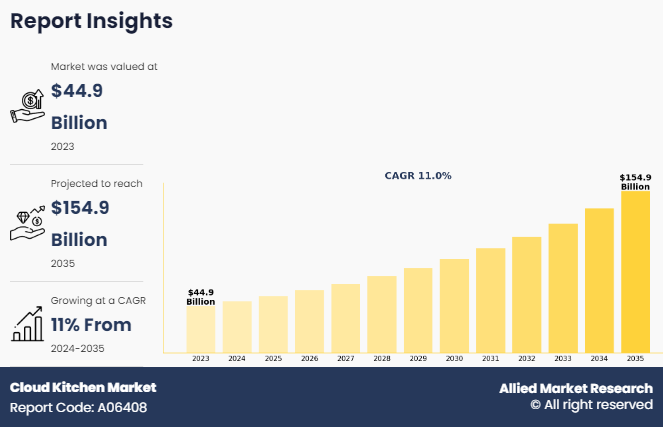
The global cloud kitchen market size was valued at $44.9 billion in 2023, and is projected to reach $154.9 billion by 2035, growing at a CAGR of 11% from 2024 to 2035. Increasing consumer demand for convenient and diverse food options, rapid adoption of online food delivery platforms, rising urbanization, and technological advancements are key factors driving the growth of the cloud kitchen market.
Key Market Trends and Insights
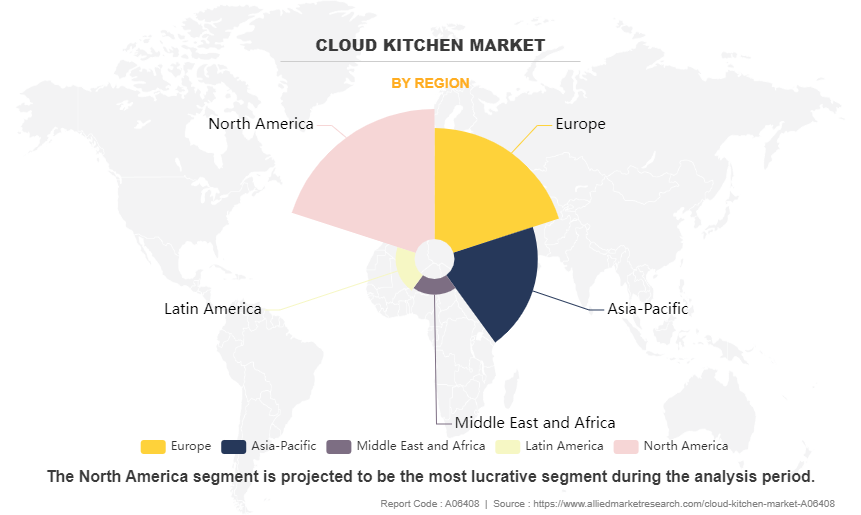
Region wise, North America generated the highest revenue in 2023.
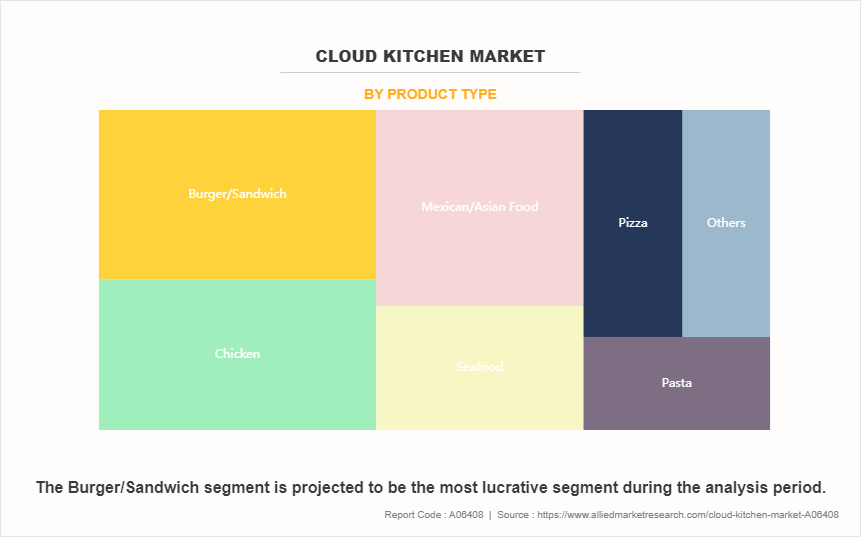
The global cloud kitchen market share was dominated by the burger and sandwich segment in 2023 and is expected to maintain its dominance in the upcoming years
The independent cloud kitchen segment is expected to witness the highest growth during the forecast
Market Size & Forecast
- 2023 Market Size: USD 44.9 Billion
- 2035 Projected Market Size: USD 154.9 Billion
- Compound Annual Growth Rate (CAGR) (2024-2035): 11%
- North America: Generated the highest revenue in 2023
Report Overview and Definition
The cloud kitchen market comprises the setup, operation, and delivery of food prepared in kitchens that do not have a dine-in facility. Also referred to as virtual kitchens, ghost kitchens, or dark kitchens, these establishments focus exclusively on fulfilling online orders through food delivery platforms and direct-to-consumer channels. The market includes standalone cloud kitchens, multi-brand kitchens, and co-working kitchen spaces catering to various cuisines and dining preferences.
Cloud kitchen operations involve food preparation, packaging, order management, logistics coordination, and quality control processes to ensure safety, taste, and timely delivery. Advanced kitchen equipment, integrated order management systems, automated cooking tools, and last-mile delivery logistics play a critical role in maintaining operational efficiency and customer satisfaction. Innovation in menus, fusion cuisines, meal customization, and health-conscious offerings has led to the emergence of plant-based, organic, and specialty diet-focused meal options catering to evolving consumer preferences.
Growing urban populations, busy lifestyles, increasing disposable income, and expanding e-commerce and food delivery infrastructure in regions such as Asia-Pacific, North America, and Europe are contributing to market expansion. Strategic partnerships, acquisitions, and brand collaborations among major food service providers, along with sustainability initiatives in packaging and supply chain management, are shaping competitive dynamics.
As consumer preferences continue to diversify and demand for convenience intensifies, the cloud kitchen market is projected to witness steady growth between 2024 and 2035, supported by menu innovation, digital platform integration, and expanding delivery networks.
Cloud kitchens are delivery-only kitchens that are owned by a brand or third party working with various brands. Brands that are using cloud kitchens can also operate virtual restaurants or brick-and-mortar restaurants. However, brick-and-mortar restaurants use separate cloud kitchens to provide more efficient delivery. These virtual kitchens make use of technology and data analytics to streamline operations that helps maximize efficiency and minimize overhead costs.
Key Takeaways
The cloud kitchen market report analyzes 20 countries, providing detailed segment-level evaluation for each nation based on market value (US$ Billion) over the forecast period of 2024–2035.
To develop comprehensive and reliable industry insights, more than 1,500 product documents, company publications, press releases, annual reports, and related materials from leading cloud kitchen industry participants were examined. In addition, credible industry journals, trade association publications, and official government sources were thoroughly reviewed to ensure data accuracy and relevance.
The study combines robust quantitative data with expert opinions, in-depth analysis, and independent viewpoints. This structured research methodology is designed to present a well-rounded assessment of the global cloud kitchen market, enabling stakeholders to make informed strategic decisions and effectively pursue their long-term growth ambitions.
Key Market Dynamics
The cloud kitchen market is influenced by shifting consumer lifestyles, rising demand for convenient and diverse food options, expanding delivery networks, and continuous menu innovation. Increasing urbanization, growth in online food ordering, and the expansion of the hospitality and foodservice sectors are significantly shaping market growth. In addition, the growing popularity of niche cuisines, health-conscious meals, and customizable food options, along with evolving digital ordering platforms and e-commerce penetration, is accelerating adoption across diverse consumer segments.
Rise in the number of young populations globally, along with changing taste preference of consumers has raised demand for online food delivery. Moreover, a hectic life schedule and rise in consumer disposable income are major factors that drive the cloud kitchen market growth in past few years. In addition, increase in use of smart phones, rise in literacy, and easy access to the internet has made ordering food easier. Now a days, food restaurants are tying up with online food service sites such as Zomato for delivery of food and to increase their sales. Moreover, online food delivery services also provide offers, which attract consumers and help in increasing the consumer base. Hence, effective offers and good customer service boosts the growth of the cloud kichen market share.
Furthermore, there has been an increase in the number of users on various social media sites with rise in internet penetration. Thus, most key players in the market strategize promoting their products and services on these social media platforms. Social media marketing is one of the major strategies adopted by various companies and industries to promote their product offerings. Thus, rise in the use of social media marketing is anticipated to provide lucrative opportunities of the cloud kitchen market growth.
However, the increase in the number of fine dining and quick service restaurants such as Subway, McDonalds, Starbucks, KFC, Pizza Hut, Restaurant Brands International, and Dunkin Donuts hampers the growth of the market. In addition, quick service restaurants have a global presence along with high amount of liquidity, owing to which smaller cloud kitchens are unable to compete with these giants. Moreover, these quick service restaurants have various product offerings, world class infrastructure along with best food delivery services, which attracts consumers. Hence, the rise in the number of quick service restaurants is expected to negatively affect the market during the cloud kitchen market forecast.
In addition, specialty diet-focused cloud kitchens are creating growth opportunities for the market by catering to the growing demand for diverse dietary preferences. These kitchens specialize in offering menus for specific diets such as vegan, keto, gluten-free, or paleo, addressing the needs of consumers who seek healthier, allergen-free, or ethically conscious food options. By focusing on niche dietary requirements, cloud kitchens are anticipated to tap into segment consisting of health-conscious consumers and individuals with certain dietary restriction in the market, attracting customers who may have limited options in traditional brick-and-mortar establishments. Also, these specialized kitchens can leverage the scalability and flexibility of the cloud kitchen model to experiment with innovative recipes and ingredients, catering to evolving dietary trends and preferences.
Moreover, specialty diet-focused kitchens can utilize the data-driven nature of cloud kitchens to analyze customer preferences and optimize menu offerings accordingly. Cloud kitchens can fine-tune their offerings to meet the specific tastes and requirements of their target audience through customer feedback, data analytics, and market research. As a result, there will be an increase in customer satisfaction and loyalty, enabling cloud kitchens to stay ahead of competitors by continuously innovating and adapting to changing dietary trends. Furthermore, specialty diet-focused kitchens present a lucrative opportunity in the global cloud kitchen market, offering a unique value proposition that matches with health-conscious consumers seeking convenient, customizable, and diet-specific meal options.
Another significant opportunity lies in the integration of advanced technology solutions to enhance operational efficiency and customer experience. Automation technologies such as robotics and AI-powered kitchen management systems can streamline food preparation processes, optimize inventory management, and minimize labor costs. Additionally, the implementation of data analytics tools enables cloud kitchen operators to gain deeper insights into consumer preferences, allowing for personalized menu recommendations and targeted marketing strategies. Furthermore, the rise of smart kitchen appliances and IoT devices presents opportunities to create interconnected kitchen ecosystems that enable seamless communication and coordination between various elements of the food production and delivery process.
Moreover, the global cloud kitchen market is the expansion into underserved or emerging markets. As urbanization and digitalization continue to reshape consumer behavior worldwide, there is growing demand for convenient and affordable dining options in both urban and suburban areas. Cloud kitchens offer a scalable and cost-effective solution to cater to these markets, providing access to a diverse range of cuisines without the need for substantial upfront investment in physical infrastructure. Thus, the flexibility of the cloud kitchen model allows for rapid deployment and customization of offerings to suit local tastes and preferences. By tapping into these underserved markets, cloud kitchen operators can unlock new revenue streams and establish themselves as key players in the global food delivery landscape.
Drivers
The cloud kitchen market size is primarily driven by changing consumer preferences and convenience trends. Consumers are increasingly seeking high-quality, freshly prepared meals delivered directly to their homes or workplaces, encouraging the growth of multi-brand and virtual kitchen setups. Product diversification, including plant-based, organic, diet-specific, and gourmet menu options, is further supporting demand.
Technological advancements in kitchen automation, order management systems, and delivery logistics are also key growth drivers. Smart kitchen equipment, integrated POS systems, and route-optimized delivery platforms enhance operational efficiency and order accuracy. Digital marketing strategies leveraging social media, food delivery apps, and influencer promotions, along with strategic partnerships between cloud kitchens and food aggregators, are expanding brand reach. Moreover, rising disposable incomes, increasing urban populations, and growing working professionals in regions such as Asia-Pacific, North America, and Europe are contributing to increased adoption of cloud kitchen services.
Restraints
Despite positive growth prospects, the cloud kitchen market faces certain constraints. Stringent food safety and hygiene regulations, coupled with varying standards across countries, can impact operational scalability and compliance costs. Intense competition among traditional restaurants, multi-brand cloud kitchens, and food delivery platforms may limit profitability. In addition, fluctuations in raw material prices, delivery costs, and labor availability can affect operational margins. Consumer concerns regarding packaging waste and environmental impact of single-use containers may also influence market perception.
Opportunities
The cloud kitchen market presents substantial opportunities driven by innovation, sustainability, and digital transformation. The expansion of niche cuisine offerings, health-focused meals, and ready-to-eat gourmet options is attracting diverse consumer segments and broadening the target demographic. Sustainable packaging solutions, energy-efficient kitchen operations, and eco-friendly supply chain initiatives are enhancing brand reputation and meeting regulatory expectations. Emerging markets with increasing smartphone penetration, growing e-commerce adoption, and rising urban populations offer untapped growth potential. Strategic collaborations, mergers, and partnerships among cloud kitchen operators, restaurants, and delivery platforms can strengthen distribution capabilities and accelerate entry into new regions. As consumer lifestyles continue to evolve and digital food ordering gains momentum, the market is expected to witness sustained growth during the forecast period.
Segmental Overview
The cloud kitchen market analysis is segmented into type, product type, nature, and region. By type, the market is categorized into independent cloud kitchen, commissary/shared kitchen, and kitchen pods. By product type, it is classified into burger/sandwich, pizza/pasta, chicken, seafood, Mexican/Asian food, and others. By nature, it is bifurcated into franchised and standalone. By region, it is analyzed across North America (the U.S., Canada, and Mexico), Europe (the UK, Germany, France, Italy, Spain, and rest of Europe), Asia-Pacific (China, Japan, India, Australia & New Zealand & New Zealand, ASEAN, and rest of Asia-Pacific), Latin America (Brazil, Argentina, Colombia, and Rest of Latin America), and Middle East and Africa (GCC, South Africa, and rest of MEA).
By Type
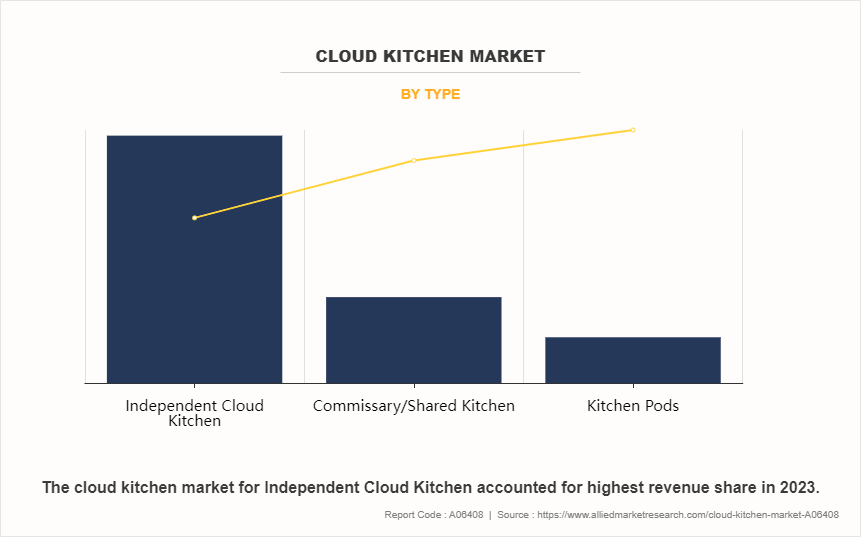
In 2023, the independent cloud kitchen segment led the global cloud kitchen market and is expected to retain its dominance throughout the forecast period. Independent cloud kitchens benefit from agility, adaptability, and lower entry barriers compared to traditional restaurant chains. Unlike established brands, they can quickly respond to changing consumer preferences, experiment with diverse cuisines, and adjust their offerings without the limitations of legacy infrastructure or brand reputation.
These kitchens typically require lower initial investments, operating from smaller, cost-effective locations or shared kitchen spaces. This enables entrepreneurs and small businesses to enter the market and compete alongside larger players. The rise of online food delivery platforms further expands their reach, allowing independent cloud kitchens to access a broader customer base and build loyalty without significant marketing expenditure or physical storefronts.
By Product Type
The burger/sandwich segment dominated the global cloud kitchen market size in 2023 and is projected to maintain their lead. These foods appeal to a broad demographic due to their universal taste, adaptability, and ease of delivery. Their customizable nature allows operators to create unique flavor combinations, helping differentiate their offerings and attract repeat customers.
Furthermore, these items enable cost-effective operations and simplified kitchen workflows, allowing cloud kitchens to optimize preparation and delivery times. Innovative pairings, seasonal menu variations, and localized flavors are increasingly used to capture niche segments, further driving cloud kitchen market demand and expanding market reach across urban and semi-urban regions globally.
By Nature
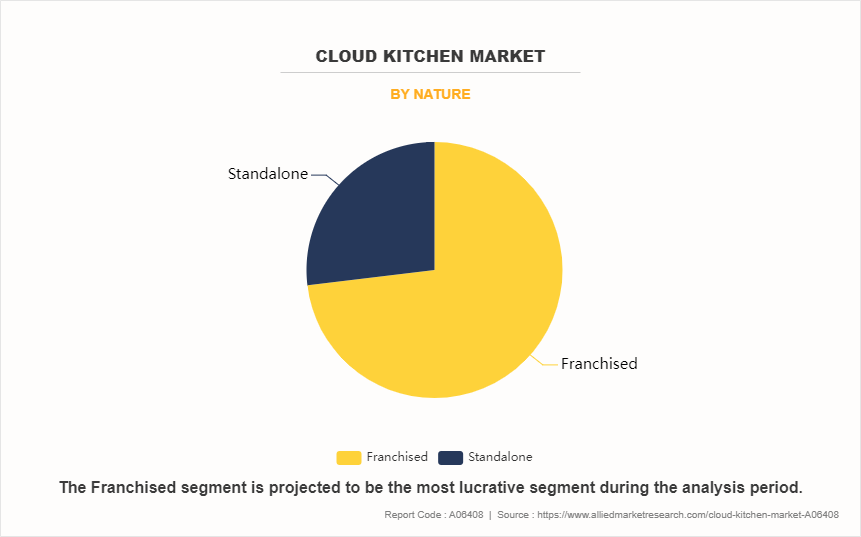
The franchised cloud kitchens segment accounted for a higher value share in 2023, supported by established brand loyalty, trademarks, and customer retention programs. Partnerships, such as Halal Guys’ collaboration with Fransmart to develop 400 new kitchens, illustrate the growth potential through effective franchising strategies.
Franchised kitchens also benefit from standardized operations, marketing support, and bulk procurement efficiencies, enabling consistent quality and faster scalability. Loyalty programs, promotional campaigns, and co-branding initiatives reinforce customer engagement, while franchise expansions into untapped markets help increase visibility, penetration, and revenue streams for operators worldwide.
By Region
North America is expected to dominate the market during the forecast period, driven by rising population, higher purchasing power, evolving lifestyles, and growing demand for fast food. Increasing urbanization, widespread smartphone adoption, and the penetration of food delivery apps are further supporting market growth. Consumers are seeking convenient, diverse, and high-quality dining options, which is boosting the adoption of cloud kitchen services.
In addition, strong infrastructure, efficient logistics networks, and a culture of online ordering contribute to seamless operations and faster delivery, reinforcing North America’s position as a key growth hub for cloud kitchen businesses globally. Expanding digital payment adoption, increasing restaurant partnerships with delivery platforms, and a strong entrepreneurial ecosystem further enhance opportunities for market expansion and innovation across multiple urban centers.
Value Chain Analysis of the Market
The cloud kitchen value chain begins with raw material sourcing, where ingredients such as fresh produce, meats, grains, and spices are procured from wholesalers, local farms, and specialty suppliers. Quality, cost efficiency, and timely delivery at this stage are critical, as they directly influence food taste, safety, and operational margins.
Next is food preparation and kitchen operations, which involves menu planning, ingredient processing, cooking, and packaging. Cloud kitchens leverage advanced kitchen equipment, automated cooking tools, and standardized workflows to ensure consistency, efficiency, and scalability. Operational efficiency is enhanced by multi-brand setups and shared kitchen spaces that reduce overhead costs.
The order management and digital integration stage is central to the cloud kitchen model. Online food delivery platforms, mobile apps, and direct-to-consumer ordering systems facilitate seamless order processing, real-time tracking, and customer engagement. Digital marketing and loyalty programs further strengthen brand visibility and repeat business.
Logistics and delivery form the final link in the value chain, involving last-mile delivery through third-party aggregators or in-house fleets. Efficient packaging, route optimization, and timely delivery ensure customer satisfaction and brand loyalty.
Supporting activities such as supply chain management, technology adoption, and quality control enhance the overall value chain, enabling cloud kitchens to operate cost-effectively while offering diverse, high-quality food options. Continuous innovation in menu offerings and delivery strategies further drives growth and competitiveness in the global market.
Which customer segments are driving growth in the market?
The growth of the cloud kitchen market is primarily driven by urban working professionals, students, and busy households seeking convenience and diverse food options. Urban working professionals contribute significantly due to high demand for quick, on-the-go meals during workdays. Students and young adults are attracted to affordable, customizable, and innovative menu offerings. In addition, food delivery platforms and corporate clients ordering in bulk for events or employee meals also drive consistent demand. Independent operators, multi-brand cloud kitchens, and franchised setups leverage these consumer segments to expand reach and establish brand loyalty.
What major trends are influencing the market?
Key trends shaping the cloud kitchen market include menu diversification, health-focused offerings, and the integration of digital ordering and payment platforms. Increasing consumer preference for plant-based, organic, and diet-specific meals has prompted operators to introduce niche menu options. The rise of hyperlocal delivery models, AI-based order prediction, and data-driven customer engagement strategies is enhancing operational efficiency and personalization. Collaboration with food aggregators, influencer marketing, and seasonal menu innovations are also redefining consumer experiences.
How is technology transforming cloud kitchen operations?
Technology plays a critical role in streamlining cloud kitchen operations. AI and machine learning are used for demand forecasting, inventory optimization, and personalized menu recommendations. Kitchen automation, smart cooking equipment, and integrated order management systems reduce preparation time and minimize errors. Digital payment solutions, mobile apps, and loyalty platforms improve customer engagement and retention, while real-time analytics allow operators to track performance, optimize delivery routes, and improve service quality.
Which technological innovations are strengthening the cloud market?
Technological advancements include automated kitchen appliances, multi-brand cloud kitchen platforms, and integrated delivery management systems. Smart refrigerators, temperature-controlled packaging, and IoT-enabled monitoring devices ensure food quality and safety. Cloud-based POS and order management platforms streamline workflow, while advanced analytics provide insights for menu optimization, operational efficiency, and customer preference tracking. Adoption of AI-driven chatbots, predictive demand models, and route-optimized delivery solutions further enhances efficiency, reduces costs, and improves overall customer satisfaction across the cloud kitchen ecosystem.
Competitive Landscape
The cloud kitchen industry comprises a mix of global delivery-focused operators, multi-brand kitchens, and tech-enabled meal solution providers. Key players include Dahmakan, DoorDash, Ghost Kitchen Orlando, Keatz, Kitchen United, Kitopi Catering Services LLC, Rebel Foods, Starbucks Corporation, Swiggy, and Zomato, alongside emerging regional brands competing for cloud kitchen market share.
These organizations offer end-to-end services, including multi-cuisine meal preparation, menu innovation, digital ordering platforms, and delivery logistics. Smaller niche firms cater to specific consumer preferences and experimental cuisines, while large conglomerates dominate through extensive networks, technology adoption, and acquisitions of innovative start-ups. Strategic partnerships, operational automation, and menu diversification help market participants enhance efficiency, meet growing demand for convenient, high-quality meals, and strengthen their competitive position in the rapidly expanding cloud kitchen industry.
Recent Developments in Market
In May 2023, Swiggy expanded its premium food delivery service, Swiggy Gourmet, to 31 cities across India, including Pune, Kolkata, and Jaipur, reinforcing its presence in the high-end food segment. In March 2022, DoorDash acquired Bbot to enhance its U.S. operations and provide merchants with integrated solutions for both in-store and online channels, including digital ordering and payment capabilities.
In 2022, Kitopi Catering Services LLC implemented a rapid expansion strategy by partnering with multiple restaurant brands to manage their cloud kitchen operations, enabling faster market penetration and increasing operational scalability across regions.
In July 2021, DoorDash further extended its services by launching a temporary kitchen in San Jose, California, preparing meals for six restaurants to broaden its delivery offerings.
Key Benefits For Stakeholders
This report delivers a comprehensive quantitative analysis of the cloud kitchen market forecast from 2023 to 2035, covering market segments, current trends, forecasts, and dynamics to identify key growth opportunities. It provides insights into the primary drivers, restraints, and cloud kitchen market opportunities shaping the landscape.
A Porter’s Five Forces analysis evaluates the influence of buyers and suppliers, enabling stakeholders to make profit-oriented decisions and strengthen supplier–buyer networks. Detailed cloud kitchen market segmentation analysis helps identify prevailing opportunities across different segments. Key countries within each region are mapped based on their revenue contribution to the global market.
The report also includes market player positioning, facilitating benchmarking and offering a clear understanding of the competitive landscape. Furthermore, it provides an in-depth review of regional and global cloud kitchen market trends, major market players, application areas, and growth strategies, equipping stakeholders with actionable insights for strategic planning and business development in the cloud kitchen industry.
Cloud Kitchen Market Report Highlights
| Aspects | Details |
 Forecast period | 2023 - 2035 |
 Report Pages | 285 |
 By Nature |
|
 By Type |
|
 By Product Type |
|
 By Region |
|
 Key Market Players | KITCHEN UNITED, DOORDASH KITCHEN, STARBUCKS (STAR KITCHEN), DAHMAKAN, KEATZ, ZUUL KITCHEN, GHOST KITCHEN ORLANDO, Rebel Foods, Zomato, Kitopi |
Analyst Review
As per the perspective of top-level CXOs, the global cloud kitchen market is expected to offer various business opportunities in the developing economies such as India and China. Innovation is the key for the growth of the global cloud kitchen market, in terms of value sales. Rise in demand for various international cuisines among consumers makes way for manufacturers to come up with cloud kitchens comprising features such as online delivery.
CXOs further stated that increase in the number of young populations globally, along with changing taste preferences consumers has led to rise in demand for online food delivery. A hectic life schedule and rise in consumer disposable income are the major factors that propel the market growth. Furthermore, increase in use of smart phones, rise in literacy, and easy access to the internet have made ordering food easier. Now a days, food restaurants are tying up with online food service sites such as Zomato for delivery of food to increase their sales. Moreover, online food delivery services also provide lots of offers, which attracts consumers and helps in increasing the consumer base. Hence, effective offers and good customer service boost the growth of the cloud kitchen market.
The global cloud kitchen market was valued at $44.9 billion in 2023, and is projected to reach $154.9 billion by 2035
The global Cloud Kitchen market is projected to grow at a compound annual growth rate of 11% from 2024 to 2035 $154.9 billion by 2035
The key players profiled in the reports includes DOORDASH KITCHEN, ZUUL KITCHEN, KEATZ, GHOST KITCHEN ORLANDO, DAHMAKAN, KITCHEN UNITED, Rebel Foods, Zomato, STARBUCKS (STAR KITCHEN), Kitopi
Region-wise, North America is anticipated to dominate the global cloud kitchen market with the largest share during the forecast period.
Increasing demand for online food delivery services, Cost-effectiveness and efficiency of cloud kitchen operations, Adaptation to changing consumer preferences, especially post-COVID-19
Loading Table Of Content...
Loading Research Methodology...