
Computer On Module Market Research, 2034
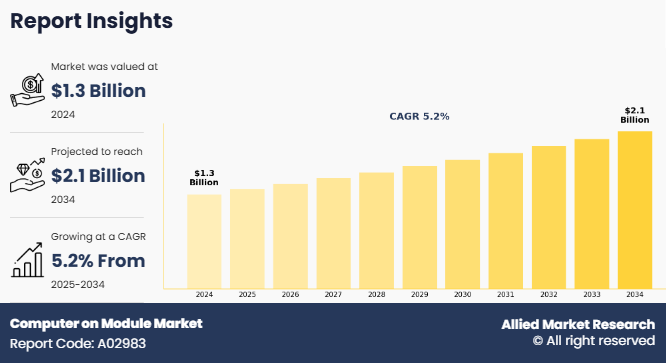
The global computer on module market size was valued at $1.3 billion in 2024, and is projected to reach $2.1 billion by 2034, growing at a CAGR of 5.2% from 2025 to 2034. The computer on module (COM) market is witnessing steady growth, driven by the rapid adoption of embedded computing across industrial automation, medical devices, transportation, and smart infrastructure, along with the growing need for compact, scalable, and high-performance computing platforms. The rise in deployment of Industry 4.0 solutions, edge computing, AI-enabled devices, and IoT systems creates strong demand for COMs that integrate processors, memory, power management, and I/O on a single module. This enables faster product development and reduces time-to-market for OEMs.
Computer on Module (COM) solutions are compact embedded computing platforms designed to integrate processing power, memory, storage, and essential interfaces onto a single module, enabling faster product development and scalable system design. They play a critical role in enhancing performance, reliability, and flexibility across applications such as industrial automation, medical devices, transportation, robotics, and IoT-enabled systems. With the rapid growth of smart manufacturing, edge computing, and connected devices, COMs have become essential for enabling real-time data processing, low-latency control, and efficient system upgrades without redesigning entire hardware architectures.
Furthermore, increasing demand for miniaturized electronics, customization-friendly platforms, extended product lifecycles, and ruggedized modules for harsh environments, along with innovations in high-performance processors, AI/ML acceleration, and low-power computing, are supporting computer on module market growth. Thus, the computer on module market is positioned for continued expansion as it addresses the rising need for scalable, future-ready embedded computing solutions across diverse industries.
Key Takeaways
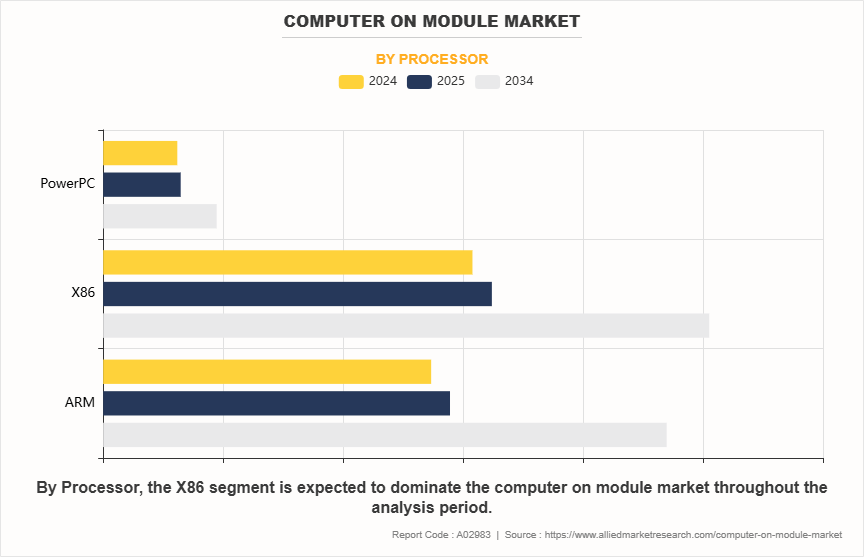
- On the basis of processor, the X86 segment dominated the market in 2024 and is anticipated to grow at the fastest CAGR during the forecast period.
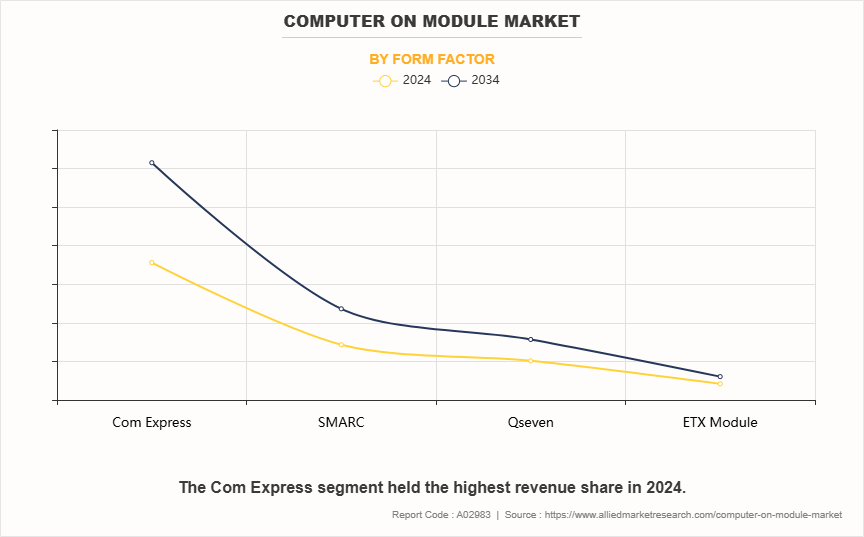
- On the basis of form factor, the com express segment dominated the market in 2024 and is anticipated to grow at the fastest CAGR during the forecast period.
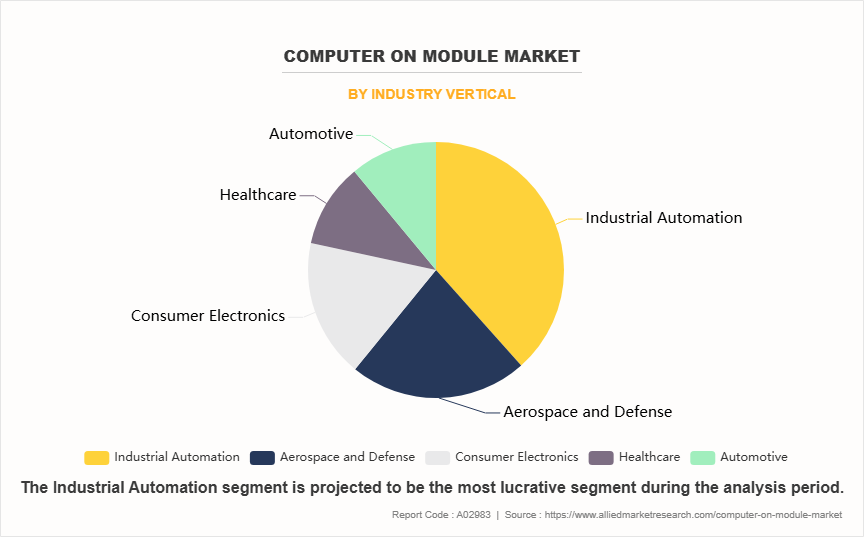
- On the basis of industry verical, the industrial automation segment dominated the market in 2024 and is anticipated to grow at the fastest CAGR during the forecast period.
- On the basis of region, the North America segment dominated the market in 2024. However, the Asia Pacific region is anticipated to grow at the fastest CAGR during the forecast period.
Market Dynamics
Surge in digital transformation initiatives and rising demand for connected, intelligent devices are fueling the demand for computer on module (COM) solutions. Modern industrial and commercial systems increasingly require compact, high-performance, and energy-efficient computing platforms to support edge analytics, real-time control, and AI-enabled applications. The proliferation of Industry 4.0, smart factories, and IoT ecosystems is accelerating adoption of COMs across manufacturing, healthcare, transportation, and smart infrastructure. In addition, growing deployment of automation, robotics, machine vision, and embedded AI workloads is intensifying the need for scalable computing architectures that enable faster time-to-market and long-term upgradeability without complete system redesigns. OEMs and system integrators are becoming more proactive in adopting standardized COM platforms as part of their product roadmaps to reduce development cycles, ensure supply continuity, and manage product lifecycles more efficiently.
However, the market faces several restraints. One major challenge is the high upfront cost associated with high-performance COMs and carrier board customization, which can limit adoption among small and mid-sized OEMs. In addition, supply chain disruptions and component shortages—particularly for semiconductors—have led to longer lead times and price volatility, impacting production planning and project timelines. Design complexity and integration challenges, including thermal management, electromagnetic compatibility (EMC), and long-term software support, can also slow adoption for companies with limited embedded systems expertise. Furthermore, rapid technology obsolescence and frequent processor platform updates create concerns around long-term availability and lifecycle management for industrial and medical applications that require extended product support.
Nevertheless, the market offers multiple growth opportunities. The rapid expansion of edge AI, machine learning inference, and computer vision applications is expected to significantly broaden the use cases for COMs across smart manufacturing, autonomous systems, and intelligent transportation. The Asia-Pacific region, in particular, is witnessing accelerated industrialization and digital infrastructure investments, with China, India, South Korea, and Southeast Asia driving strong demand for embedded computing platforms in smart factories and urban infrastructure projects. Furthermore, innovation in module standards (such as COM Express, SMARC, and Qseven), low-power AI accelerators, and fanless ruggedized designs is improving performance, reliability, and deployment flexibility in harsh environments. Growing integration of cloud-native software stacks, OTA (over-the-air) updates, and platform-as-a-service models is also expected to drive long-term demand. Additionally, increasing focus on long lifecycle support, cybersecurity-by-design, and open, standardized ecosystems is creating new opportunities for differentiation as OEMs seek future-ready and secure embedded computing solutions.
Segmental Overview
The computer on module market is segmented into processor, form factor, industry vertical, and region. On the basis of processor, the market is divided into ARM, X86, and PowerPC. On the basis of form factor, the market is segregated into Com Express, SMARC, Qseven, and ETX Module. On the basis of industry vertical, the market is into industrial automation, aerospace & defense, consumer electronics, healthcare, and automotive. Region-wise, the market is analyzed across North America (the U.S., Canada, and Mexico), Europe (Germany, France, the UK, Italy, Spain, Russia, and rest of Europe). Asia-Pacific (Japan, China, Australia, India, South Korea, Thailand, Malaysia, Indonesia, and rest of Asia-Pacific), LAMEA (Brazil, Saudi Arabia, Argentina, South Africa, UAE, and rest of LAMEA).
By Processor
On the basis of processor, the market is divided into ARM, X86, and PowerPC. The X86 segment dominated the Computer on Module market share in 2024 and is anticipated to grow at the fastest CAGR during the forecast period. This is attributed to its strong performance capabilities, broad software compatibility, and long-standing adoption across industrial and commercial applications.
By Form Factor
On the basis of form factor, the market is segregated into Com Express, SMARC, Qseven, and ETX Module. The com express segment dominated the market in 2024 and is anticipated to grow at the fastest CAGR during the forecast period. This is attributed to its high-end processors supports, including advanced x86 and ARM architectures, along with high-speed interfaces such as PCIe, SATA, USB 3.x, and high-resolution display outputs, that’s makes them ideal for compute-intensive use cases. Its standardized pin-out, multiple module sizes, and type variants allow system designers to balance performance, power consumption, and space constraints while ensuring design flexibility and future upgradeability. In addition, it offers strong ecosystem maturity, long product lifecycle support, and broad vendor availability, which are critical for industries such as industrial automation, medical equipment, transportation, and defense, thereby reinforcing its leading market position.
By Industry Vertical
On the basis of industry vertical, the market is classified into industrial automation, aerospace & defense, consumer electronics, healthcare, and automotive. The industrial automation segment dominated the market in 2024 and is anticipated to grow at the fastest CAGR during the forecast period. It is driven by the growing adoption of smart factories, Industry 4.0 initiatives, and advanced process automation across manufacturing industries. Industrial automation systems require high reliability, long product lifecycles, real-time processing, and rugged performance, all of which are well supported by COM-based architectures.
By Region
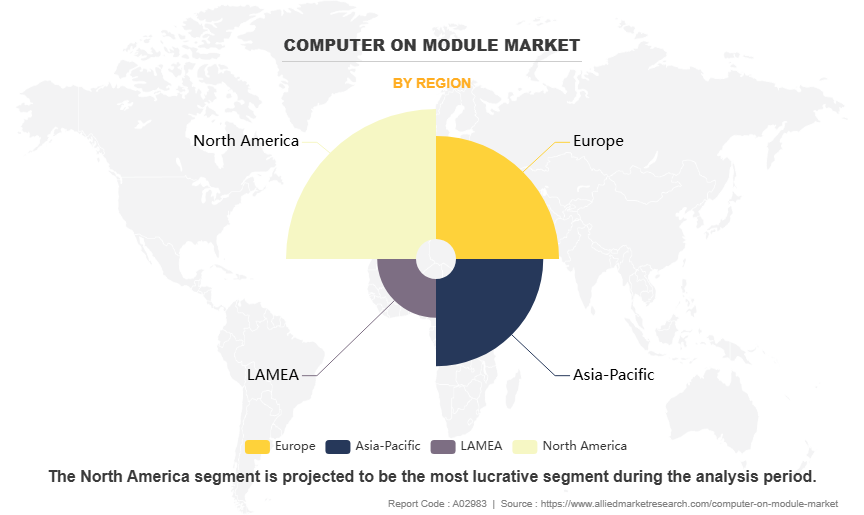
Region-wise, the computer on module market is analyzed across North America, Europe, Asia-Pacific, and LAMEA. The North America segment dominated the market in 2024 owing to the presence of a well-established industrial and IT infrastructure, high adoption of advanced computing technologies across sectors such as automotive, healthcare, and defense, and significant investments in R&D by key players in the region.
However, the Asia Pacific region is anticipated to grow at the fastest CAGR during the forecast period owing to rapid industrialization, increasing adoption of IoT and automation solutions, growing electronics manufacturing hubs in countries such as China, India, and Japan, and rising Computer on Module Market demand from automotive and consumer electronics sectors.
Competition Analysis
Key players in the computer on module market include ADLINK Technology Inc, Advantech Co., Ltd, Kontron AG, Texas Instruments Incorporated, AAEON Co., Ltd, Intel Corporation, C-Lab Ltd, EUROTECH S.p.A, Penguin Solutions, Deutsche Beteiligungs AG.
Recent Developments in Computer on Module Industry
- In June 2024, AAEON, a leader in industrial IoT and AI Edge solutions, has released the uCOM-ADN, a SMARC module powered by Intel Atom x7425E, Intel Processor N97, and Intel Core i3-N305 processors. The uCOM-ADN represents the revival of AAEON’s involvement in the SMARC module sphere, where it is clear that the company’s extensive experience in creating reliable and high-performance Computer-on-Modules has proven invaluable.
- In December 2025, Penguin Solutions, Inc is a major provider of high-performance computing and AI infrastructure systems, has introduced its latest SMART 64GB DDR5-6400 ECC CSODIMM memory modules. This new release expands the company’s existing lineup of DDR5 SODIMM products.
- In June 2025, C-lab Ltd announce the MCM-iMX95 solderable System-on-Module, built around the high-performance NXP i.MX 95 System-on-Chip family to deliver enhanced performance and integration.
Key Benefits For Stakeholders
- This report provides a quantitative analysis of the market segments, current trends, estimations, and dynamics of the computer on module market analysis from 2024 to 2034 to identify the prevailing computer on module market opportunities.
- The market research is offered along with information related to key drivers, restraints, and opportunities.
- Porter's five forces analysis highlights the potency of buyers and suppliers to enable stakeholders make profit-oriented business decisions and strengthen their supplier-buyer network.
- In-depth analysis of the computer on module market segmentation assists to determine the prevailing market opportunities.
- Major countries in each region are mapped according to their revenue contribution to the global market.
- Market player positioning facilitates benchmarking and provides a clear understanding of the present position of the market players.
- The report includes the analysis of the regional as well as global computer on module market trends, key players, market segments, application areas, and market growth strategies.
Computer on Module Market Report Highlights
| Aspects | Details |
 Market Size By 2034 | USD 2.1 billion |
 Growth Rate | CAGR of 5.2% |
 Forecast period | 2024 - 2034 |
 Report Pages | 330 |
 By Processor |
|
 By Form Factor |
|
 By Industry Vertical |
|
 By Region |
|
 Key Market Players | AAEON Co., Ltd., Intel Corporation, C-Lab Ltd., Texas Instruments Incorporated, EUROTECH S.p.A, Deutsche Beteiligungs AG, ADLINK Technology Inc., Advantech Co., Ltd., Penguin Solutions, Kontron AG |
Analyst Review
According to the opinions of various CXOs of leading technology and industrial automation companies, the computer on module market is expected to witness a steady increase in computer on modulesdemand during the forecast period. The rising adoption of embedded computing solutions and the growing focus on digitalization and smart systems are expected to drive the demand for computer on modules. It plays a critical role in enabling compact, scalable, and high-performance computing across a wide range of applications, which make them an integral part of modern embedded system design. As industries increasingly focus on optimizing development timelines, reducing system complexity, and enhancing product performance, COM-based architectures provide a flexible and efficient solution by separating the computing core from application-specific hardware.
The demand for computer on modules is particularly evident in sectors such as industrial automation, healthcare equipment, transportation, and telecommunications, where reliable and continuous computing is essential. In these industries, COMs enable faster product development, easier upgrades, and long-term system scalability. By integrating processing power, memory, and connectivity into a standardized module, COMs allow manufacturers to reuse designs across multiple product platforms while customizing carrier boards for specific functions. This approach significantly improves operational efficiency and reduces overall development costs, which makes the COMs increasingly attractive for complex and evolving applications.
Moreover, the growing focus on digital transformation and edge intelligence is a key driver for the adoption of computer on modules. As industries worldwide embrace technologies such as Industrial IoT, artificial intelligence, and real-time data analytics, the need for decentralized, on-device computing continues to rise. Computer on modules support these trends by delivering high performance with optimized power consumption in compact form factors. Their compatibility with advanced processors and support for long lifecycle management align well with long-term digitalization strategies. As organizations aim to enhance productivity, connectivity, and system intelligence while maintaining energy efficiency and reliability, the adoption of computer on module solutions is expected to increase significantly during the forecast period.
The top companies holding major market share in the Computer on Module (COM) market include Kontron AG, congatec AG, Advantech, ADLINK Technology, and AAEON, driven by their strong industrial portfolios and global customer base.
The computer on module market was valued at $1,285.40 million in 2024 and is estimated to reach $2,138.04 million by 2034, exhibiting a CAGR of 5.2% from 2025 to 2034.
The largest regional market for the Computer on Module (COM) market currently is North America, driven by advanced industrial infrastructure, high adoption of embedded and edge computing technologies, and strong presence of technology OEMs and R&D investments.
The leading application of the Computer on Module (COM) market is industrial automation, driven by its use in PLCs, HMIs, robotics, and machine-vision systems where compact size, reliability, and long lifecycle support are critical.
Key upcoming global Computer on Module (COM) market trends include the integration of AI and edge computing capabilities in compact modules to support real-time processing, along with growing adoption in IoT, industrial automation, automotive (ADAS) and 5G applications. Additionally, manufacturers are focusing on standardized form factors, energy-efficient designs, and modular customization to reduce development time and enhance scalability across industries.
Loading Table Of Content...
Loading Research Methodology...