
Drug Abuse Testing Market Research, 2033
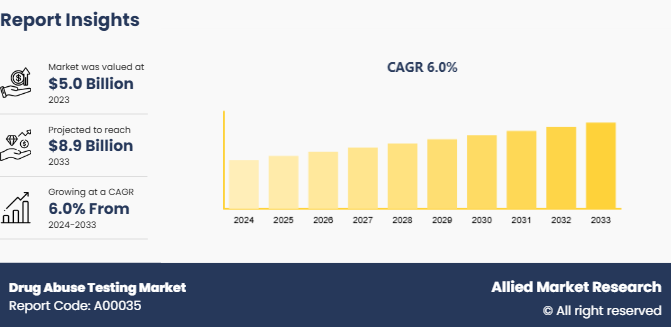
The global drug abuse testing market size was valued at $5.0 billion in 2023, and is projected to reach $8.9 billion by 2033, growing at a CAGR of 6% from 2024 to 2033. The surge in number of people who consume alcohol and illicit drugs such as marijuana, cocaine, and others, is one of the major factors driving the growth of the drug abuse testing market. In addition, technological advancements in drug screening/testing devices and stringent government regulations mandating drug screening boost the market growth.
Market Introduction and Definition
Commercial protocols of drug abuse testing have undergone considerable change over the recent years owing to rise in new substances being abused, alternative matrices, and market demands.
Key Takeaways
- The drug abuse testing market share study covers 20 countries. The research includes a segment analysis of each country in terms of value for the projected period 2023-2033.
- More than 1, 500 Product & Service literatures, industry releases, annual reports, and other such documents of major drug abuse testing industry participants along with authentic industry journals, trade associations' releases, and government websites have been reviewed for generating high-value industry insights.
- The study integrated high-quality data, professional opinions and analysis, and critical independent perspectives. The research approach is intended to provide a balanced view of global markets and to assist stakeholders in making educated decisions in order to achieve their most ambitious growth objectives.
Key Market Dynamics
Drivers
An increase in prevalence of substance abuse worldwide is one of the major factors the drives the growth of the drug abuse testing market. Rise in misuse of opioids, synthetic drugs, and prescription medications has created a strong requirement for reliable testing methods. Governments and organizations are also focusing on implementation of stricter regulations to control drug abuse. This further increases demand for testing services. Further, workplace safety concerns also drive the adoption of drug testing programs. Employers aim to reduce accidents, maintain productivity, and protect their workforce. Drug testing is mandatory in industries where safety plays an important role. Surge in awareness of public health and safety at schools, sports organization and law enforcement agencies also boost the need for drug abuse testing. Advancements in technology also support the growth of the market. Improved testing technologies provide faster results, higher accuracy, and the ability to detect new synthetic drugs. Further, the development and adoption of portable and rapid testing devices have made on-site testing more accessible and efficient. This drives the demand for drug abuse testing.
Restraints
Privacy and ethical concerns are a major factor that limits the growth of the drug abuse testing market. Drug testing may be viewed as intrusive, and employees or individuals may resist testing programs. Legal regulations regarding consent and confidentiality also differ across regions. This is also projected to limit implementation. Moreover, high costs associated with advanced laboratory testing limit the adoption of drug abuse testing across small organizations. Another challenge is the possibility of inaccurate results, false positives and false negatives, which can create legal and professional complications. Thus, concerns about reliability may discourage some organizations from adopting testing programs. This is also projected to deter the market growth.
Opportunities
An increase in awareness and improvements in healthcare systems are anticipated to boost the growth of the drug abuse testing market in the upcoming years. In addition, government initiatives to control drug abuse are projected to be opportunistic for the growth of the market. The development of innovative testing technologies is another major opportunity for the market growth. Introduction of rapid testing kits, non-invasive methods, and advanced detection systems help improve convenience and user acceptance. The surge in usage of oral fluid and hair testing is anticipated to provide alternatives to traditional urine testing. These factors are, thus, projected to drive the growth of the drug abuse testing market during the forecast period.
How Are Consumer Preferences Shaping Market Trends?
Consumer preferences play an important role in shaping the growth of the drug abuse testing market. Organizations and individuals prioritize convenience, accuracy, speed, and privacy when selecting testing solutions. There is an increase in demand for non-invasive testing methods among the consumers. Employers and healthcare providers prefer methods that reduce discomfort while maintaining reliability. There is also an increase in preference for speed and efficiency in drug abuse testing. Many organizations require rapid results to make decisions in real time. Rapid testing kits that provide results within minutes are thus gaining popularity. Cost-effectiveness of drug abuse testing also plays an important role. Organizations prefer affordable testing options that meet regulatory requirements. This preference encourages manufacturers to develop budget-friendly testing kits and scalable solutions.
Another major factor being considered includes reliability. Consumers expect testing solutions to provide precise results with minimal risk of false positives or false negatives. This has increased demand for advanced confirmatory testing methods and high-quality laboratory services. Privacy and confidentiality are also gaining traction. Employees and individuals focus on handling of personal data and test results.
Market Segmentation
The drug abuse testing market is segmented into product & service, sample type, and end user. By product & service, the market is divided into analyzers, rapid testing devices, consumables and laboratory services. Analyzers are further segmented into immunoassay analyzers, chromatography analyzers and breath analyzers. Rapid testing devices are further segmented into urine testing devices and oral fluid testing devices. Consumables are further segmented into assay kits, sample collection cups, calibrators & controls, and others. Based on sample type, the market is segmented into urine, oral fluid, breath, hair, and other samples. Based on end user, the market is segmented into workplaces and schools, criminal justice systems and law enforcement agencies, research laboratories and hospitals. Region wise, the market is analyzed across North America, Europe, Asia-Pacific, and LAMEA.
Which Segment Holds the Largest Drug Abuse Testing Market Share and Why?
The consumables segment under “product & service” holds the largest market share. Consumables include assay kits, sample collection cups, calibrators, and controls. These products are used every time a test is conducted. Urine same testing is another largest segment. Urine testing is widely adopted approach because it is inexpensive, well understood, and accepted by regulatory bodies worldwide. Also, it is simple to collect urine samples which increases its demand in the market.
From the end-user perspective, workplaces and schools hold the largest share. Employers in transportation, construction, manufacturing, and other sectors use routine drug testing as part of compliance with workplace safety standards. Educational institutions also adopt screening to promote student safety. This fosters the demand for drug abuse testing across different sectors.
Which Region Dominates the Global Drug Abuse Testing Market and What Drives Its Leadership?
North America dominates the global drug abuse testing market, with the United States serving as the principal contributor within this region. This is attributed to presence of stringent government regulations and rise in awareness about workplace safety standards across the region. Federal and state-level mandates require routine and random drug screening in the transportation, aviation, construction, and manufacturing industries. This further fosters the demand for North America drug abuse testing market.
Also, advancements in healthcare infrastructure support adoption of both laboratory-based and point-of-care testing solutions. Laboratories across the region are well-equipped with enhanced technologies which help improve accuracy and reduce turnaround times. Also, surge in awareness of drug abuse issues among employers, healthcare providers, and the general public drives the demand for screening. Organizations use pre-employment testing, random screening, and post-incident testing as a part of workplace safety and employee wellness programs.
How Do Government Policies and Regulations Impact Regional Market Growth?
Government policies and regulatory frameworks play an important role in shaping the growth of the drug abuse testing market.
- Federal agencies, in North America, require mandatory drug testing in commercial driving, aviation, and transit. These regulations ensure adoption of drug testing protocols in workplaces and law enforcement settings across the region. Compliance with these regulations ensures safety at workplace.
- Many EU member states have workplace safety mandates that need drug screening in transportation, construction, and healthcare sectors. These regulations aim to balance workplace safety with individual rights. Privacy protections can helps moderate testing frequency and data handling procedures across the region.
- Regulations in Asia Pacific aim to address the rise in substance abuse and workplace safety. Government initiatives focus on public health strategies, mandating testing in healthcare settings or encouraging voluntary workplace programs.
- LAMEA is gradually implementing regulatory policies to address drug misuse. Governments, across the region, are introducing laws and guidelines supporting drug screening.
Why Is Demand Increasing in The Drug Abuse Testing Market?
There is an increase in demand for drug abuse testing due to the rise in prevalence of substance abuse across many regions. The misuse of opioids, synthetic drugs, cannabis, and prescription medications has become a major public health concern. Governments and organizations are taking stronger actions to reduce drug-related harm, which has increased the need for reliable drug testing solutions. Workplace safety is another major factor driving the demand for drug abuse testing. Substance abuse in the workplace can lead to accidents, injuries, reduced efficiency, and higher healthcare costs. Therefore, companies are adopting routine and random drug testing programs.
Government regulations and compliance requirements are also contributing to the market growth. Many countries have introduced laws requiring drug testing for specific sectors, especially in transportation and public safety roles. Regulatory frameworks encourage organizations to implement structured drug screening programs, which increases the demand for testing kits, laboratory services, and monitoring systems. Another important factor is the surge in awareness of public health and community safety. Educational institutions, law enforcement agencies, and sports organizations are increasingly using drug testing to discourage substance misuse. Technological advancements further support the rise in demand. Modern drug testing methods are faster, accurate, and less invasive. Rapid test kits and portable devices allow for on-site testing. This makes the process convenient and efficient.
Regional/Country Market Outlook
- North America and Europe are the two dominant regions in the drug abuse testing industry. These regions have significant demand for drug testing products and services due to various factors such as strict workplace regulations, substance abuse prevalence, and advancements in drug testing technologies.
- Asia-Pacific witnessed highest growth rate for the drug abuse testing market and is expected to remain dominant throughout the Drug Abuse Testing Market Forecast period attributed to the rise in expenditure on healthcare, increased consumption of alcohol & illicit drugs, and surge in awareness among employers and government agencies toward adverse effects of drugs of abuse.
Industry Trends
- In May 2024, the Quest Diagnostics Drug Testing Index (DTI) report for 2024 indicates a continued rise in overall drug positivity rates in the workplace. The increase in marijuana positivity persists despite its legalization in many states. Notably, specific industries such as professional office-based sectors, real estate, and technical services have seen significant jumps in positive drug tests. There has also been a notable rise in attempts to tamper with drug test samples.
- In April 2024, according to DISA Global Solutions Inc. there has been significant development in drug testing methodologies, including the adoption of more advanced urine analysis, hair testing, and oral fluid testing. These advancements aim to improve accuracy and address the rising use of synthetic opioids like fentanyl. The increasing inclusion of fentanyl in drug testing panels reflects its major role in overdose deaths among workforce-age adults.
Competitive Landscape
The major companies profiled in the report include Drägerwerk AG & Co. KGAA, Abbott Laboratories, Hoffmann-La Roche AG, Bio Rad Laboratories, Inc., Siemens AG, Thermo Fisher Scientific, Inc., Laboratory Corporation of America Holdings, Danaher Corporation, Quest Diagnostics Incorporated, and Express Diagnostics International Inc. These players are adopting different growth strategies to maintain their foothold in the drug abuse testing market.
Recent Key Strategies and Developments
- In December 2023, Quest Diagnostics launched a new 88-compound novel psychoactive substance test panel. The new panel, which tests for 88 compounds, covers a broad array of drug classes, such as designer opioids, designer benzodiazepines, designer stimulants, fentanyl analogs, synthetic cannabinoids, and other illicit additives. Two of these classes are rapidly accelerating America's overdose crisis: other illicit additives (xylazine) and fentanyl analogs (acetyl fentanyl) .
- In December 2022, Omega Laboratories announced the launch of Urine Drugs of Abuse testing services in its modern laboratory in Ontario, Canada. The laboratory has started offering Urine Drug Testing services from January 3, 2022, to complement its molecular testing.
Key Sources Referred
- World Health Organization
- Substance Abuse and Mental Health Services Administration (SAMHSA)
- National Institute on Drug Abuse (NIDA)
- National Institutes of Health (NIH)
- Centers for Disease Control and Prevention (CDC)
Key Benefits For Stakeholders
- This report provides a quantitative analysis of the market segments, current trends, estimations, and dynamics of the drug abuse testing market analysis from 2025 to 2033 to identify the prevailing drug abuse testing market opportunity.
- The drug abuse testing market research is offered along with information related to key drivers, restraints, and opportunities.
- Porter's five forces analysis highlights the potency of buyers and suppliers to enable stakeholders make profit-oriented business decisions and strengthen their supplier-buyer network.
- In-depth analysis of the drug abuse testing market segmentation assists to determine the prevailing market opportunities.
- Major countries in each region are mapped according to their revenue contribution to the global drug abuse testing market .
- Market player positioning facilitates benchmarking and provides a clear understanding of the present position of the market players.
- The report includes the analysis of the regional as well as global drug abuse testing market size, trends, key players, market segments, application areas, and market growth strategies.
The report helps mitigate risks by offering in-depth insights. It also offers competitive landscape which helps stakeholders make strategic decisions for their businesses. It studies the changes in domain and helps support long-term business growth. The AMR report offers industry insights and trends along with market dynamics. This helps the stakeholders make strategic decisions.
The report, published by Allied Market Research, focuses on market dynamics and key trends of the drug abuse testing market Growth analysis. The study provides competitive landscape analysis of the key players to understand the adopted strategies and competitive intensity of competitors. It also offers a study of threat of new entrants, and bargaining power of buyers, on the drug abuse testing market outlook.
Drug Abuse Testing Market Report Highlights
| Aspects | Details |
 Market Size By 2033 | USD 8.9 Billion |
 Growth Rate | CAGR of 6% |
 Forecast period | 2024 - 2033 |
 Report Pages | 280 |
 By Product And Service |
|
 By Sample Type |
|
 By End User |
|
 By Region |
|
 Key Market Players | Bio Rad Laboratories, Inc., Thermo Fisher Scientific, Inc., F. HOFFMANN-LA ROCHE AG, Laboratory Corporation of America Holdings, The Drägerwerk AG & Co. KGaA, Quest Diagnostics Incorporated, Express Diagnostics International Inc., Danaher Corporation, Siemens AG, Abbott Laboratories |
Analyst Review
The drug testing market is a fragmented market and is largely influenced by the growth in population of drug addicts. Based on the sample type, urine is the most widely tested biological matrix, without the need for venipuncture or potential infection at the site of injection. Whereas, hair sample segment is projected to grow at a higher CAGR when compared with other segments due to advantages offered by it including high resistance to evasion by adulterating or substituting samples and also provides wider window of detection.
However, some countries have individual privacy protection rights, wherein drug abuse tests are considered as violations of an individual’s privacy. In addition, the most common drug test (urine test) that is used globally for its convenience, flexibility, and economical element can be manipulated to a certain extent, which can result in flawed conclusions. This could be a major hindrance for the growth of the drug screening market. Many key players have been working on rapid testing devices to avail the technology in the developing markets at reasonable costs.
North America accounted for the highest market share and is estimated to continue the same during the forecast period. This is attributed to the presence of better medical facilities and ease of availability of the drug abuse testing devices. However, untapped regions such as Asia-Pacific, Africa, and Latin America, are estimated to emerge as lucrative markets, owing to the introduction of promising drug screening technology, growth in demand for the latest drug screening devices, and increase in disposable incomes.
Upcoming trends in Drug Abuse Testing Market include advancements in rapid testing technologies, increased adoption of drug testing in workplaces and schools, and heightened awareness of substance abuse issues. Additionally, the integration of AI and machine learning for more accurate and efficient testing is a notable trend.
The leading product & service in the drug abuse testing market are analyzers.
North America the largest regional market for Drug Abuse Testing Market
The Drug Abuse Testing Market was valued at $5.01 billion in 2023 and is estimated to reach $8.81 billion by 2033, exhibiting a CAGR of 6.0% from 2024 to 2033.
Top companies to hold major market share in drug abuse testing market are Siemens, Danaher Corporation, and Thermo Fisher Scientific Inc.
Loading Table Of Content...