Electrical Steel Market Overview
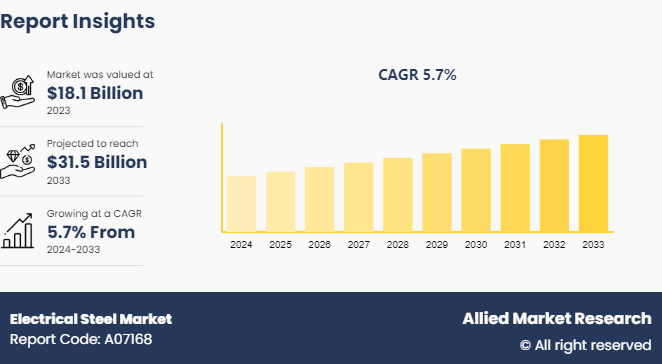
The global electrical steel market size was valued at USD 18.1 billion in 2023, and is projected to reach USD 31.5 billion by 2033, growing at a CAGR of 5.7% from 2024 to 2033.
Market Introduction and Definition
Electrical steel, also known as silicon steel or lamination steel, is a specialized steel alloy primarily used in the production of magnetic cores for electrical equipment and transformers. It is designed to exhibit low core losses and high magnetic permeability that makes it ideal for applications where efficient energy conversion and minimal electromagnetic interference are essential. The alloy typically contains silicon in varying concentrations, which helps to reduce eddy current losses by increasing the electrical resistance of the material. Electrical steel is often produced in thin sheets, which are then laminated to minimize eddy current losses further.
The alloy typically contains varying amounts of silicon, which increases electrical resistivity and significantly reduces eddy current losses. Electrical steel is commonly manufactured in thin sheets that are stacked and laminated together, further minimizing eddy currents and improving overall performance.
Electrical steel plays a vital role in renewable energy systems by improving the efficiency of power generation and conversion. It is used in wind turbine generators, hydroelectric generators, and solar inverters due to its high magnetic permeability and low core losses. By reducing energy waste and heat generation, laminated electrical steel enhances performance, reliability, and lifespan, helping maximize renewable energy output and support sustainable power infrastructure.
Electrical steel is widely used in transformers, electric motors, generators, inductors, and power distribution equipment. Its high magnetic permeability and low core loss improve energy efficiency in power transmission and conversion systems. It is essential in renewable energy applications such as in electric vehicles and industrial machinery. Laminated electrical steel cores reduce eddy current losses, ensuring reliable performance, lower heat generation, and enhanced operational efficiency in high-frequency and high-power electrical systems.
Key Takeaways
The electrical steel market study covers 20 countries. The research includes a segment analysis of each country in terms of value ($Billion) for the projected period.
More than 1,500 product literatures, industry releases, annual reports, and other such documents of major electrical steel industry participants along with authentic industry journals, trade associations' releases, and government websites have been reviewed for generating high-value industry insights.
The study integrated high-quality data, professional opinions and analysis, and critical independent perspectives. The research approach is intended to provide a balanced view of global markets and to assist stakeholders in making educated decisions to achieve their most ambitious growth objectives.
Key Market Dynamics
Drivers
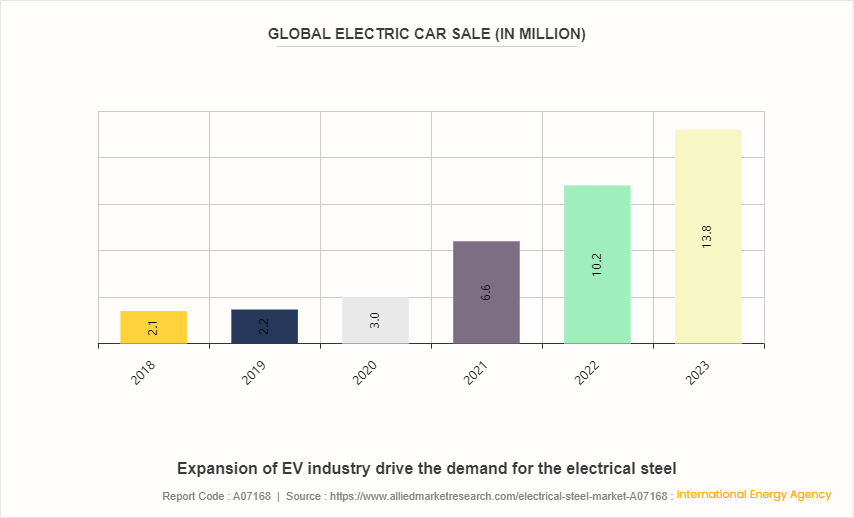
Electric motors in electric and hybrid vehicles require high-performance materials that efficiently conduct magnetic flux while minimizing energy loss. Electrical steel—also known as silicon steel or laminated steel—offers excellent magnetic properties, including high permeability and low core loss, making it ideal for motor cores. The rapid growth of the electric vehicle (EV) market is significantly increasing demand for electrical steel in the automotive sector. Beyond motors, it is also essential for transformers, inverters, and generators used in electrified powertrains. Together, these factors are expected to drive strong growth in the electrical steel market during the forecast period.
Restraints
Fluctuations in raw material prices significantly affect the production costs and profitability of electrical steel manufacturers, posing a major challenge to industry growth. Key inputs such as iron ore, coal, and various alloying elements are essential for producing electrical steel, and volatility in their prices can create cascading effects across the supply chain.
Moreover, unstable raw material costs weaken investment confidence and complicate capital expenditure planning. Uncertain market conditions and unpredictable cost structures discourage long-term investments in R&D, technology upgrades, and capacity expansions—initiatives that are critical for maintaining competitiveness. Collectively, these factors hamper the growth of the electrical steel market.
Opportunities
Advancements in process optimization and automation are enabling electrical steel manufacturers to improve production efficiency, reduce waste, and lower overall manufacturing costs. Modern automation systems and digital monitoring tools provide real-time process control, predictive maintenance, and enhanced quality assurance, resulting in tighter tolerances, higher throughput, and more consistent product performance.
Furthermore, innovations in energy-efficient processing technologies—such as thin slab casting and continuous annealing—help reduce energy consumption and environmental impact. These improvements support sustainability objectives while ensuring compliance with increasingly stringent industry regulations. All the above mentioned factors are expected to provide lucrative opportunities for the growth of the electrical steel market during the forecast period.
How are Consumer Preferences Shaping Market Trends?
Consumer preferences are significantly shaping market trends across industries by influencing product design, innovation priorities, and sustainability strategies. Increasing awareness of environmental issues has led consumers to favor energy-efficient, low-carbon, and sustainably sourced products. This shift compels manufacturers to adopt cleaner production methods, improve material efficiency, and develop eco-friendly alternatives.
Digitalization has also transformed expectations. Consumers now demand transparency, customization, and faster delivery, encouraging companies to integrate smart technologies, data analytics, and agile supply chains. In sectors such as automotive and energy, growing interest in electric vehicles and renewable power solutions is accelerating demand for advanced materials and high-efficiency components.
Price sensitivity combined with quality expectations further drives competition, pushing companies to balance cost optimization with performance enhancement. Additionally, health, safety, and durability considerations are influencing purchasing decisions, leading to stricter standards and improved product reliability. Overall, evolving consumer priorities are prompting businesses to innovate continuously, enhance sustainability efforts, and align offerings with emerging lifestyle and environmental values.
Market Segmentation
The electrical steel market is segmented into type, application, end use and region. By type, the market is bifurcated into grain-oriented electrical steel and non-grain-oriented electrical steel. By application, the market is divided into transformers, motors, inductors, generators, and others. By end use, the market is classified into energy and power generation, automotive, manufacturing, household appliances, and others. Region-wise the market is analyzed across North America, Europe, Asia-Pacific, and LAMEA.
Regional Market Outlook
The Asia-Pacific region is experiencing a strong shift toward renewable energy, driven by the need to reduce carbon emissions and combat climate change. Countries such as China, India, and Japan are heavily investing in wind, solar, and hydroelectric power projects. High-grade silicon electrical steel is critical for manufacturing transformers, generators, and other key electrical components, enhancing the efficiency and reliability of these renewable energy systems.
Simultaneously, ongoing industrialization and urbanization across Asia-Pacific are boosting demand for electrical steel. Rapidly growing economies like India, Indonesia, and Vietnam are investing in infrastructure development, including power grids, transportation networks, and industrial facilities. Electrical steel is essential for producing transformers, motors, and other electrical equipment that support these projects. Together, the expansion of renewable energy and large-scale infrastructure development is driving significant growth in the electrical steel market across the region.
Rapid industrialization and urbanization in emerging Asia-Pacific economies are fueling demand for electrical steel across infrastructure projects such as power distribution networks, industrial machinery, and building construction. As countries in the region invest in modernizing infrastructure and expanding manufacturing capabilities, the need for high-performance, energy-efficient electrical steel is increasing to ensure reliability, efficiency, and long-term sustainability of these critical developments.
Which Segment Is Expected to Grow at the Fastest Rate?
The automotive segment, particularly driven by electric vehicles (EVs) and hybrid vehicles, is expected to grow at the fastest rate in the electrical steel market. Rising global demand for EVs, fueled by stricter emissions regulations and consumer adoption, is increasing the need for high-performance electrical steel in motors, transformers, and power electronics. In addition, advancements in motor efficiency and lightweight designs are driving the development of specialized electrical steel grades. This rapid growth, combined with the expansion of electrified automotive infrastructure, positions the automotive segment as the fastest-growing and most strategically important sector for electrical steel manufacturers.
Competitive Landscape
The major players operating in the electrical steel market include POSCO, JFE Steel Corporatio, Cleveland-Cliffs Inc., Baosteel Co., Ltd., NIPPON STEEL CORPORATION, Slovenian Steel Group, Aperam, Tata Steel, ArcelorMittal, and voestalpine Stahl GmbH.
- In October 2023, United States Steel Corporation launched of new electrical steel line with ribbon cutting in Osceola, Arkansas. This new line helps to expand its portfolio of products needed to serve growing markets and help customers meet their sustainability goals.
- In April 2023, Beijing Shougang announced the operation of a new grain-oriented (GO) electrical steel production line. The new line is expected to have an annual output of 90, 000 tons of high-performance GO electrical steel.
The Crucial Role of Electrical Steel in the Renewable Energy Sector
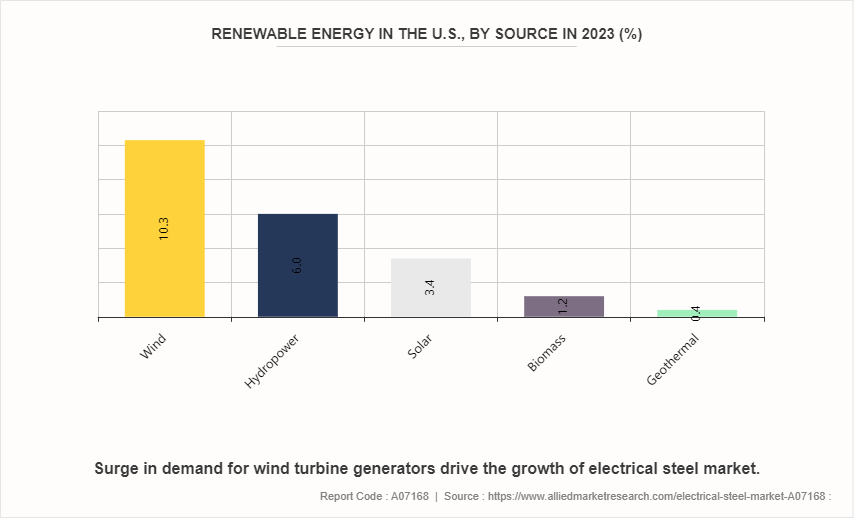
In wind energy, electrical steel is essential for the construction of wind turbine generators. These generators convert the mechanical energy from wind into electrical energy, and the efficiency of this conversion process is significantly enhanced by the use of high-grade electrical steel. The material's high magnetic permeability and low core loss reduce energy dissipation during operation, ensuring that a greater proportion of the wind's kinetic energy is converted into usable electrical power. Wind energy is the largest contributor among renewable sources in the United States, accounting for 10.3% of the energy mix. As the demand for wind energy grows, the need for advanced electrical steel that supports larger and more efficient wind turbines is also increasing. In addition, hydroelectric power generation relies on electrical steel in its turbines and generators. The material’s robustness and efficiency are critical for withstanding the demanding operational conditions of hydroelectric plants, where large volumes of water are converted into electrical energy. Electrical steel helps ensure that the turbines and generators operate with minimal energy losses and high reliability, contributing to the overall efficiency and sustainability of hydroelectric power plants.
How are AI, Automation, or Advanced Analytics Enhancing Efficiency and Outcomes?
AI, automation, and advanced analytics are transforming efficiency and outcomes across industries by optimizing operations, reducing errors, and enabling data-driven decision-making. In manufacturing, automation systems streamline repetitive tasks, improve precision, and increase throughput while minimizing labor costs and human error. Advanced sensors and robotics integrated with AI allow for real-time process monitoring, predictive maintenance, and adaptive control, reducing downtime and enhancing equipment lifespan.
AI-powered analytics also enable organizations to identify inefficiencies, forecast demand, and optimize supply chains. By analyzing large volumes of operational data, companies can detect patterns, anticipate bottlenecks, and implement proactive measures that improve productivity and resource utilization.
In sectors such as energy, healthcare, and automotive, these technologies enhance outcomes by improving quality, safety, and sustainability. For example, in energy systems, AI and analytics optimize grid performance and reduce losses, while in healthcare, they support accurate diagnostics and personalized treatment plans. Overall, the integration of AI, automation, and advanced analytics drives operational excellence, reduces costs, and enables more informed strategic decisions, leading to higher efficiency and improved business results.
How Intense is Market Competition and What Defines Competitive Advantage?
Market competition in the electrical steel industry is intense, driven by a limited number of global producers, high capital requirements, and growing demand across automotive, energy, and industrial sectors. Competitive advantage is defined by factors such as product quality, magnetic performance, energy efficiency, and customization capabilities. Companies that invest in advanced manufacturing technologies, automation, and sustainable processes can offer lower production costs and higher-performing materials. Strong customer relationships, global distribution networks, and the ability to meet regulatory and environmental standards further differentiate leading players, enabling them to capture market share and maintain long-term profitability in a highly competitive landscape.
Industry Trends
The ongoing electrification of the automotive industry is driving significant demand for electrical steel. Electric vehicles (EVs) require high-performance electrical steel for their motors, transformers, and power electronics. As governments worldwide implement stricter emissions regulations and consumers increasingly embrace EVs, the demand for electrical steel in the automotive sector is expected to continue growing rapidly.
According to the Internation Energy Agency (IEA) , electric car sales in 2023 were 3.5 million higher than in 2022, a 35% year-on-year increase. This is more than six times higher than in 2018. In 2023, there were over 250, 000 new registrations per week, which is more than the annual total in 2013.
The expansion of renewable energy sources such as wind and solar power is driving demand for electrical steel used in generators and transformers. Electrical steel is critical for the efficient generation, transmission, and distribution of renewable electricity. As countries aim to reduce dependence on fossil fuels and transition to cleaner energy sources, the demand for electrical steel in the renewable energy sector is expected to increase.
According to the Internation Energy Agency, solar PV and wind account for 95% of the expansion, with renewables overtaking coal to become the largest source of global electricity generation by early 2025.
Recent Key Strategies and Developments
- In October 2023, United States Steel Corporation inaugurated a new electrical steel production line in Osceola, Arkansas. This expansion enhances the company’s product portfolio, enabling it to serve growing markets and support customers in achieving their sustainability goals.
- In April 2023, Beijing Shougang commenced operations of a new grain-oriented (GO) electrical steel production line, with an expected annual output of 90,000 tons of high-performance GO electrical steel, strengthening its capacity to meet rising demand for energy-efficient materials.
Key Sources Referred
International Trade Administration
Asian Development Bank
Invest India
United Nations Development Program
U.S. Department of Energy
International Electrical Steel Sheet Summit 2024
American Iron and Steel Institute
International Energy Agency
Key Benefits for Stakeholders
This report provides a quantitative analysis of the market segments, current trends, estimations, and dynamics of the electrical steel market analysis from 2024 to 2033 to identify the prevailing electrical steel market opportunities.
The market research is offered along with information related to key drivers, restraints, and opportunities.
Porter's five forces analysis highlights the potency of buyers and suppliers to enable stakeholders make profit-oriented business decisions and strengthen their supplier-buyer network.
In-depth analysis of the electrical steel market segmentation assists to determine the prevailing market opportunities.
Major countries in each region are mapped according to their revenue contribution to the global market.
Market player positioning facilitates benchmarking and provides a clear understanding of the present position of the market players.
The report includes the analysis of the regional as well as global electrical steel market trends, key players, market segments, application areas, and market growth strategies.
Electrical Steel Market Report Highlights
| Aspects | Details |
 Market Size By 2033 | USD 31.5 Billion |
 Growth Rate | CAGR of 5.7% |
 Forecast period | 2024 - 2033 |
 Report Pages | 420 |
 By Type |
|
 By Application |
|
 By End Use |
|
 By Region |
|
 Key Market Players | voestalpine Stahl GmbH, NIPPON STEEL CORPORATION, Baosteel Co.,Ltd., Slovenian Steel Group, ArcelorMittal, Cleveland-Cliffs Inc., POSCO, Aperam, JFE Steel Corporation, Tata Steel |
The global electrical steel market was valued at $18.1 billion in 2023, and is projected to reach $31.5 billion by 2033, growing at a CAGR of 5.7% from 2024 to 2033.
Asia-Pacific is the largest regional market for Electrical Steel.
Transformers is the leading application of Electrical Steel Market.
Technological advancements in electrical steel production is the upcoming trends of Electrical Steel Market in the globe.
The major players operating in the electrical steel market include POSCO, JFE Steel Corporatio, Cleveland-Cliffs Inc., Baosteel Co.,Ltd., NIPPON STEEL CORPORATION, Slovenian Steel Group, Aperam, Tata Steel, ArcelorMittal, and voestalpine Stahl GmbH.
Loading Table Of Content...