
Electron Microscopy Market Research, 2034
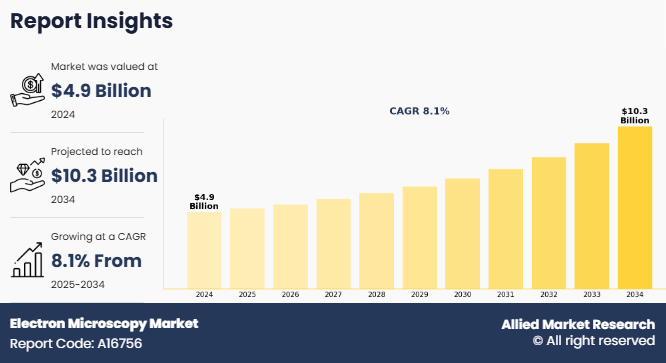
The global electron microscopy market was valued at $4.9 billion in 2024, and is projected to reach $10.3 billion by 2034, growing at a CAGR of 8.1% from 2025 to 2034.
Electron microscopy refers to a technique for obtaining high-resolution images of biological and non-biological specimens. It is extensively used in biomedical research to investigate the detailed structure of tissues, cells, organelles, and macromolecular complexes. The high resolution of these images results from the use of electrons as the source of illuminating radiation. Electron microscopy is used in conjunction with a variety of ancillary techniques, including thin sectioning, immuno-labeling, and negative staining for various research purposes. Electron microscopy images provide key information on the structural basis of cell function and of cell disease.
Key Takeaways
- The Electron Microscopy Market share covers 20 countries. The research includes a segment analysis of each country in terms of value ($Billion) for the projected period 2025-2034 for Electron Microscopy Market Forecast.
- More than 1,500 product literatures, industry releases, annual reports, and other such documents of major decorative coatings industry participants along with authentic industry journals, trade associations' releases, and government websites have been reviewed for generating high-value industry insights.
- The study integrated high-quality data, professional opinions and analysis, and critical independent perspectives. The research approach is intended to provide a balanced view of global markets and to assist stakeholders in making educated decisions to achieve their most ambitious growth objectives.
The Electron Microscopy industry has witnessed substantial growth, driven by rapid technological advancements, expanding research applications, increasing demand for nanoscale imaging, and the rise of materials science and life sciences research. This dynamic market is shaped by regulatory frameworks, innovations in imaging technology, automation in microscopy systems, and the growing need for high-resolution analytical tools across academic, industrial, and clinical sectors. Electron microscopes are primarily designed to offer superior magnification, precision, and imaging depth, enhancing analytical efficiency and enabling breakthroughs in nanotechnology, semiconductor development, and biomedical research.
Governments are playing a crucial role in advancing the electron microscopy sector by implementing initiatives that promote scientific innovation, research funding, and sustainable technology development. These public-sector efforts focus on strengthening research infrastructure, supporting nanotechnology programs, and encouraging collaboration between academia and industry. A notable example is the U.S. National Nanotechnology Initiative (NNI), which emphasizes cross-sectoral collaboration, innovation in nanoscience tools, and sustainable technological growth. Such frameworks ensure that electron microscopy manufacturers and users prioritize research excellence, data integrity, and alignment with global innovation and sustainability goals and Electron Microscopy Market Demand.
Furthermore, technology is one of the key drivers of the Electron Microscopy Market. Integration of artificial intelligence (AI), automation, and digital imaging software enables faster data acquisition, enhanced image processing, and real-time analysis. In 2024, several leading manufacturers introduced AI-powered microscopy platforms capable of autonomous image classification, automated defect detection, and predictive maintenance. Such advancements not only improve operational efficiency but also democratize access to high-end microscopy by simplifying complex analytical workflows.
In addition, the growing adoption of cryo-electron microscopy (cryo-EM), scanning transmission electron microscopy (STEM), and in situ microscopy techniques are expected to further accelerate the evolution of the Electron Microscopy Market Size and Electron Microscopy Market Growth. These cutting-edge technologies allow scientists to visualize biological macromolecules in near-native states, analyze material behavior under dynamic conditions, and drive innovations in structural biology, nanofabrication, and advanced materials research.
The Electron Microscopy Market is segmented on the basis of type, application, end user. By type, scanning electron microscope (SEM) and transmission electron microscope (TEM). Depending on application, it is categorized into life sciences, material sciences, and others. Based on end user, it is segregated into healthcare, research institute, and others. Region wise, it is analyzed across North America, Europe, Asia-Pacific, and LAMEA (Latin America, and the Middle East & Africa).
By Type
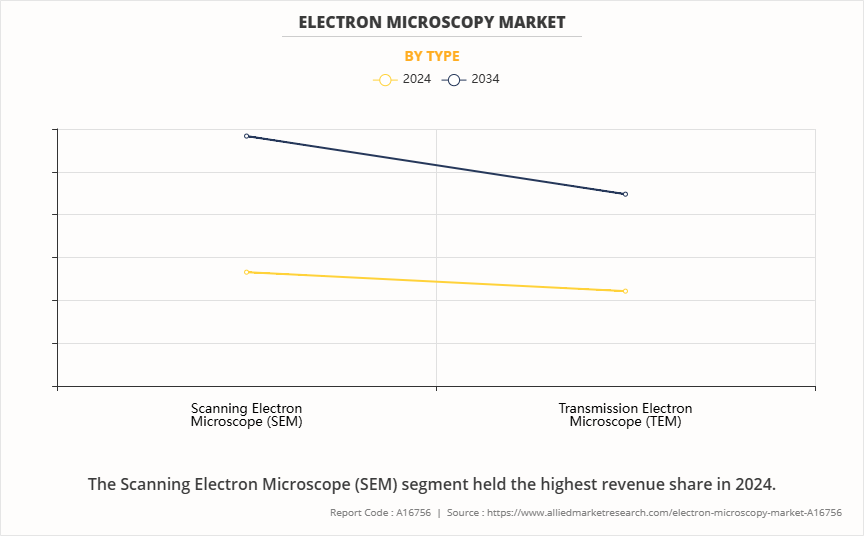
Based on type, the Scanning Electron Microscope (SEM) segment dominated the global market in the year 2024 and is likely to remain dominant during the forecast period. This dominance is attributed to the widespread adoption of SEMs across diverse industries, including materials science, semiconductors, life sciences, and nanotechnology, owing to their versatility, high-resolution imaging capabilities, and cost-effectiveness compared to other electron microscopy types.
By Application
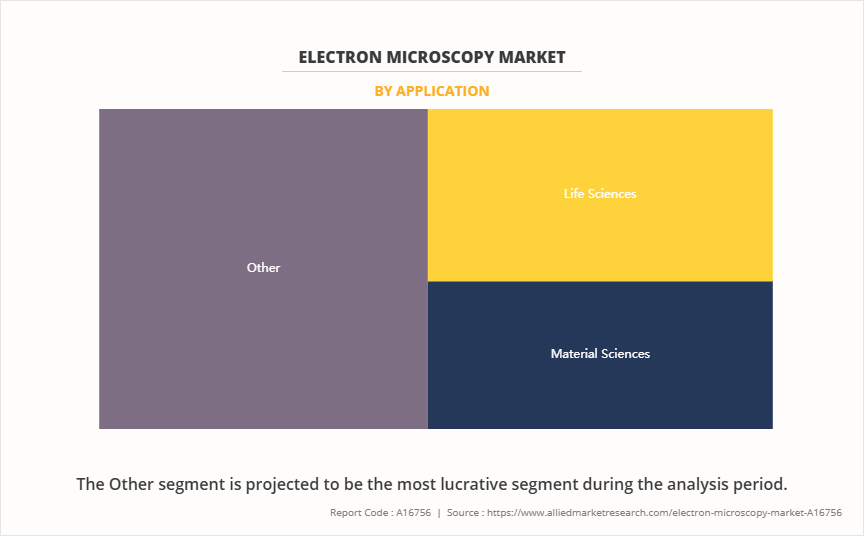
Based on application, Life Sciences accounted for the largest market share in 2024 and are projected to lead during the forecast period. Based on application, Life Sciences accounted for the largest market share in 2024 and are projected to lead during the forecast period.
By End-User
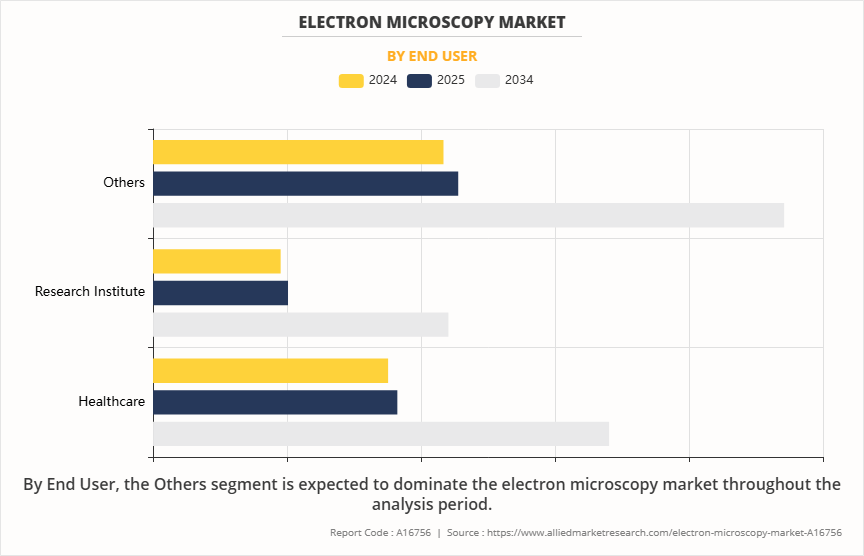
Based on end-user, Healthcare held the highest market share, owing to the increasing adoption of electron microscopy in biomedical research, pathology, and drug development.
By Region
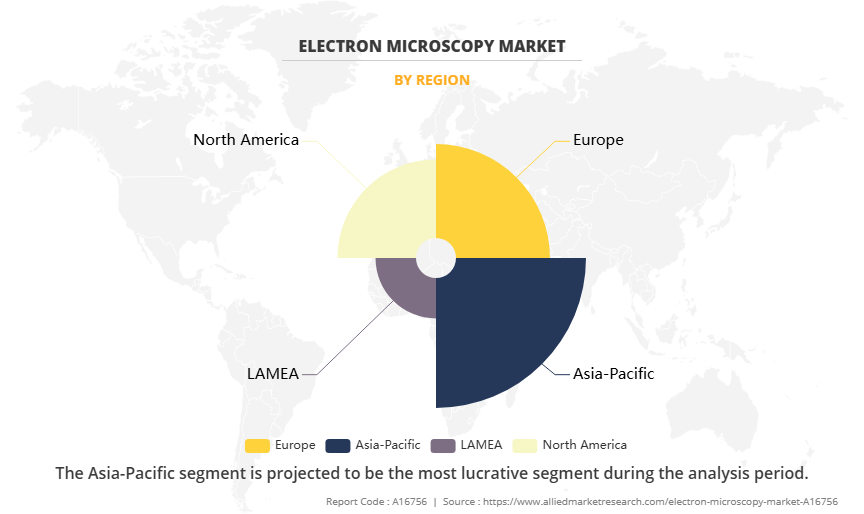
Based on region, the Asia-pacific region dominated the global market in the year 2024 and is likely to remain dominant during the forecast period. This dominance is attributed to rapid expansion of research infrastructure, increasing government funding for scientific innovation, and the strong presence of semiconductor, materials science, and healthcare industries across countries such as China, Japan, South Korea, and India.
Competition Analysis
The key players included in the Electron Microscopy Market analysis are Bruker, Hitachi High-Tech Corporation, Oxford Instruments, JEOL Ltd, Advantest Corporation, Thermo Fisher Scientific, Inc.,Nikon Corporation, Delong Instruments, ZEISS Group.
Key Benefits For Stakeholders
- This report provides a quantitative analysis of the market segments, current trends, estimations, and dynamics of the electron microscopy market analysis from 2024 to 2034 to identify the prevailing electron microscopy market opportunities.
- The market research is offered along with information related to key drivers, restraints, and opportunities.
- Porter's five forces analysis highlights the potency of buyers and suppliers to enable stakeholders make profit-oriented business decisions and strengthen their supplier-buyer network.
- In-depth analysis of the electron microscopy market segmentation assists to determine the prevailing market opportunities.
- Major countries in each region are mapped according to their revenue contribution to the global market.
- Market player positioning facilitates benchmarking and provides a clear understanding of the present position of the market players.
- The report includes the analysis of the regional as well as global electron microscopy market trends, key players, market segments, application areas, and market growth strategies.
Electron Microscopy Market Report Highlights
| Aspects | Details |
 Market Size By 2034 | USD 10.3 billion |
 Growth Rate | CAGR of 8.1% |
 Forecast period | 2024 - 2034 |
 Report Pages | 300 |
 By Type |
|
 By Application |
|
 By End User |
|
 By Region |
|
 Key Market Players | Advantest Corporation, Oxford Instruments, Hitachi High-Tech Corporation, Thermo Fisher Scientific, Inc., Bruker, ZEISS Group, Nikon Corporation, Delong Instruments, Tescan Group a.s., JEOL Ltd. |
Analyst Review
The electron microscopy market is currently experiencing a dynamic phase of transformation, shaped by advancements in imaging technology, growing interdisciplinary applications, and increasing investments in materials and life sciences research. Historically, the market’s focus centered on achieving higher magnification and resolution capabilities for fundamental research and industrial quality control. However, recent years have witnessed a decisive shift toward digitalization, automation, and integration with complementary analytical techniques. One of the most notable developments in Electron Microscopy Market Demand is the growing adoption of hybrid microscopy systems—combining electron microscopy (EM) with spectroscopy, tomography, and AI-driven image analysis—to deliver deeper structural and compositional insights at the nanoscale drive Electron Microscopy Market Demand. This evolution is reinforced by the expanding use of EM across diverse domains such as semiconductors, nanotechnology, pharmaceuticals, and biotechnology, supported by government and private funding for advanced research infrastructure. Manufacturers are also emphasizing user-friendly designs, improved sample preparation workflows, and cloud-based data management to make high-resolution imaging more accessible and efficient.
The surge in nanotechnology and semiconductor innovation continues to act as a pivotal growth catalyst. In electronics manufacturing, electron microscopy (EM) has become indispensable for process development, defect analysis, and 3D characterization of integrated circuits, enabling companies to enhance precision and yield in advanced node production. Similarly, in life sciences, cryo-electron microscopy (cryo-EM) has emerged as a revolutionary tool for structural biology, allowing researchers to visualize biomolecules in their near-native states without the need for crystallization. The convergence of EM with artificial intelligence and automation is further transforming research workflows by reducing analysis times, improving reproducibility, and facilitating high-throughput imaging.
Nevertheless, the industry faces structural and operational challenges. High capital and maintenance costs, along with the need for specialized technical expertise, remain significant barriers to wider adoption, particularly among small and mid-sized laboratories. Moreover, supply chain disruptions and fluctuations in raw material and component costs—such as electron sources and detectors—continue to exert pricing pressures on manufacturers.
Despite these headwinds, the market is poised for robust expansion as innovation accelerates. The adoption of AI-enhanced imaging, digital twin modeling, and remote microscopy platforms enabling real-time collaboration and predictive diagnostics. As sustainability becomes a cross-industry imperative, leading EM manufacturers are also exploring energy-efficient system designs and eco-friendly manufacturing processes. With global R&D expenditure on nanotechnology and life sciences projected to rise substantially through 2035, the intersection of automation, digitalization, and scientific discovery is set to define the next growth chapter of the electron microscopy market and boost the Electron Microscopy Market Demand.
Growth in cryo-electron microscopy, AI-based image analysis, in-situ & 3D EM, correlative microscopy (CLEM), and rising adoption in Asia-Pacific.
Life sciences and materials science research—especially structural biology, nanotechnology, and semiconductor analysis.
Asia-Pacific leads the market, followed by Europe with the fastest growth.
The electron microscopy market was valued at $4,872.0 million in 2024 and is estimated to reach $10,313.3 million by 2034, exhibiting a CAGR of 8.1% from 2025 to 2034.
Bruker, Hitachi High-Tech Corporation, Oxford Instruments, JEOL Ltd, Advantest Corporation, Thermo Fisher Scientific, Inc.,Nikon Corporation, Delong Instruments, ZEISS Group.
Loading Table Of Content...
Loading Research Methodology...