
Genomics Market Research, 2033
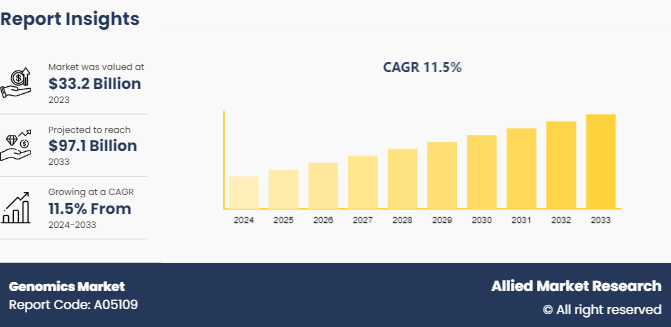
The global genomics market was valued at $33.2 billion in 2023, and is projected to reach $97.1 billion by 2033, growing at a CAGR of 11.5% from 2024 to 2033. Rise in prevalence of genetic disorders, cancer, and rare diseases, along with increase in adoption of precision medicine, drives the growth of the genomics industry.
Market Introduction and Definition
Genomics is the branch of science focused on the comprehensive study of an organism’s complete set of DNA, including gene structure, function, variation, and interaction. It enables the analysis of genetic information to understand disease mechanisms, predict health risks, and support the development of personalized therapies. Genomic technologies are widely applied in clinical diagnostics, drug discovery, oncology, reproductive health, and population-based research. Key techniques include whole genome sequencing, whole exome sequencing, and targeted gene sequencing, supported by advanced bioinformatics tools for data interpretation.
The benefits of genomics include early and accurate disease diagnosis, identification of inherited conditions, and selection of targeted treatments based on an individual’s genetic profile. In oncology, genomics supports tumor profiling and companion diagnostics, improving treatment outcomes. In pharmaceutical research, genomic insights help identify novel drug targets and optimize clinical trials. Technological advancements such as next-generation sequencing, automation, and AI-driven data analysis have significantly improved sequencing accuracy, reduced costs, and shortened turnaround times.
Genomics plays a major role in advancing precision medicine and preventive healthcare, enabling more informed clinical decision-making and improved patient outcomes. Increasing integration of genomic data with electronic health records, along with expanding digital and cloud-based platforms, is enhancing data accessibility and collaboration. As investments in genomic research grow and adoption expands across clinical and research applications, the genomics market is expected to witness steady growth, supporting the evolution of personalized and data-driven healthcare over the coming years.
Key Takeaways
- The genomics market study covers 20 countries. The research includes a segment analysis of each country in terms of value for the projected period 2023-2033.
- More than 1, 500 product literatures, industry releases, annual reports, and other such documents of major Genomics industry participants along with authentic industry journals, trade associations' releases, and government websites have been reviewed for generating high-value industry insights.
- The study integrated high-quality data, professional opinions and analysis, and critical independent perspectives. The research approach is intended to provide a balanced view of global markets and to assist stakeholders in making educated decisions to achieve their most ambitious growth objectives.
Key Market Dynamics Shaping the Genomics Industry
What Is Driving Market Growth?
Increase in adoption of precision medicine and the rise in prevalence of genetic disorders, cancer, and rare diseases drive expansion of the genomics sector. Advances in next-generation sequencing (NGS) technologies have significantly reduced sequencing costs while improving speed and accuracy, making genomic analysis more accessible for both research and clinical applications. The expanding use of genomics in oncology for tumor profiling and targeted therapy selection is a major growth driver. In addition, growing awareness among healthcare providers and patients regarding the clinical value of genetic testing supports wider adoption. Pharmaceutical and biotechnology companies increasingly rely on genomics for drug discovery, biomarker identification, and clinical trial optimization, further strengthening market demand. Rising investments in genomics research, supported by government initiatives, academic collaborations, and private funding, also contributes to market expansion. The integration of genomic data with electronic health records and advanced bioinformatics platforms enhances clinical decision-making, reinforcing the role of genomics in modern healthcare.
Challenges Limiting Market Expansion
Despite strong growth potential, high costs associated with advanced sequencing platforms, data storage, and bioinformatics infrastructure can limit adoption, particularly in resource-constrained settings. Interpreting complex genomic data requires specialized expertise, and a shortage of skilled professionals remains a significant barrier. Data privacy and security concerns related to the handling of sensitive genetic information pose regulatory and ethical challenges. In addition, variability in regulatory frameworks across regions can slow the approval and commercialization of genomic tests. Limited reimbursement policies for genetic testing in some healthcare systems further restrict patient access and market penetration.
Emerging Opportunities and Future Outlook
Advancements in AI-powered bioinformatics tools are improving variant interpretation, disease risk prediction, and clinical reporting, enhancing the utility of genomic data. Expanding applications of genomics in population health studies, preventive medicine, and pharmacogenomics open new growth avenues. The increasing adoption of cloud-based genomic platforms supports scalable data analysis and global collaboration among researchers and clinicians. Growth in direct-to-consumer genetic testing and expanded use of genomics in reproductive health and newborn screening further broaden market reach. Moreover, rising investments in genomic infrastructure across emerging economies and increasing government support for national genomics programs are expected to accelerate adoption. Collectively, these factors are anticipated to drive sustained growth and innovation in the genomics market in the coming years.
Factors Fueling Demand Growth in the Genomics Market
In recent years, demand for genomics has increased due to the growing focus on precision medicine and personalized healthcare. The rising prevalence of genetic disorders, cancer, and rare diseases has accelerated the need for advanced genomic testing to support accurate diagnosis and targeted treatment selection. Increasing awareness among clinicians and patients about the clinical value of genomic insights is also contributing to market growth.
Technological advancements in next-generation sequencing (NGS), bioinformatics, and data analytics have significantly reduced sequencing costs and turnaround times, making genomic solutions more accessible across research and clinical settings. Expanding applications of genomics in drug discovery, companion diagnostics, and population health studies further support demand growth.
Genomics Market Segmentation
The genomics market share is segmented into product, technology, application, and end user. By product, the market is divided into consumables and reagent, services and instruments, systems and software. As per technology, the market is divided into sequencing, PCR, flow cytometry, microarray and others. By application, the market is divided into functional genomics, epigenomics, pathway analysis, biomarker discovery and others. By end user, the market is divided into clinical research, academic and government institutions, hospitals and clinics, pharmaceutical and biotechnology companies and others. Region wise, the market is analyzed across North America, Europe, Asia-Pacific, and LAMEA.
Key End Users Driving Adoption in the Genomics Market
The primary end users of the genomics market include research institutions, clinical laboratories, and hospitals. Research institutions and academic centers play a major role in driving adoption by using genomic technologies for gene discovery, population studies, and disease research. Clinical laboratories utilize genomics for diagnostic testing, including oncology profiling, rare disease diagnosis, and prenatal screening. Hospitals increasingly integrate genomic testing into clinical workflows to support precision medicine, targeted therapies, and personalized treatment planning.
Pharmaceutical and biotechnology companies are also key end users, leveraging genomics for drug discovery, biomarker identification, and clinical trial optimization. In addition, contract research organizations (CROs) support genomic analysis and sequencing services for research and biopharma clients.
Regional/Country Market Outlook
In developed regions such as North America and Europe, the market is driven mostly due to favorable government initiatives and funding. Further, the wide spread of genomic technologies such as next-generation sequencing (NGS) , PCR-based diagnostics, and other genomic technologies further drives the market growth.
In Asia-Pacific, the Genomics Market Size is expected to grow at a healthy growth rate during the Genomics Market Forecast period. This is attributed to the presence of key players and rise in number of genomic related start-up companies in the region. For instance, few of the companies which were incorporated after 2020 include Medisix Therapeutics, Gene Solutions, Novena Global Lifecare and Asa Rén among others.
Key Growth Strategies
- In March 2024, Illumina, a U.S.-based genomics technology company, announced strategic collaborations with multiple pharmaceutical and biotechnology companies to expand the use of next-generation sequencing (NGS) in oncology and rare disease research.
- In September 2023, Thermo Fisher Scientific expanded its genomics manufacturing and laboratory capabilities in Europe to meet the growing demand for genetic testing, precision medicine, and biopharma research.
- In 2024, several genomics companies increased investments in AI-enabled bioinformatics platforms to enhance data interpretation and clinical utility of genomic data. These investments focus on improving variant analysis, disease prediction, and personalized treatment selection.
How AI is Transforming the Genomics Domain
Artificial intelligence plays an important role in the genomics market. It supports genomic research, data interpretation, and clinical decision-making across applications such as diagnostics, drug discovery, and personalized medicine. AI-driven algorithms help analyze massive genomic datasets, including DNA sequencing data, gene expression profiles, and variant information, at high speed and accuracy. These tools assist in identifying disease-associated mutations, predicting disease risk, and uncovering novel biomarkers. AI also improves the accuracy of genome sequencing by reducing errors and enhancing variant calling. In drug discovery, AI helps identify new therapeutic targets and optimize candidate selection based on genomic insights. In addition, AI supports clinical genomics by enabling personalized treatment strategies, such as selecting targeted therapies based on a patient’s genetic profile. These capabilities help accelerate research timelines, improve diagnostic precision, and reduce development costs. This is anticipated to foster the growth of the genomics market in the upcoming years.
Role of Digital Technologies in the Genomics Industry
Digital technologies play an important role in the genomics market. They help enhance data management, collaboration, and accessibility across the genomics workflow. Cloud-based platforms enable secure storage and processing of large-scale genomic datasets, allowing researchers and clinicians to analyze data efficiently. Digital bioinformatics tools and software platforms support sequence alignment, variant annotation, and data visualization. Integration with electronic health records enables the use of genomic data in clinical decision-making and precision medicine initiatives. In addition, digital platforms facilitate collaboration among research institutions, laboratories, and pharmaceutical companies by enabling data sharing and standardized workflows. Automation technologies improve laboratory efficiency by streamlining sample preparation, sequencing, and data analysis. These technologies help improve research productivity, expand the adoption of genomic testing, and support the development of personalized healthcare solutions. This is anticipated to foster the growth of the genomics market in the upcoming years.
Industry Trends
- In April 2024, according to NIH (National Institutes of Health) , researchers are leveraging advancements in sequencing technology to understand cancer mechanisms, identify genetic risks, and develop personalized treatments. Comprehensive genomic profiling is increasingly used to identify actionable mutations in tumors, which can be targeted with specific therapies, improving treatment outcomes.
- According to the Center for Genomics and Data Science Research (NHGRI) in May 2024, the NHGRI launched the CGDSR to tackle the challenges of analyzing complex genomic datasets. The center focuses on developing computational methods to understand the genomic basis of diseases, aiming to translate these findings into clinical practice.
Competitive Landscape
The major players operating in the genomics sector are Color Genomics, Inc., BGI Genomics, Agilent Technologies, Bio-Rad Laboratories, Inc., Danaher Corporation, Eppendorf AG, Eurofins Scientific, F. Hoffmann-La Roche Ltd., GE Healthcare and Illumina, Inc.?These players adopt different strategies to stay competitive in the market. These include partnerships, collaborations, and acquisitions with healthcare providers and competitors. This helps companies?establish?their foothold in the market.?
Recent Key Strategies and Developments
- In May 2024, Sophia Genetics had announced that it is collaborating with Microsoft and NVIDIA to influence their expertise in technology and genomics to bring a streamlined and scalable whole genome sequencing (WGS) analytical solution to healthcare institutions, with the aim to make the solution available to customers before the end of the year.?
- In May 2024, Bruker Corporation had announced that it has closed its asset acquisition of the business of NanoString Technologies, Inc. This acquisition strengthened its portfolio as the company has now acquired substantially all the assets and rights associated with NanoString’s business, including the nCounter, GeoMx, CosMx and AtoMx product lines, for approximately $392.6 million in cash, and the assumption of certain liabilities. In 2023, NanoString generated revenues of approximately $168 million.
Key Sources Referred
- World Health Organization
- Center of Disease Control and Prevention
- National Library of Medicine
- Global Alliance for Genomics and Health (GA4GH) ?
- Genomics Organization for Academic Laboratories (GOAL)
- Alliance for Genomic Discovery (AGD)
The report helps mitigate risks by offering in-depth insights. It also offers?a competitive?landscape which helps stakeholders make strategic decisions for their businesses. It studies the changes in domain and helps support long-term business growth. The report also focuses on market dynamics and key trends of?genomics market analysis. The study provides competitive landscape analysis of the key players to understand the adopted strategies and competitive intensity of competitors. It also offers a study of?threat?of?new entrants, and bargaining power of buyers, on the?genomics market?outlook.??
Key Benefits For Stakeholders
- This report provides a quantitative analysis of the market segments, current trends, estimations, and dynamics of the genomics market analysis from 2024 to 2033 to identify the prevailing genomics market opportunity.
- The market research is offered along with information related to key drivers, restraints, and opportunities.
- Porter's five forces analysis highlights the potency of buyers and suppliers to enable stakeholders to make profit-oriented business decisions and strengthen their supplier-buyer network.
- In-depth analysis of the genomics industry segmentation assists in determining the prevailing market opportunities.
- Major countries in each region are mapped according to their revenue contribution to the global market.
- Market player positioning facilitates benchmarking and provides a clear understanding of the present position of market players.
- The report includes the analysis of the regional as well as global genomics market trends, key players, market segments, application areas, and market growth strategies.?
Genomics Market Report Highlights
| Aspects | Details |
 Market Size By 2033 | USD 97.1 Billion |
 Growth Rate | CAGR of 11.5% |
 Forecast period | 2024 - 2033 |
 Report Pages | 280 |
 By Product |
|
 By Technology |
|
 By Application |
|
 By End User |
|
 By Region |
|
 Key Market Players | Eurofins Scientific SE, Color Genomics, Inc., Illumina, Inc., Danaher Corporation, Bio-Rad Laboratories, Inc. , F. Hoffmann-La Roche Ltd., GE Healthcare, Eppendorf AG, Agilent Technologies, BGI Genomics |
Upcoming trends in the global genomics market include the increasing use of AI and machine learning for data analysis, the growth of personalized medicine, and the integration of genomics into routine clinical practice. Additionally, advancements in sequencing technologies and the expansion of direct-to-consumer genetic testing are expected to drive market growth.
Leading application of genomics market is functional genomics in 2023.
North America is the largest regional market for Genomics Market in 2023
The Genomics Market was valued at $33.2 billion in 2023 and is estimated to reach $97.14 billion by 2033, exhibiting a CAGR of 11.5% from 2024 to 2033.
Key players to occupy major share in the genomics market include players such as Agilent Technologies, Bio-Rad Laboratories, Inc., and Danaher Corporation among others.
Loading Table Of Content...