
Genomics Services Market Research, 2033
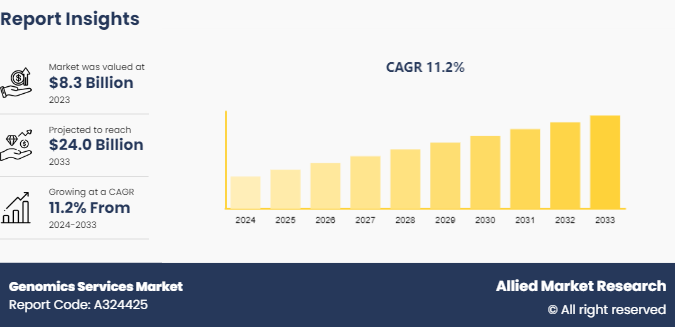
The global genomics services market size was valued at $8.3 billion in 2023, and is projected to reach $24.0 billion by 2033, growing at a CAGR of 11.2% from 2024 to 2033. AI-driven genomic research can accelerate the discovery of new biomarkers and therapeutic targets, opening new avenues for drug development and improving patient outcomes and driving the market growth.
Market Introduction and Definition
Genomic services encompass a range of advanced technologies used to analyze and interpret an organism’s complete DNA, including its genes and genetic sequences. These services include DNA sequencing, genotyping, gene expression analysis, and bioinformatics. They play a vital role in research areas such as personalized medicine, disease diagnosis, and therapeutic development. By offering detailed insights into genetic variations and functions, genomic services help identify disease markers, support the development of targeted treatments, and advance precision medicine.
Genomic services drive innovation and improve outcomes with wide applications across healthcare, agriculture, biotechnology, and environmental science. In healthcare, they enable disease diagnosis, risk prediction, personalized medicine, and the development of targeted therapies and vaccines. Genomic analysis helps identify genetic mutations associated with conditions such as cancer, rare diseases, and inherited disorders. In agriculture, genomic technologies improve crop productivity, enhance resistance to pests and diseases, and support efficient livestock breeding. Biotechnology companies use genomic data for drug discovery, biomarker identification, and therapeutic development. In environmental science, genomics is used to study biodiversity, monitor microbial communities, track pathogens, and support conservation efforts and sustainable ecosystem management.
Key Takeaways
- The genomics services market share study covers 20 countries. The research includes a segment analysis of each country in terms of value for the projected genomics services market forecast period.
- More than 1, 500 product literatures, industry releases, annual reports, and other such documents of major genomics services industry participants along with authentic industry journals, trade associations' releases, and government websites have been reviewed for generating high-value industry insights.
- The study integrated high-quality data, professional opinions and analysis, and critical independent perspectives. The research approach is intended to provide a balanced view of global markets and to assist stakeholders in making educated decisions in order to achieve their most ambitious growth objectives.
Key Market Dynamics
The growth of the genomics services market is primarily driven by the increasing demand for personalized medicine. Personalized medicine tailors treatment plans according to an individual’s genetic profile, improving treatment effectiveness while minimizing adverse effects. Advancements in genomic technologies, particularly next-generation sequencing (NGS), have made genetic analysis faster, more accessible, and more affordable, accelerating the adoption of personalized healthcare approaches. Moreover, the rising prevalence of chronic diseases such as cancer and cardiovascular disorders has increased the need for precise diagnostic and therapeutic solutions, further boosting the demand for genomic services.
However, the high cost of genomic testing and data analysis remains a key challenge for market growth. Although technological advancements have gradually reduced costs, comprehensive genomic analyses can still be expensive, limiting accessibility for many patients and healthcare providers. In addition, the complexity of genomic data requires advanced infrastructure and skilled professionals for accurate interpretation, which further increases operational costs. These financial barriers can restrict the widespread adoption of genomic technologies, particularly in resource-limited settings and developing regions.
Nevertheless, the integration of artificial intelligence (AI) and machine learning (ML) with genomic data analysis presents significant growth opportunities for the market. AI and ML technologies can efficiently process large volumes of genetic data, identifying patterns and correlations that traditional analytical methods may overlook. This capability can improve disease diagnosis, predict genetic susceptibility to diseases, and support the development of personalized treatment strategies. Furthermore, the growing collaboration between technology companies and genomic research institutions is expected to foster innovation and expand the application of genomics in healthcare.
Patent Analysis for Genomic Services
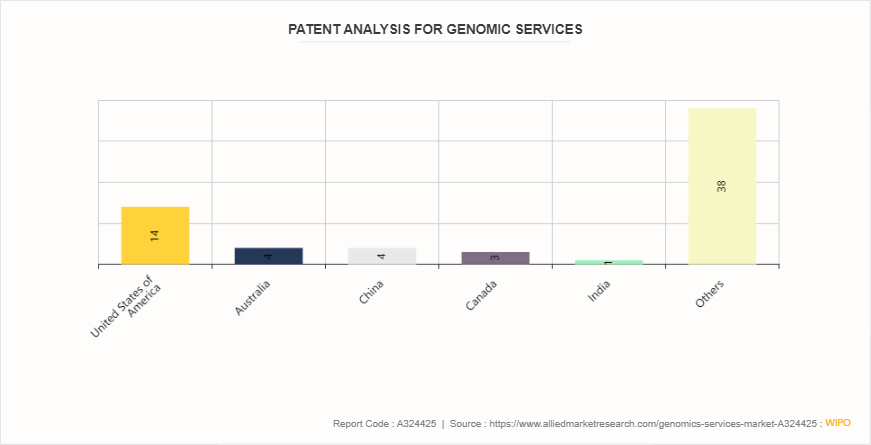
According to the WIPO PatentScope database, the genomic services market features a diverse distribution of patents across multiple countries. The U.S. leads with 14 patents, which reflects strong investments in biotechnology and genomic research. Australia and China each account for four patents, indicating notable advancements and growing interest in genomic technologies within these regions. Canada holds three patents, demonstrating its increasing contribution to genomic innovation. India has one patent, suggesting emerging research activity in the genomic sector. The “Others” category comprises 38 patents from various countries, highlighting widespread global interest and collaborative efforts to advance genomic services and related technologies worldwide.
Why Is Demand Increasing in This Market?
Demand in the genomics services market is rising rapidly due to several converging factors that reflect both scientific advancements and expanding applications. First, the declining cost of genome sequencing, driven by technological innovations and high-throughput platforms, has made large-scale genomic studies more accessible to research institutions, healthcare providers, and biotechnology companies. This affordability allows organizations to undertake more ambitious projects, from personalized medicine to population genomics.
Second, there is growing adoption of precision medicine and personalized healthcare, which rely on genomic information to tailor treatments to individual patients. As clinicians increasingly integrate genomics into diagnosis, risk assessment, and therapy selection, the need for reliable sequencing and bioinformatics services grows.
Third, advances in AI and data analytics are enabling faster, more accurate interpretation of complex genomic data, increasing the value of sequencing services. In addition, expanding applications in agriculture, industrial biotechnology, and disease surveillance are driving demand beyond healthcare.
Finally, government initiatives and private investments supporting genomics research further stimulate market growth. Collectively, these trends are boosting the demand for comprehensive genomics services capable of handling large, diverse datasets efficiently and accurately.
Market Segmentation
The genomics services industry is segmented into service type, technology, end user and region. On the basis of service type, the market is categorized into gene expression services (RNASeq) , epigenomics services, genotyping, next-generation sequencing, sanger sequencing, and others. On the basis of technology, the market is categorized into polymerase chain reaction (PCR) , next-generation sequencing (NGS) , microarray, sanger sequencing, and others. On the basis of end user, the market is categorized into research institutes, healthcare facilities & diagnostic centers, pharmaceutical & biotechnological companies, and contract research organizations (CROs) . Region-wise, it is analyzed across North America, Europe, Asia-Pacific, and LAMEA.
Regional/Country Market Outlook
The genomics services market demonstrates notable regional variations in market share. North America dominates the market, driven by substantial investments in research and development, advanced healthcare infrastructure, and the strong presence of leading biotechnology companies. Europe follows, supported by favorable regulatory frameworks and the growing adoption of personalized medicine. The Asia-Pacific region is witnessing rapid growth due to increasing healthcare expenditures, expanding genomic research activities, and government initiatives promoting biotechnology innovation. Countries such as China and India are emerging as important contributors with rising investments in genomics. Meanwhile, Latin America and the Middle East & Africa are gradually adopting genomic services, supported by improving healthcare infrastructure and increasing awareness of genomic applications in medicine.
- In December 2021, BGI Genomics, in partnership with the Institute of Molecular Genetics and Genetic Engineering (IMGGE) at the University of Belgrade, helped design and establish the Center for Genome Sequencing and Bioinformatics, the first genome sequencing hub in Serbia.
What Makes the U.S./Europe/Asia-Pacific a Key Market for Industry Players?
The U.S., Europe, and Asia-Pacific are key markets for genomics services due to a combination of strong infrastructure, significant investments, and growing demand for precision medicine. In the U.S., advanced research institutions, robust healthcare systems, and substantial government and private funding support large-scale genomic studies and biotech innovation. Europe benefits from coordinated genomics initiatives, well-established regulatory frameworks, and collaborations between academic and commercial entities, fostering a mature market for sequencing and bioinformatics services.
Asia-Pacific is emerging as a rapidly growing market, driven by large populations, increasing healthcare investments, and expanding genomics research in countries like China, Japan, and India. Technological adoption, declining sequencing costs, and rising awareness of personalized medicine further fuel demand. Collectively, these regions offer industry players access to advanced infrastructure, skilled talent, and diverse applications, making them strategic hubs for market expansion and innovation.
Industry Trends
- In April 2021, the UK Health Secretary Matt Hancock announced $51.4 million in funding for genomics and data initiatives aimed at strengthening the life sciences sector. The funding was allocated through the Genome U.K. Implementation Plan and the UK Functional Genomics Initiative.
What Are the Major Risks and Challenges Facing the Market?
The genomics services market faces several key risks and challenges. High costs of advanced sequencing platforms and infrastructure can limit accessibility for smaller organizations. Data privacy and security concerns, particularly regarding sensitive genetic information, pose regulatory and ethical hurdles. Complex regulatory frameworks across regions may slow market entry or commercialization. In addition, the growing volume of genomic data requires sophisticated analytics, and insufficient bioinformatics expertise can hinder effective data interpretation. Market competition is intensifying, with numerous players vying for technological leadership and client contracts, creating pressure on pricing and innovation timelines.
How Is Artificial Intelligence Transforming The Genomics Services Market?
Artificial Intelligence (AI) is revolutionizing the genomics services market by enhancing the speed, accuracy, and scalability of genomic analysis. Sequencing projects generate massive amounts of complex data, and AI algorithms can efficiently process this information to identify genetic variants, detect mutations, and uncover meaningful patterns that would be difficult or impossible to discern manually. This dramatically shortens the time from raw sequencing data to actionable insights.
In clinical genomics, AI enables precision medicine by linking genetic information to disease risk, treatment responses, and personalized therapeutic strategies. In research and drug development, AI accelerates target discovery, optimizes experimental design, and predicts outcomes, reducing costs and improving success rates. In addition, AI improves quality control by automatically identifying sequencing errors and optimizing data interpretation workflows, making large-scale projects more feasible.
Beyond healthcare, AI-powered analytics in genomics services are transforming agriculture, biotechnology, and population studies, enabling large-scale genomic insights and predictive modeling. Overall, AI is becoming a core driver of efficiency, innovation, and growth in the genomics services market.
Competitive Landscape
The major players operating in the genomics services market size include Illumina, Inc., QIAGEN, PerkinElmer Inc., Eurofins Scientific, Macrogen, Inc., GENEWIZ, LGC Limited, Q2 Solutions, and Bio Rad Laboratories, Inc. Other key players include Eurofins Scientific SE, Agilent Technologies, and others.
How Intense Is Market Competition and What Defines Competitive Advantage?
Competition in the genomics services market is highly intense, driven by numerous global and regional players offering sequencing, bioinformatics, and analytical services. Companies compete on technology, speed, accuracy, data integration, and the ability to handle large-scale projects. Competitive advantage is defined by access to advanced sequencing platforms, AI-driven analytics, robust quality control, and a strong track record in delivering reliable, actionable genomic insights. Additional differentiators include strategic partnerships, regulatory compliance, cost efficiency, and the ability to provide end-to-end solutions for research, clinical, and industrial applications, enabling companies to attract high-value clients and expand market share.
Recent Key Strategies and Developments
- In July 2023, Eremid Genomic Services, LLC (“Eremid”) announced a significant expansion of its in-house sequencing capabilities with the installation of PacBio’s latest HiFi sequencing platform, the Revio. This advanced system is the newest addition to Eremid’s suite of high-end genomics tools and reinforces the company’s commitment to supporting larger-scale and more diverse genomics projects.
What Technological Innovations Are Creating New Growth Opportunities?
Several technological innovations are driving new growth opportunities in the genomics services market. High-throughput sequencing platforms, such as next-generation sequencing (NGS) and long-read technologies, have dramatically increased sequencing speed and accuracy while reducing costs, enabling large-scale and more complex genomic projects. Platforms like PacBio’s HiFi sequencing and Oxford Nanopore’s real-time sequencers allow researchers to access high-quality, long-read genomic data that was previously difficult or impossible to obtain.
Artificial Intelligence (AI) and machine learning are transforming data analysis by rapidly identifying genetic variants, predicting functional impacts, and uncovering patterns in massive datasets. AI-powered tools streamline workflows, reduce errors, and support precision medicine initiatives, expanding the market for genomics services in clinical and research settings.
In addition, advancements in single-cell sequencing, spatial genomics, and multi-omics integration are creating opportunities to study gene expression, epigenetics, and molecular interactions at unprecedented resolution. Cloud-based bioinformatics platforms and automated laboratory systems further enhance scalability, collaboration, and efficiency.
Together, these innovations are enabling more comprehensive, accurate, and faster genomic insights, opening new applications in healthcare, agriculture, drug development, and population genomics, and driving market expansion.
Key Sources Referred
- World Health Organization (WHO)
- Centers for Medicare & Medicaid Services (CMS)
- WIPO
- National Health Service (NHS)
- National Health Mission (NHM)
- Institute for Health Metrics and Evaluation
- Centers for Disease Control and Prevention (CDC)
- Food and Drug Administration (FDA)
- National Institutes of Health (NIH)
Key Benefits for Stakeholders
- This report provides a quantitative analysis of the market segments, current trends, estimations, and dynamics of the genomics services market analysis from 2024 to 2033 to identify the prevailing genomics services market opportunity.
- The market research is offered along with information related to key drivers, restraints, and opportunities.
- Porter's five forces analysis highlights the potency of buyers and suppliers to enable stakeholders make profit-oriented business decisions and strengthen their supplier-buyer network.
- In-depth analysis of the genomics services market segmentation assists to determine the prevailing market opportunities.
- Major countries in each region are mapped according to their revenue contribution to the global market.
- Market player positioning facilitates benchmarking and provides a clear understanding of the present position of the market players.
- The report includes the analysis of the regional as well as global genomics services market trends, key players, market segments, application areas, and market growth strategies.
Genomics Services Market Report Highlights
| Aspects | Details |
 Market Size By 2033 | USD 24.0 Billion |
 Growth Rate | CAGR of 11.2% |
 Forecast period | 2024 - 2033 |
 Report Pages | 216 |
 By ServiceType |
|
 By Technology |
|
 By End User |
|
 By Region |
|
 Key Market Players | PerkinElmer Inc., Agilent Technologies, LGC Limited, Bio Rad Laboratories, Inc, Macrogen, Inc, Eurofins Scientific SE, Eurofins Scientific, QIAGEN, Illumina, Inc., Q2 Solutions |
The total market value of genomics services market was $8.3 billion in 2023.
The forecast period for genomics services market is 2024 to 2033.
The market value of genomics services market is projected to reach $24.0 billion by 2033
The base year is 2023 in genomics services market.
Genomic services include a range of advanced techniques and technologies used to analyze and interpret an organism's complete set of DNA, including its genes and sequences.
Loading Table Of Content...