
Intracranial Pressure Monitoring Market Summary
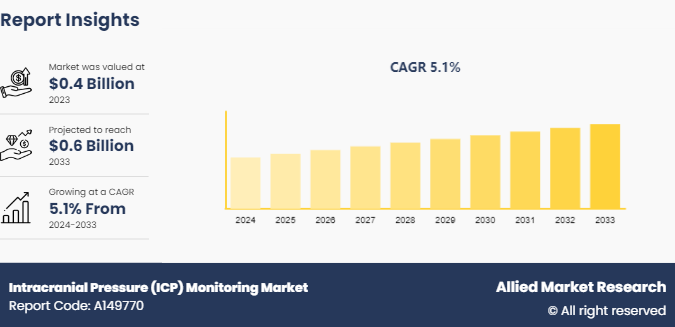
The global intracranial pressure monitoring market size was valued at $0.4 billion in 2023, and is projected to reach $0.6 billion by 2033, growing at a CAGR of 5.1% from 2024 to 2033. Increase in incidence of neurological disorders drives the intracranial pressure monitoring market growth.
Market Introduction and Definition
Intracranial pressure monitoring plays an important role in different medical conditions. Monitoring intracranial pressure helps healthcare providers assess the severity of brain injury, detect changes in intracranial dynamics, and guide treatment decisions. Elevated intracranial pressure can lead to serious complications such as brain herniation, decreased cerebral perfusion, and neurological deterioration. Timely detection and management of elevated intracranial pressure are essential to prevent secondary brain damage and improve patient outcomes. Therefore, intracranial pressure monitoring is important in optimizing patient care and minimizing the risk of long-term neurological impairment or mortality associated with intracranial hypertension.
Intracranial pressure monitoring is a medical procedure used to measure the pressure inside the skull. This pressure is exerted by the brain, cerebrospinal fluid, and blood within the cranial cavity. Intracranial pressure monitoring involves the insertion of a device, such as a catheter or sensor, into the brain or cerebrospinal fluid space to directly measure the pressure.
Key Takeaways
- The intracranial pressure monitoring market share study covers 20 countries. The research includes a segment analysis of each country in terms of value for the projected period.
- More than 1, 500 product literatures, industry releases, annual reports, and other such documents of major intracranial pressure monitoring market participants along with authentic industry journals, trade associations' releases, and government websites have been reviewed for generating high-value industry insights.
- The study integrated high-quality data, professional opinions and analysis, and critical independent perspectives. The research approach is intended to provide a balanced view of global markets and to assist stakeholders in making educated decisions in order to achieve their most ambitious growth objectives.
What Is the Current Market Size and How Is the Market Expected to Grow?
Intracranial pressure monitoring plays an important role in the neurocritical care and medical devices industry. It focuses on tools that measure pressure inside the skull. This monitoring plays an important role for managing conditions that can lead to severe complications if not detected and managed promptly. It helps clinicians make informed treatment decisions, minimize secondary brain injury, and improve patient outcomes. Developments in the intracranial pressure monitoring market is fueled by rise in incidence of neurological disorders. The development of non-invasive Intracranial pressure monitoring devices also contributes to market expansion by improving patient comfort and reducing procedure-related complications.
What Are the Key Factors Driving the Intracranial Pressure Monitoring Market Growth?
Rise in prevalence of traumatic brain injuries and other neurological disorders boost the growth of the market. These conditions often lead to elevated intracranial pressure to prevent secondary brain damage. Technological improvements also foster the growth of the intracranial pressure monitoring market during the forecast period. These improvements help improve patient comfort, reduce procedural risks, and can provide real-time data that helps clinicians make faster treatment decisions. Further, healthcare providers also prefer less invasive solutions that reduce complications and improve patient experience. These factors boost the growth of the intracranial pressure monitoring market.
Key Market Dynamics
The technological innovations in intracranial pressure monitoring devices have significantly improved accuracy, reliability, and patient comfort. Miniaturization of sensors, wireless connectivity, and integration with digital health platforms have enhanced the efficiency and effectiveness of intracranial pressure monitoring. These advancements drive the intracranial pressure monitoring market growth by enabling healthcare providers to obtain real-time data, make informed decisions, and optimize patient care in neurocritical settings.
However, despite technological advancements, the high cost associated with intracranial pressure monitoring devices poses a significant restraint to intracranial pressure monitoring market growth. The initial investment in acquiring monitoring systems, along with recurring costs for maintenance, calibration, and consumables, can be prohibitive for healthcare facilities, especially in resource-constrained settings. Cost constraints limit the adoption of intracranial pressure monitoring devices, particularly in low- and middle-income countries, thus hindering market expansion.
Moreover, increase in incidence of neurological disorders, such as traumatic brain injury, stroke, intracranial hemorrhage, and brain tumors, serves as a significant opportunity for the intracranial pressure monitoring market growth. Continuous monitoring is essential for timely detection and intervention to prevent secondary brain injury and optimize patient outcomes.
How Is the Market Performing Compared to Previous Years?
The intracranial pressure monitoring market is witnessing steady growth over the recent years. Rise in rates of traumatic brain injuries and increase in hospitalization for neurological conditions also boost the growth of the market. Improvements in critical care management, trauma care systems, and acute neurology have collectively increased reliance on intracranial pressure monitoring as a standard of care for severe brain injuries. Traditional invasive systems remain vital in critical care settings, however there is an increase in the demand for non-invasive alternatives due to reduced procedural risk and improved patient comfort. Overall, the intracranial pressure monitoring market is stable and experiencing growth. This is attributed to increase in healthcare access, rise in clinical need, and improvements in technologies.
Non-Invasive Methodologies Statistics
Non-Invasive Methodologies | % (Percentage) |
Neuroimaging | 14.2% |
Audiological | 10.5% |
Cerebral Fluid Dynamics | 21.5% |
Ophthalmic | 37.9% |
Electrophysiological | 6.8% |
Miscellaneous | 9.1% |
Market Segmentation
The intracranial pressure monitoring market is segmented into technique, application, end user, and region. On the basis of technique, the market is bifurcated into invasive and non-invasive. On the basis of application, the market is divided into traumatic brain injury, intracerebral hemorrhage, meningitis and others. On the basis of end user, the market is divided into hospitals, clinics, private medical offices, trauma centers, and government and research organizations. By region, it is analyzed across North America, Europe, Asia-Pacific, and LAMEA.
Regional/Country Market Outlook
The regional and country market outlook for the intracranial pressure monitoring market share varies significantly based on factors such as healthcare infrastructure, prevalence of neurological disorders, regulatory landscape, and reimbursement policies. In developed regions such as North America and Europe, where there is a robust healthcare system and high prevalence of neurological conditions, the market for ICP monitoring devices is well-established. Emerging economies in Asia-Pacific and Latin America are witnessing rapid growth in intracranial pressure monitoring market forecast, driven by increase in healthcare expenditure, improvement in healthcare infrastructure, and rise in awareness about neurocritical care. Countries such as China, India, and Brazil are expected to contribute significantly to market growth. However, challenges such as limited access to healthcare services and regulatory hurdles may hinder market growth in certain regions. Overall, the regional and country market outlook for the ICP monitoring devices market reflects a complex interplay of factors influencing demand and adoption of these critical medical devices.
Strategies of Key Players
Leading companies invest in research and development to improve device accuracy, sensor reliability, and patient safety. These investments help maintain leadership and respond to clinical demand for safer and efficient monitoring solutions. Players like Natus Medical and Philips aim to broaden their product offerings by adding intracranial pressure monitoring systems that integrate with broader neurocritical care platforms. This allows these companies to serve comprehensive monitoring needs in intensive care, trauma centers, and surgical settings. To strengthen market presence, companies form strategic collaborations with hospital networks, distributors, and healthcare providers. This helps accelerate device adoption across diverse geographies and clinical environments. Established multinationals often leverage existing global sales and service networks to support adoption in both developed and emerging intracranial pressure monitoring market.
Industry Trends
- In April 2024, The Brain Trauma Foundation (BTF) and the Military Traumatic Brain Injury Initiative (MTBI2) announced their collaboration for multicenter randomized, phase one, clinical trial and the development of three new clinical TBI practice guidelines. A successful, previous collaboration between the MTBI2 and the BTF to produce new penetrating brain injury guidelines fostered this recent collaboration.
- The American Society of Craniofacial Surgery (ASCFS) primarily focuses on craniofacial surgical interventions for congenital and acquired craniofacial anomalies. ASCFS surgeons may collaborate with neurosurgeons to assess and manage elevated ICP, aiming to optimize patient outcomes. While ASCFS guidelines primarily address craniofacial surgical techniques and principles, understanding the implications of elevated ICP and its management is essential for comprehensive craniofacial care.
- In April 2023, the third edition of the Brain Trauma Foundation’s evidence-based guidelines for the prehospital management of traumatic brain injury (TBI) was published in Prehospital Emergency Care.
Competitive Landscape
The major players operating in the ICP monitoring devices market size include AMETEK, Elekta AB, Koninklijke Philips N.V., Smiths Medical, Sick AG, Teleflex Incorporated, GE Healthcare, Integra LifeSciences, Natus Medical Incorporated, BrainLAB. Other players in intracranial pressure monitoring market include Medtronic PLC, Codman, and Shurtleff inc., Sophysa Ltd., Orsan Medical Technologies, Raumedic AG and so on.
Recent Key Strategies and Developments
- In January 2023, Natus Medical Incorporated, a leading provider of medical device solutions focused on the screening, diagnosis, and treatment of central nervous and sensory system disorders, announced the closing of its acquisition of Micromed Holding SAS ("Micromed"), a global provider of neurophysiology solutions. This newly merged organization brings together innovative neurodiagnostic and neuromonitoring solutions and experienced teams to offer a broader portfolio of products, services and support to customers worldwide.
- In August 2020, IRRAS AB, with a broad portfolio of innovative products for neurocritical care, announced the first patient treatment with Hummingbird Solo, a new line extension to its innovative Hummingbird ICP Monitoring devices product family.
Who Are the Key Players in the Market and What Are Their Strategies?
The global Intracranial Pressure Monitoring Market features several major medical device companies that lead in product development, innovation, and global reach. According to Allied Market Research, key participants include METEK, Elekta AB, Koninklijke Philips N.V., Smiths Medical, Sick AG, Teleflex Incorporated, GE Healthcare, Integra LifeSciences, Natus Medical Incorporated, BrainLAB. Other players in intracranial pressure monitoring market include Medtronic PLC, Codman, and Shurtleff inc., Sophysa Ltd., Orsan Medical Technologies, Raumedic AG and so on. These companies collectively shape the competitive environment by offering a range of invasive and non-invasive ICP monitoring devices technologies, from advanced sensor systems to fully integrated neuromonitoring platforms.
How Are Consumer Preferences Shaping Market Trends?
One of the most significant shifts is the growing preference for non-invasive intracranial pressure monitoring systems. These technologies provide accurate pressure measurements without the need for invasive procedures that involve drilling into the skull or inserting catheters. Patients and healthcare providers favor non-invasive options because they reduce procedural risk, lower discomfort, and simplify monitoring. This preference reflects a major trend in healthcare toward minimally invasive care. Non-invasive intracranial pressure monitoring aligns with this trend by making neurological assessment accessible and less traumatic. The demand for real-time data and connectivity also fosters the growth of the intracranial pressure monitoring market. Healthcare providers increasingly require continuous monitoring systems that deliver real-time intracranial pressure values, integrate with electronic health records, and support remote or telemedicine capabilities. Advancements in digital health platforms, wireless connectivity, and sensor technology are meeting these expectations by enabling faster decision-making and better patient tracking. This trend also supports adoption of intracranial pressure monitoring outside traditional ICU settings.
Key Sources Referred
- World Health Organization (WHO)
- Brain Injury Association of America (BIAA)
- Centers for Medicare & Medicaid Services (CMS)
- Brain Trauma Foundation (BTF)
- National Health Service (NHS)
- Australian Government Department of Health and Aged Care
- Government of Canada's Health and Wellness
- Ministry of Health and Family Welfare (MoHFW)
- National Health Mission (NHM)
- Ayushman Bharat - Health and Wellness Centers (AB-HWCs)
- Centers for Disease Control and Prevention (CDC)
- Food and Drug Administration (FDA)
- National Institutes of Health (NIH)
Key Benefits for Stakeholders
- This report provides a quantitative analysis of the market segments, current trends, estimations, and dynamics of the intracranial pressure monitoring market analysis from 2024 to 2033 to identify the prevailing intracranial pressure monitoring market opportunity.
- The market research is offered along with information related to key drivers, restraints, and opportunities.
- Porter's five forces analysis highlights the potency of buyers and suppliers to enable stakeholders make profit-oriented business decisions and strengthen their supplier-buyer network.
- In-depth analysis of the intracranial pressure monitoring market segmentation assists to determine the prevailing ICP monitoring devices market opportunities.
- Major countries in each region are mapped according to their revenue contribution to the global intracranial pressure monitoring market.
- Market player positioning facilitates benchmarking and provides a clear understanding of the present position of the intracranial pressure monitoring market players.
- The report includes the analysis of the regional as well as global intracranial pressure monitoring market trends, key players, market segments, application areas, and market growth strategies.
The report includes the analysis of the regional as well as global intracranial pressure monitoring market trends, key players, market segments, application areas, and market growth strategies.
Intracranial Pressure (ICP) Monitoring Market Report Highlights
| Aspects | Details |
 Market Size By 2033 | USD 0.6 Billion |
 Growth Rate | CAGR of 5.1% |
 Forecast period | 2024 - 2033 |
 Report Pages | 216 |
 By Technique |
|
 By Application |
|
 By End User |
|
 By Region |
|
 Key Market Players | BrainLAB, Teleflex Incorporated, Integra LifeSciences, Sick AG, Natus Medical Incorporated, Smiths Medical, AMETEK, GE Healthcare, Elekta AB, Koninklijke Philips N.V |
Loading Table Of Content...