
Laboratory Proficiency Testing Market Research, 2033
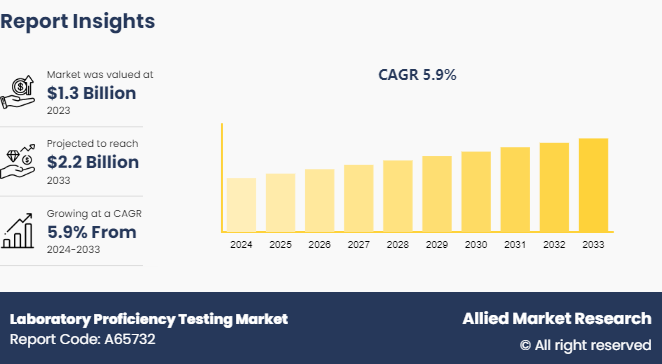
The global laboratory proficiency testing market was valued at $1.3 billion in 2023, and is expected to reach $2.2 billion by 2033, growing at a CAGR of 5.9% from 2024 to 2033. Increasing regulatory emphasis on quality assurance, rising complexity of diagnostic testing, expanding clinical laboratory networks, and growing globalization of healthcare services are key factors driving the growth of the laboratory proficiency testing market.
Market Overview
The laboratory proficiency testing market encompasses programs, services, and digital platforms designed to evaluate the performance and accuracy of laboratories by comparing their testing results against predefined standards or peer laboratories. Proficiency testing (PT) is a critical component of laboratory quality management systems and is widely used to ensure compliance with international standards such as ISO/IEC 17025 and ISO 15189. These programs help laboratories identify performance gaps, maintain accreditation, and enhance reliability in diagnostic, pharmaceutical, environmental, and food safety testing.
Laboratory proficiency testing involves periodic distribution of standardized samples to participating laboratories, which analyze the samples and submit their results to the PT provider for evaluation. The provider then assesses accuracy, precision, and overall performance through statistical analysis and benchmarking. PT services are applied across disciplines including clinical chemistry, microbiology, hematology, molecular diagnostics, toxicology, and environmental analysis. Increasing adoption of advanced diagnostic technologies, including molecular assays and automated analyzers, has further elevated the need for robust external quality assessment programs.
In recent years, rising regulatory scrutiny from health authorities and accreditation bodies across regions such as North America and Europe has strengthened demand for proficiency testing services. Additionally, expanding pharmaceutical research, contract research organizations (CROs), and biotechnology laboratories are contributing to market growth. Digital reporting platforms, data analytics integration, and global harmonization of quality standards are further enhancing program efficiency. As laboratory testing volumes continue to rise worldwide, the laboratory proficiency testing market is projected to witness steady growth between 2024 and 2033, supported by regulatory compliance requirements and increasing focus on quality assurance.
Key Takeaways
- The laboratory proficiency testing market analysis spans 20 countries, offering detailed segment-level evaluation for each nation in terms of market value (in $ billion) for the forecast period from 2024 to 2033. This country-specific assessment provides comprehensive insights into regional trends, growth patterns, and revenue projections across key markets.
- To develop robust and reliable industry insights, the study reviews more than 1,500 product documents, company publications, press releases, annual reports, and related materials from leading participants in the laboratory proficiency testing industry. In addition, credible industry journals, trade association publications, and official government sources have been extensively examined to ensure data accuracy and relevance.
- The research methodology combines high-quality quantitative data, expert opinions, and in-depth analytical frameworks with independent perspectives. This structured approach is designed to present a well-balanced and objective view of the global laboratory proficiency testing market. By integrating validated information with professional analysis, the study enables stakeholders—including laboratories, accreditation bodies, service providers, and investors—to make strategic, data-driven decisions and pursue long-term growth opportunities with confidence.
Key Market Dynamics
The laboratory proficiency testing market is influenced by increasing regulatory oversight, the growing complexity of diagnostic and analytical procedures, and rising emphasis on quality assurance across healthcare, pharmaceutical, environmental, and food testing laboratories. Expanding global laboratory networks and harmonization of international accreditation standards are significantly shaping market growth. Additionally, the surge in molecular diagnostics, automation in laboratories, and digital data management systems is strengthening the demand for structured external quality assessment programs. Continuous advancements in statistical analysis tools, cloud-based reporting platforms, and inter-laboratory benchmarking systems are further enhancing service efficiency and reliability across the global market landscape.
Drivers
The laboratory proficiency testing market is primarily driven by stringent regulatory requirements and accreditation mandates. Laboratories are required to comply with international standards such as ISO/IEC 17025 and ISO 15189 to maintain operational credibility and certification. Regulatory agencies and accreditation bodies increasingly mandate participation in external proficiency testing programs to ensure accuracy, reliability, and consistency of test results. This regulatory pressure significantly boosts demand across clinical, environmental, and industrial laboratories.
Another key growth driver is the rapid expansion of clinical diagnostics and molecular testing. The increasing prevalence of chronic and infectious diseases has led to higher testing volumes, requiring laboratories to demonstrate competency through regular performance validation. Pharmaceutical and biotechnology companies also rely on proficiency testing to maintain quality standards in drug development, bioanalysis, and clinical trials. Furthermore, the globalization of laboratory services and cross-border sample testing necessitate standardized benchmarking systems, supporting market expansion. Technological advancements, including automation and digital reporting systems, have improved efficiency in proficiency testing programs.
Restraints
Despite strong growth potential, the laboratory proficiency testing market faces certain challenges. High participation costs, particularly for small and mid-sized laboratories, may limit enrollment in comprehensive proficiency programs. Additionally, logistical complexities in sample distribution, especially for international participants, can create delays and increase operational expenses.
Variability in regulatory frameworks across countries may also hinder uniform adoption. Differences in accreditation standards and testing requirements can complicate program implementation. Limited awareness about the benefits of structured proficiency testing in developing regions further restricts market penetration.
Opportunities
The laboratory proficiency testing market presents significant opportunities driven by digital transformation and expanding laboratory infrastructure in emerging economies. Integration of advanced data analytics, artificial intelligence, and automated performance evaluation systems can enhance program accuracy and scalability.
Growing investments in healthcare infrastructure across Asia-Pacific, Latin America, and the Middle East are expected to create new demand for quality assurance services. Strategic collaborations between accreditation bodies, healthcare institutions, and proficiency testing providers can further strengthen global standardization efforts. Increasing emphasis on laboratory transparency, patient safety, and global harmonization of quality benchmarks is projected to accelerate long-term market growth between 2024 and 2033.
Analysis of Micro and Macro Economic Factors
The laboratory proficiency testing market is influenced by a combination of micro and macroeconomic factors that shape its dynamics and growth. At the microeconomic level, the market is impacted by factors such as the cost of participation for laboratories and the confidence they have in the proficiency testing outcomes provided by organizers. Laboratories invest significant resources, including labor and costs, in participating in proficiency tests, emphasizing the importance of a competent PT provider and a well-designed protocol. The choice of reference values, particularly the use of certified reference materials (CRMs) , plays a crucial role in ensuring the accuracy and reliability of proficiency testing results. However, the prohibitive costs and limited availability of CRMs pose challenges for laboratories, prompting them to seek alternative methodologies for establishing reference values.
On the macroeconomic front, broader economic trends and policies also influence the laboratory proficiency testing market. Economic factors such as overall market demand, government regulations, and funding allocations for research and development impact the uptake of proficiency testing services. For instance, increased regulatory scrutiny in industries such as healthcare and environmental monitoring can drive demand for proficiency testing to ensure compliance with standards and regulations. Additionally, fluctuations in funding for scientific research and quality assurance programs can affect the spending capacity of laboratories and their willingness to invest in proficiency testing services.
Market Segmentation
The laboratory proficiency testing market share is segmented into industry, technology, end use, and region. On the basis of industry, the market is divided into clinical diagnostics, pharmaceuticals, microbiology, cannabis, and others. As per technology, the market is segregated into cell culture, spectrometry, polymerase chain reaction, chromatography, immunoassays, and others. By end use the market is segmented on the basis of hospitals, contract research organizations, pharmaceutical & biotechnology companies, laboratories, and others. Region wise, the laboratory proficiency testing market share is analyzed across North America, Europe, Asia-Pacific, and LAMEA.
The laboratory proficiency testing market shows diverse growth across segments. By industry, clinical diagnostics holds the largest share, followed by pharmaceuticals and microbiology, with cannabis and other sectors contributing steadily. By technology, immunoassays and PCR dominate, while chromatography, spectrometry, and cell culture also play key roles. By end use, laboratories lead due to accreditation needs, followed by hospitals, CROs, and pharmaceutical & biotechnology companies.
Country Market Outlook
The U.S. laboratory proficiency testing market is experiencing steady growth, supported by a strong focus on quality assurance and regulatory compliance within healthcare and clinical diagnostics. Increasing demand for accurate and dependable laboratory results—essential for patient management and medical research—continues to drive expansion. Strict regulatory oversight from frameworks such as the Clinical Laboratory Improvement Amendments (CLIA) and accreditation programs led by the College of American Pathologists (CAP) further strengthens market adoption. Moreover, ongoing advancements in diagnostic technologies and the rising burden of chronic diseases require precise and validated laboratory testing, reinforcing the importance of structured proficiency programs across the healthcare system.
In April 2022, Spex CertiPrep, under Antylia Scientific, announced that NSI Lab Solutions partnered with the U.S. Pharmacopeia (USP) to deliver a global proficiency testing program, supporting accreditation, quality management systems, and regulatory confidence.
Analysis of Micro and Macro Economic Factors
The laboratory proficiency testing market is shaped by a combination of microeconomic and macroeconomic factors that influence its growth and operational dynamics. At the microeconomic level, key considerations include the cost of participation for laboratories and the confidence in the accuracy of proficiency testing results provided by PT organizers. Laboratories allocate considerable resources, including personnel time and financial investment, to engage in proficiency programs, highlighting the importance of reliable providers and rigorously designed testing protocols. The selection of reference values, particularly the use of certified reference materials (CRMs), is critical for ensuring result accuracy and consistency. However, high costs and limited availability of CRMs often compel laboratories to explore alternative approaches for establishing reference standards.
From a macroeconomic perspective, broader economic trends, policies, and regulatory frameworks significantly affect the market. Factors such as overall market demand, government regulations, and research and development funding influence proficiency testing adoption. Heightened regulatory oversight in sectors like healthcare, environmental monitoring, and food safety increases the need for proficiency programs to ensure compliance. Conversely, fluctuations in funding for scientific research and quality assurance initiatives can impact laboratories’ ability and willingness to invest in these services.
Which End-User Segments Are Fueling Expansion in the Laboratory Proficiency Testing Market?
The growth of the laboratory proficiency testing market is primarily driven by clinical laboratories, hospitals, pharmaceutical and biotechnology companies, and contract research organizations (CROs). Clinical laboratories represent the largest share due to mandatory participation in external quality assessment programs to maintain accreditation and comply with international. These laboratories rely on proficiency testing to validate accuracy, ensure reliability, and benchmark performance against peer institutions.
Hospitals with in-house diagnostic facilities are also significant contributors, as increasing patient volumes and complex testing procedures require continuous quality monitoring. Pharmaceutical and biotechnology companies depend on proficiency testing to maintain data integrity in drug development, bioanalytical testing, and clinical trials.
What Major Trends Are Influencing the Laboratory Proficiency Testing Industry?
A key trend shaping the laboratory proficiency testing market is the digital transformation of quality assessment programs. Cloud-based reporting platforms, automated result submission systems, and real-time performance dashboards are improving efficiency and transparency. Laboratories increasingly prefer digital solutions that enable quicker feedback, enhanced benchmarking, and streamlined documentation.
Another important trend is the harmonization of international quality standards, driven by globalization of laboratory services and cross-border collaborations.
- In January 2023, BIPEA launched a new interlaboratory proficiency testing program, PTS 101D, designed to support laboratories in detecting Listeria spp. and Listeria monocytogenes on stainless steel surface samples. During the first round, three stainless steel plates were distributed to participating laboratories for analysis. Participants were required to determine the presence or absence of the target pathogens using reference standards ISO 18593 and ISO 11290-1, or validated alternative methods.
- In October 2021, Biogenix Labs, a subsidiary of G42 Healthcare, partnered with the Abu Dhabi Quality and Conformity Council (ADQCC) to introduce the UAE’s first Proficiency Testing (PT) program for external COVID-19 testing. The initiative involved distributing RT-PCR samples prepared by Biogenix Labs to more than 15 public and private laboratories across the country. ADQCC assessed the submitted results and provided performance feedback to ensure compliance with quality standards. Initial survey samples were evaluated across five diagnostic platforms, including LamPORE technology.
How Is Artificial Intelligence Shaping the Laboratory Proficiency Testing Market?
Artificial intelligence (AI) is enhancing laboratory proficiency testing by improving data analysis, performance evaluation, and predictive quality monitoring. AI-powered analytics can rapidly identify trends, detect deviations, and flag potential errors in laboratory results. This enables early corrective actions and reduces the risk of diagnostic inaccuracies.
Machine learning algorithms support statistical modeling and benchmarking processes, which makes performance assessments more precise and efficient. Automated anomaly detection and intelligent reporting systems further reduce administrative workload while improving decision-making capabilities for laboratory managers.
What Technological Advancements Are Strengthening the Laboratory Proficiency Testing Market?
Technological innovation in the laboratory proficiency testing market centers on advanced statistical tools, digital integration, and automation. Web-based platforms with secure data exchange capabilities allow seamless global participation. Enhanced sample tracking systems and improved logistics management ensure timely distribution and result processing.
Moreover, integration with laboratory information management systems (LIMS) improves workflow efficiency and data traceability.
Competitive Landscape
The laboratory proficiency testing market comprises a combination of globally recognized quality assurance providers and specialized external assessment organizations focused on laboratory performance evaluation and regulatory compliance. Major players operating in this market include LGC Limited, Randox Laboratories Ltd., Bio-Rad Laboratories, Inc., Merck KGaA, QACS, NSI Lab Solutions, Weqas, BIPEA, Absolute Standards, Inc., and INSTAND. Additionally, AOAC International and other regional participants contribute to market competition.
These organizations offer comprehensive proficiency testing schemes, reference materials, and digital reporting platforms across clinical, pharmaceutical, environmental, and food testing sectors. Market participants focus on program expansion, technological integration, strategic collaborations, and geographic outreach to strengthen global presence and meet increasing accreditation and compliance requirements.
Recent Key Strategies and Developments
- In February 2024, LGC Limited PT expanded its proficiency testing portfolio with the launch of its 2024 interactive online catalogue. The platform provides streamlined access to detailed scheme information and application forms, improving user convenience and program enrollment. The updated catalogue introduces more than 50 new samples, covering testing areas such as Salmonella and Listeria detection in meat, sterility testing in milk, PFAS analysis in food products, gluten detection in cake mix, and mycotoxin assessment in spices.
- In January 2023, BIPEA introduced Proficiency Testing Scheme (PTS) 20G to support laboratories in evaluating their analytical capabilities through fish sample analysis. The program requires assessment of a 600g frozen fish using routine laboratory methodologies. It encompasses a broad range of parameters, including caloric value indicators (moisture, ash, water activity, pH, proteins, cholesterol, and energy value), freshness markers (TVB-N and TMA), mineral composition (calcium, copper, iron, manganese, magnesium), vitamin content (tocopherols, B1, B2, PP), fatty acid profiling, and PremiTest analysis
Industry Trends
- In January 2023, BIPEA introduced a new interlaboratory test, PTS 101D, enabling laboratories to detect Listeria spp and Listeria monocytogenes on stainless steel plate samples. In its first round, BIPEA provided three stainless steel plate samples for participating laboratories to analyze. Laboratories will determine the presence or absence of Listeria spp and Listeria monocytogenes using reference methods ISO 18593 and ISO 11290-1, or alternative methods. This initiative aims to standardize detection practices and ensure accuracy in identifying these pathogens.
- In October 2021, Biogenix Labs, a G42 Healthcare company, in collaboration with the Abu Dhabi Quality and Conformity Council (ADQCC) , launched the UAE's first Proficiency Testing (PT) program for COVID-19 external testing procedures. This initiative involved sending COVID-19 RT-PCR samples prepared by Biogenix Labs to over 15 government and private laboratories across the UAE. The ADQCC evaluated the results and provided feedback to ensure quality standards. The initial survey samples were tested on five different platforms, including LamPORE, which combines loop-mediated isothermal amplification with nanopore sequencing, enhancing the accuracy and reliability of the testing process.
Key Sources Referred
- BIPEA
- FAPAS
- RCPA (Royal College of Pathologists of Australasia) Quality Assurance Programs
- Bio-Rad Laboratories, Inc.
- LGC Limited
- Merck KGaA
Key Benefits For Stakeholders
- This report presents a detailed quantitative analysis of the laboratory proficiency testing market, evaluating key segments, emerging trends, forecasts, and market dynamics for the period 2024 to 2033 to identify prevailing growth opportunities. It provides comprehensive insights into major drivers, restraints, and future prospects influencing industry expansion.
- Porter’s Five Forces analysis assesses the bargaining power of buyers and suppliers, helping stakeholders make informed, profit-oriented business decisions and strengthen supplier–buyer relationships. An in-depth segmentation analysis highlights opportunities across industries, technologies, end users, and regions.
- The study maps major countries based on their revenue contribution to the global market, offering clear regional performance insights. Additionally, competitive positioning analysis enables benchmarking by outlining the current standing of key players. The report also covers regional and global trends, application areas, and strategic growth initiatives shaping the laboratory proficiency testing market landscape.
Laboratory Proficiency Testing Market Report Highlights
| Aspects | Details |
 Market Size By 2033 | USD 2.2 Billion |
 Growth Rate | CAGR of 5.9% |
 Forecast period | 2024 - 2033 |
 Report Pages | 300 |
 By Industry |
|
 By Technology |
|
 By Region |
|
 Key Market Players | INSTAND, LGC Limited, QACS, Weqas, Merck KGaA, NSI Lab Solutions, Randox Laboratories Ltd., Bio-Rad Laboratories, Inc., Absolute Standards, Inc., BIPEA |
The growing adoption of laboratory proficiency testing (PT) is driven by stringent regulations, ensuring accuracy and reliability in test results.
The hospitals sub-segment is expected to dominate throughout the forecast period
North America region to held the dominant share of the market owing to the advanced healthcare infrastructure, rigorous regulatory standards, and continuous technological advancements in laboratory testing.
The laboratory proficiency testing market was valued at $1.25 billion in 2023.
The major players operating in the laboratory proficiency testing market include LGC Limited, Randox Laboratories Ltd., Bio-Rad Laboratories, Inc., Merck KGaA, QACS, NSI Lab Solutions, Weqas, BIPEA, Absolute Standards, Inc., and INSTAND.
Loading Table Of Content...