
Loitering Munition System Market Research, 2035
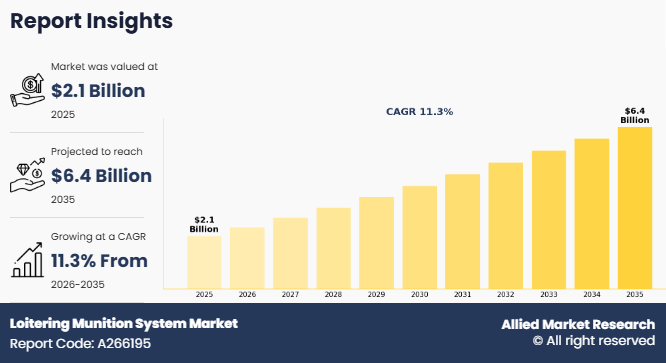
The global loitering munition system market was valued at $2.1 billion in 2025, and is projected to reach $6.4 billion by 2035, growing at a CAGR of 11.3% from 2026 to 2035. The loitering munition system refers to a category of unmanned aerial systems (UAS) designed to carry an explosive payload and remain airborne over a target area until a target is identified and engaged. These systems combine the persistence of UAV surveillance with the strike capability of precision munitions, enabling rapid target acquisition, reduced sensor-to-shooter timelines, and improved operational flexibility in dynamic battlefield environments.
Surging Demand for Loitering Munition System Industry in Forces of Special Operations is boosting the Market Growth
A loitering munition offers the enabling quick reaction upon target recognition, especially for targets that are in the firing line for a brief duration, such as an antiaircraft missile launcher or a moving command vehicle. Without exposing valuable people-operated platforms, such as attack helicopters and kamikaze drone technology, targets can be detected. These systems boost demand and accelerate market growth since they are utilized against the target without causing human casualties.
Homing ammunition is increasingly employed for purposes apart from SEAD missions. As direct sustenance carried "in the backpack" by light infantry and special operations forces (SOF) troops, ammunition is being loitered. The autonomous rocket's presence will remain above Earth for a while in order to locate a target and launch an attack in response to suggestions from outside sources, including other unmanned platforms and soldiers from the Special Operations Force. Suicide drones and kamikaze drones are other names for this weapon.
For example, Israel's UVISION Company will supply Italy's Special Forces with Hero-30 Loitering Ammunition as part of its defense aims. According to the defense services, it is essential that weapons for self-defense be made available to Tier 1 Special Forces stationed in fighting areas in case they come across an enemy threat that poses a risk of harm.
Rise in Deployment of Antiballistic Missile and Drone Systems Could Hamper Market
Anti-drone technologies function as drone detection tools, tracking drone activity through passive surveillance and disrupting drone communication to neutralize the threat. These devices detect approaching drones fast and offer useful information to defend against them. As a result, the growing use of these systems is impeding market growth.
Surface-to-air antiballistic missiles are made to thwart missile defense systems. Growth in the market is hindered by using this technique to intercept and eliminate missile threats. For instance, in October 2023, the U.S. deployed an antiballistic missile defense system and several Patriot missile battalions to the Middle East. In addition, the Taiwan Ministry of Defense approved an allocation of $146 million in 2022 to purchase the defensive systems, which were to be deployed in 45 military bases across the island until 2026.
The wide-ranging operational capabilities of Kamikaze Drones for various units and forces driving the market demand.
Precision munitions systems are essential for current warfare because they can manage or recall ammunition in the event of a final strike, as well as detect and intercept threats that are important enough. These needs can increase the demand for loitering ammunition, stimulating growth in the loitering munition system market demand. Modern warfare depends heavily on loitering munition, which offers maximum tactical flexibility. This system provides the armed forces with an extremely precise munition system, along with the capacity to fire autonomously and high-caliber intelligence, surveillance, and reconnaissance.
In April 2023, Elbit Systems Ltd. announced that it had been awarded a $150 million contract to supply an international customer with PULSTM (Precise and Universal Launching Systems) rocket launchers and a bundle of precision-guided long-range rockets. The deal was to be completed over a three-year timeframe. The PULS from Elbit Systems was a complete and cost-efficient solution that could launch unguided rockets, precision-guided munitions, and missiles with effective ranges of up to 300 kilometers.
In order to preserve their supremacy, the world's most powerful armies concentrate on obtaining cutting-edge weapons that can locate, capture, and follow a low-signature hostile target over a prolonged period of time without interference from other sources.
For instance, in September 2023, Rheinmetall and UVision launched a loitering munition called the HERO series. The HERO hovering munition hovers over the operational area, follows and identifies the enemy, investigates possible targets to assist in identifying the most crucial ones, ascertains the ideal assault angle and timing, and executes precise attacks in real time.
The several dimensions of land and marine pressures can be addressed by the HERO series, which offers customized operating solutions. HERO may be used for a wide range of missions and has demonstrated its effectiveness in leading combat units, including those of powerful NATO nations, through deployments.
The loitering munition system market is segmented into Operation Type, Platform, Type, Launch Mode and Range.On the basis of operation type, the market is bifurcated into autonomous loitering munition systems and manual loitering munition systems. On the basis of platform, the market is divided into land, air, and navy. On the basis of type, the market is bifurcated into recoverable and expendable. On the basis of launch mode, the market is bifurcated into air-launched effect, vertical take-off, catapult-launched, canister-launched, and hand-launched. By range, the market is divided into short, medium, and long.
Region-wise, the loitering munition system market trends are analyzed across North America (U.S., Canada, and Mexico), Europe (UK, Germany, France, Russia, Italy, Spain, and the rest of Europe), Asia-Pacific (China, India, Japan, Australia, South Korea, and the rest of Asia-Pacific), Latin America (Brazil, Argentina, and the rest of Latin America), and the Middle East and Africa (Saudi Arabia, UAE, Israel, Turkey, and the rest of the Middle East and Africa).
By Operation Type
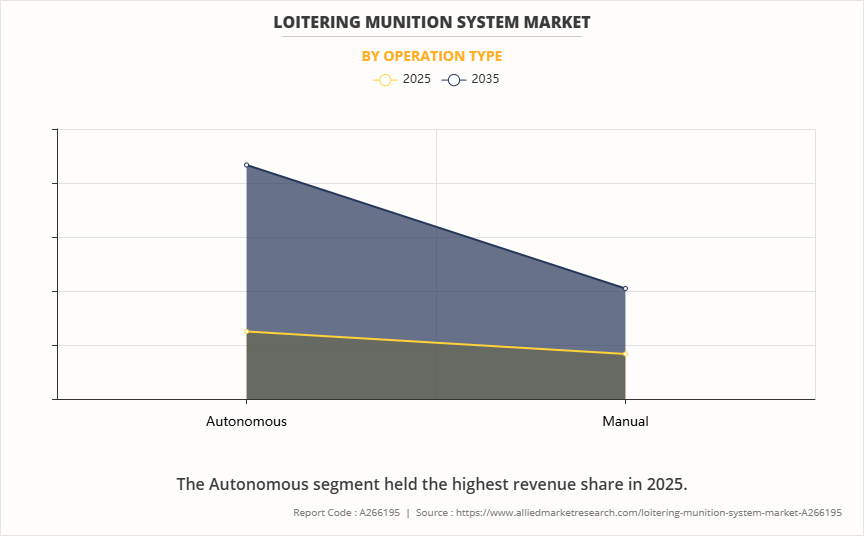
The loitering munition systems market is bifurcated into autonomous and manual systems based on operation type. Autonomous loitering munition systems dominate the market in 2025 due to the increasing demand for faster decision-making and higher mission efficiency in complex battlefield environments. Autonomous systems reduce operator workload by enabling automated navigation, target search, tracking, and engagement workflows, which improves effectiveness in time-sensitive missions. They are also better suited for electronic warfare (EW)-contested conditions where real-time human control can be disrupted. Modern militaries are increasingly prioritizing systems that can maintain operational continuity with minimal command input, especially for distributed operations and multi-target missions. Additionally, the integration of AI/ML-enabled target recognition further supports autonomous adoption by improving strike accuracy and reducing the probability of human error. As a result, autonomous systems are increasingly preferred in institutional procurement programs, thereby strengthening their market leadership.
By Platform
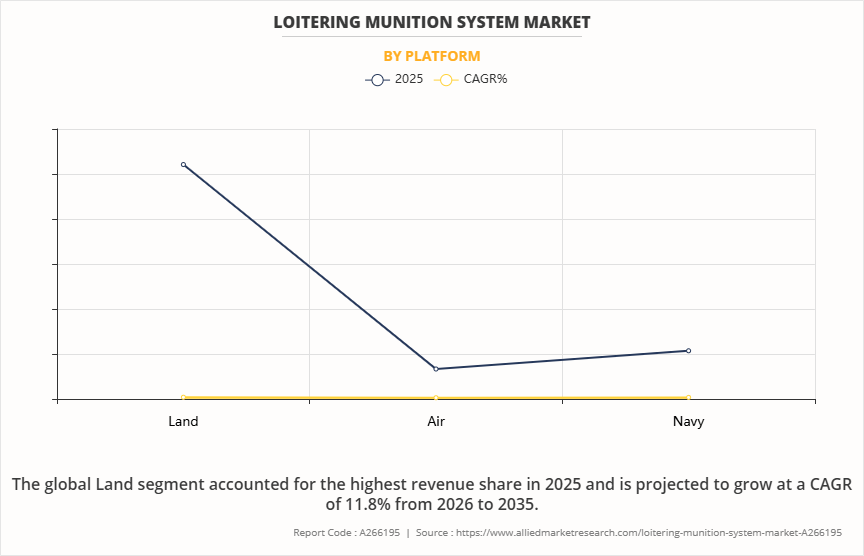
By platform, the market is categorized into land, air, and navy. Land-based loitering munition systems dominate the market in 2025, primarily because most loitering munition deployments today are aligned to land warfare requirements such as counter-battery operations, strike missions against armored vehicles, and rapid engagement of tactical targets. Land forces represent the largest end-user base due to the widespread adoption of loitering munitions as organic precision firepower at the infantry and brigade levels. Another key reason is the relatively simpler deployment and integration of land systems compared to naval or airborne platforms, which require additional compatibility with platform constraints and operational doctrine. In addition, land based loitering munition usage has been validated extensively in active conflict theaters, encouraging procurement scaling and replenishment-led demand. Overall, the high operational urgency, frequent usage cycles, and broad adoption across ground forces make land the leading platform segment.
By Type
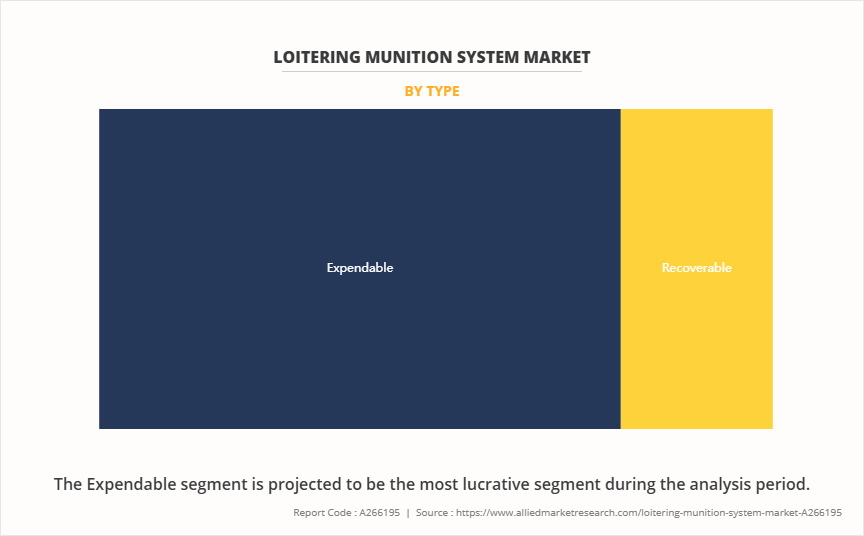
On the basis of type, the market is segmented into recoverable and expendable loitering munitions. Expendable systems dominate the market in 2025 because loitering munitions are inherently designed as a one-way strike capability where the munition destroys itself upon target impact. Expendable systems are procured similar to conventional ammunition—high volume, recurring replenishment, and mission-driven consumption, which aligns strongly with current procurement behavior in Europe and North America. In addition, expendable munitions offer a cost-effective alternative to missiles and enable armed forces to conduct repeated precision engagements without requiring retrieval, maintenance, and redeployment. Recoverable systems, although valuable for ISR and reuse, are less common in loitering munition programs and are typically procured in smaller quantities due to higher unit costs and operational constraints. Therefore, expendable loitering munitions remain the preferred and dominant category in 2025.
By Launch Mode
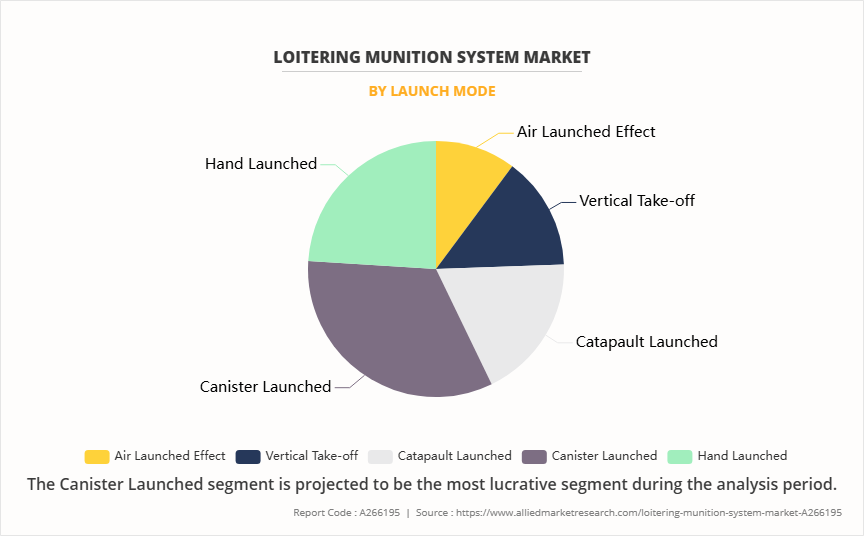
By launch mode, the market includes air-launched effect (ALE), vertical take-off (VTOL), catapult-launched, canister-launched, and hand-launched systems. Canister-launched loitering munition systems dominate the market in 2025 due to their operational flexibility, improved safety in storage and transport, and rapid deployment capability. Canister launch designs provide sealed protection for the munition, improving shelf life and reducing degradation risks, an important factor as loitering munitions shift toward stockpiling and replenishment cycles. Additionally, canister systems can be integrated across multiple deployment configurations such as ground vehicles, naval platforms, and fixed installations, making them attractive for multi-domain operational needs. Compared to hand-launched systems, canister-launched solutions are generally better suited for larger payloads, higher endurance, and more advanced guidance systems. They also support quicker launch preparation and faster response times in active tactical conditions. These operational and logistical advantages drive canister-launched dominance in 2025.
By Range
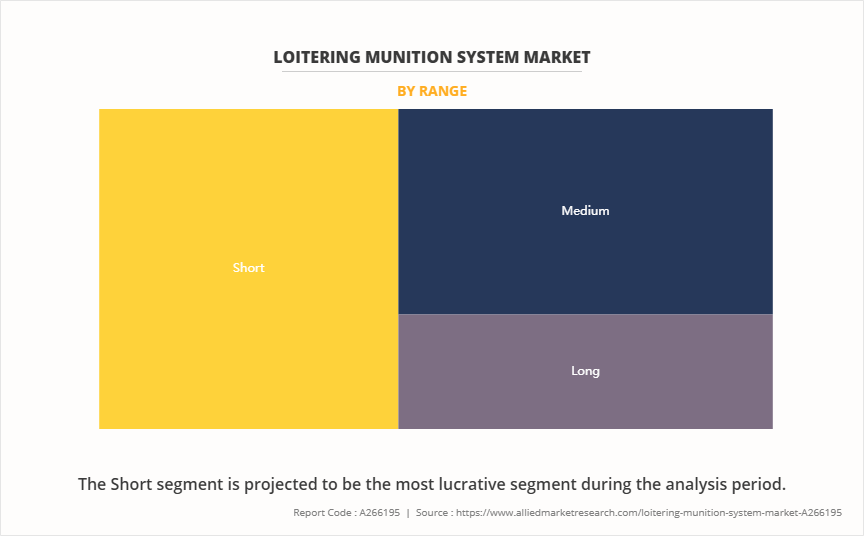
By range, the market is bifurcated into short-range, medium-range, and long-range loitering munitions. While all three segments are growing, demand dynamics are heavily influenced by tactical battlefield requirements. In 2025, the market is primarily driven by short- and medium-range systems, as they are most widely deployed for infantry-level precision strike, close tactical engagements, and rapid battlefield interdiction missions. These systems offer high adoption due to affordability, portability, and strong relevance for tactical units. Medium range systems are also gaining importance because they support extended tactical operations and offer flexibility for engaging targets beyond the immediate frontline. Long-range systems are typically procured in smaller volumes due to higher costs, stricter operational controls, and more specialized mission use cases such as deep strike and high-value target interdiction. As procurement is increasingly aligned with large-volume tactical consumption and replenishment, short- and medium-range categories together drive the majority of market demand in 2025.
By Region
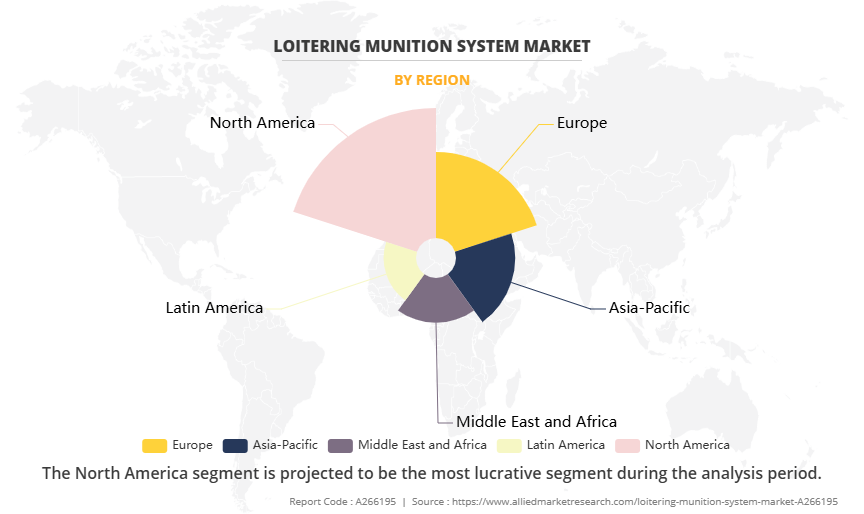
Region-wise, the loitering munition systems market trends are analyzed across North America, Europe, Asia Pacific, Latin America, Middle East and Africa. In 2025, the market is largely influenced by North America and Europe, driven by recurring procurement programs and increased defense modernization efforts. North America continues to lead due to structured defense acquisition, ongoing procurement cycles, and institutional adoption of tactical loitering munitions. Europe, on the other hand, is experiencing accelerated adoption due to heightened security requirements and readiness-driven stockpiling influenced by the Russia–Ukraine conflict. Asia-Pacific is also emerging as a high-growth region due to border security priorities and modernization efforts, while LAMEA demand is supported by defense localization agendas and growing procurement interest in cost effective precision strike capabilities.
Competitive Analysis
Competitive analysis and profiles of the major global loitering munition system market players that have been provided in the report include Rheinmetall AG, AeroVironment, Inc., WB Group, Israel Aerospace Industries Ltd., UVision Air Ltd., Elbit Systems Ltd., STM Savunma Teknolojileri, and ZALA Aero Group.
KEY BENEFITS FOR STAKEHOLDERS
- This study comprises analytical depiction of the global loitering munition system market size and Loitering Munition System Market Opportunities along with the current trends and future estimations to depict the imminent investment pockets.
- The overall global loitering munition system market analysis is determined to understand the profitable trends to gain a stronger foothold.
- The report presents information related to key drivers, restraints, and opportunities with a detailed impact analysis.
- The current global loitering munition system market forecast is quantitatively analyzed from 2026 to 2035 to benchmark the financial competency.
- Porters five forces analysis illustrates the potency of the buyers and suppliers in the loitering munition system.
- The report includes the market share of key vendors and the global loitering munition system market.
Loitering Munition System Market Report Highlights
| Aspects | Details |
 Market Size By 2035 | USD 6.4 billion |
 Growth Rate | CAGR of 11.3% |
 Forecast period | 2025 - 2035 |
 Report Pages | 412 |
 By Operation Type |
|
 By Platform |
|
 By Type |
|
 By Launch Mode |
|
 By Range |
|
 By Region |
|
 Key Market Players | Rheinmetall AG, Embenation, WB Group, ZALA, Elbit Systems Ltd., AeroVironment, Inc., Uvision, Thales, IAI, Paramount Group |
Analyst Review
The loitering munition system market is undergoing a significant phase of transformation, driven by evolving modern warfare doctrines, rising demand for precision strike capabilities, and rapid advancements in autonomous and network-centric combat technologies. Traditionally, the market was centered on relatively simple, short-range loitering munitions designed primarily for tactical surveillance and point-target engagement. However, the landscape has shifted as military forces increasingly demand extended endurance, enhanced target discrimination, multi-mission flexibility, and higher lethality with minimal collateral damage. This evolution is accelerating the adoption of advanced loitering munition platforms incorporating artificial intelligence–enabled target recognition, secure data links, multi-sensor payloads, and improved propulsion and guidance systems. Integration with battlefield management systems, ISR networks, and manned–unmanned teaming concepts is transforming loitering munitions from standalone assets into critical nodes within broader combat ecosystems. These developments are supported by rising defense investments, asymmetric warfare requirements, and growing procurement programs across NATO members, Asia-Pacific nations, and the Middle East.
The increasing emphasis on force modernization and operational efficiency continues to drive rapid expansion of the loitering munition system market. Heightened geopolitical tensions, border security challenges, and the proliferation of low-cost precision strike technologies have encouraged armed forces to prioritize loitering munitions as cost-effective alternatives to traditional missiles and air-delivered munitions. In high-threat environments, these systems provide commanders with persistent surveillance, rapid decision-making, and time-sensitive strike capabilities. They are particularly valuable in counterinsurgency operations, suppression of enemy air defenses, and urban warfare scenarios, where precision and adaptability are critical. Moreover, the growing focus on distributed lethality and expeditionary operations has expanded demand for portable, vehicle-mounted, and ship-launched loitering munitions capable of operating across land, sea, and littoral domains.
However, despite strong demand, the market faces technological, regulatory, and operational challenges that may constrain broader adoption. Advanced loitering munition systems rely on sophisticated components such as AI-driven autonomy software, secure communication links, advanced sensors, and high-performance warheads, all of which increase system complexity and procurement costs. Export controls, arms regulations, and ethical concerns surrounding autonomous lethal systems further complicate international sales and deployment approvals. Additionally, vulnerabilities related to electronic warfare, GPS jamming, and cyber intrusion pose operational risks, necessitating continuous investment in resilience, redundancy, and countermeasure technologies.
Despite these constraints, the loitering munition system market is positioned for sustained, innovation-driven growth as manufacturers and defense agencies prioritize modularity, autonomy, and digital integration. Industry players are increasingly focusing on scalable platforms, swarming capabilities, and multi-role payload architectures to enhance mission flexibility and cost efficiency. Advances in artificial intelligence, edge computing, and secure communications are enabling smarter, more resilient systems capable of operating in contested environments. As global defense strategies continue to emphasize precision, speed, and information dominance, the next phase of the loitering munition system market will be defined by intelligent autonomy, interoperable combat networks, and adaptable manufacturing approaches, reinforcing the sector’s role as a cornerstone of future battlefield capabilities.
Key trends include AI-enabled autonomy, swarming technology, electronic warfare resistance, modular payloads, extended endurance, and increased integration with network-centric and manned–unmanned combat systems.
Precision strike and ISR missions dominate the market, as loitering munitions provide real-time surveillance, rapid target engagement, and high accuracy with minimal collateral damage.
North America is the largest regional market, driven by high defense spending, advanced military modernization programs, and strong adoption of autonomous and precision-guided weapon systems.
The loitering munition system market was valued at $2,084.40 million in 2025 and is estimated to reach $6,379.60 million by 2035, exhibiting a CAGR of 11.3% from 2026 to 2035.
Key companies include Rheinmetall AG, AeroVironment, Inc., WB Group, Israel Aerospace Industries Ltd., UVision Air Ltd., Elbit Systems Ltd., STM Savunma Teknolojileri, and ZALA Aero Group.
Loading Table Of Content...
Loading Research Methodology...