
Medical Eye Sponge Market Research, 2033
The global medical eye sponge market size was valued at $154.1 million in 2023, and is projected to reach $285.6 million by 2033, growing at a CAGR of 6.3% from 2024 to 2033. The medical eye sponge market growth is driven by rise in prevalence of ophthalmic surgeries such as cataract and vitreoretinal procedures, increase in demand for precise surgical tools, and advancements in minimally invasive techniques. In addition, growing awareness of post-surgical care and infection control further propels medical eye sponge market growth.

Market Introduction and Definition
The growth of the medical eye sponge market is driven by the increasing prevalence of ophthalmic surgeries, including cataract and vitreoretinal procedures, as well as the rising demand for precise and reliable surgical tools. Advancements in minimally invasive surgical techniques have further boosted the adoption of medical eye sponges. Additionally, growing awareness of post-surgical care, infection prevention, and patient safety is contributing to market expansion, reinforcing the importance of these products in modern ophthalmic practice.
A medical eye sponge is a specialized absorbent device used during ophthalmic surgeries and procedures. Made from soft, biocompatible materials such as PVA (polyvinyl alcohol) or cellulose, these sponges minimize irritation and ensure gentle contact with delicate ocular tissues. They are designed to absorb excess fluids, including tears and blood, maintain a clear surgical field, and provide gentle pressure or support during procedures. Medical eye sponges are available in various shapes and sizes and are sterilized to reduce the risk of infection and are commonly used in cataract surgery, vitrectomy, and other ophthalmic interventions, which enhances both precision and patient safety.
Key Takeaways
- The medical eye sponge market study covers 20 countries. The research includes a segment analysis of each country in terms of value ($Million) for the projected period 2024-2033.
- More than 1, 500 product literatures, industry releases, annual reports, and other such documents of major medical eye sponge industry participants along with authentic industry journals, trade associations' releases, and government websites have been reviewed for generating high-value industry insights.
- The study integrated high-quality data, professional opinions and analysis, and critical independent perspectives. The research approach is intended to provide a balanced view of global markets and to assist stakeholders in making educated decisions in order to achieve their most ambitious growth objectives.
Key Market Dynamics
The medical eye sponge market is driven by the growing prevalence of ocular diseases, including glaucoma, cataracts, and retinal disorders, which require precise surgical interventions. According to the World Health Organization, approximately 2.2 billion people globally experienced vision impairment or blindness in 2023, fueling demand for advanced ophthalmic surgical tools, including eye sponges. The rising number of ophthalmic procedures, such as cataract surgeries—projected to reach 30 million globally by 2030—further supports market growth. Innovations in sponge materials, including biocompatible and highly absorbent polymers, enhance surgical efficiency and patient outcomes, driving product adoption.
However, market growth is constrained by the high cost of premium-grade sponges and limited awareness in developing regions, where access to ophthalmic care remains a challenge. Regulatory hurdles for new materials and stringent quality standards also pose challenges for manufacturers.
Emerging markets present significant opportunities, with countries like India and China experiencing rapid expansion of eye care facilities and procedures. The increasing adoption of minimally invasive surgeries and single-use disposable devices further boosts demand. Investments in R&D to develop sponges with higher absorption capacity and eco-friendly materials offer manufacturers a competitive edge by addressing performance and sustainability priorities.
Why Is Demand Increasing in This Market?
Demand for medical eye sponges is increasing due to the rising prevalence of ocular disorders, such as cataracts, glaucoma, and age-related macular degeneration, which require precise surgical interventions. The growing geriatric population, more prone to eye-related conditions, further drives the need for ophthalmic procedures and associated surgical tools. Technological advancements in sponge materials, including highly absorbent and biocompatible designs, enhance surgical efficiency and patient safety, encouraging adoption among healthcare providers.
Additionally, the expansion of specialty eye clinics, hospitals, and healthcare infrastructure, particularly in developed and emerging markets, supports increased usage. Growing awareness of infection control, post-surgical care, and minimally invasive techniques further fuels demand for disposable and advanced eye sponges. These factors combined are contributing to steady market growth, as surgeons and healthcare facilities prioritize precision, patient safety, and improved outcomes in ophthalmic surgeries.
Market Segmentation
The medical eye sponge industry is segmented into type, end user, and region. On the basis of type, the market is bifurcated into PVA type and cellulose type. By end user, the market is divided into hospitals & clinics, ambulatory surgical centers, and others. Region wise, the market is analyzed across North America, Europe, Asia-Pacific, and LAMEA.
Who Are the Primary End Users Driving Market Adoption?
The primary end users driving adoption of medical eye sponges are hospitals, specialty eye clinics, and ambulatory surgical centers performing ophthalmic procedures such as cataract surgery, vitrectomy, and glaucoma interventions. Surgeons and operating room staff rely on these sponges to maintain a clear surgical field, absorb fluids, and provide gentle tissue support, making them essential tools in eye care procedures.
Ophthalmologists and retinal specialists are key professional users who demand high-quality, biocompatible, and sterile sponges to ensure precision and minimize the risk of infection or complications. Additionally, the growing number of geriatric patients requiring ocular surgeries indirectly drives demand, as hospitals and clinics increase procurement to meet procedural needs.
Emerging end users in home-based or outpatient eye care settings are also beginning to adopt disposable, easy-to-use sponges as part of minimally invasive procedures, further expanding market reach and supporting long-term growth.
Regional/Country Market Outlook
North America has largest medical eye sponge market share and is driven by several factors. The increasing prevalence of ocular disorders such as cataracts, glaucoma, and age-related macular degeneration has significantly boosted the demand for eye surgeries, where medical eye sponges are extensively used for fluid absorption and maintaining a clear surgical field. The growing geriatric population, prone to eye-related issues, further accelerates medical eye sponge market growth.
Technological advancements in surgical procedures and sponge materials, such as the development of highly absorbent and biocompatible sponges, enhance their efficacy and usage. In addition, the rising awareness of advanced ophthalmic care and the expanding network of specialty eye clinics and hospitals across North America contribute to expansion during medical eye sponge market forecast. Favorable reimbursement policies and increasing investments in healthcare infrastructure also play a vital role in driving this market.
What Makes the U.S./Europe/Asia-Pacific a Key Market for Industry Players?
The U.S., Europe, and Asia-Pacific are key markets for medical eye sponges due to their growing demand for ophthalmic procedures, well-established healthcare infrastructure, and increasing investments in eye care. In the U.S., the high prevalence of ocular disorders such as cataracts, glaucoma, and age-related macular degeneration, coupled with a large geriatric population, drives substantial demand for surgical interventions. The presence of advanced hospitals, specialty eye clinics, and favorable reimbursement policies further supports the adoption of high-quality, disposable eye sponges.
Europe represents a significant market owing to well-developed public healthcare systems, mandatory surgical protocols, and high awareness of infection control and post-surgical care. Countries such as Germany, France, and the UK have advanced ophthalmic services and active R&D, fostering the adoption of innovative sponge materials and designs.
The Asia-Pacific region is emerging rapidly, driven by increasing healthcare infrastructure, rising healthcare expenditure, and expanding access to eye care services. High birth rates, a growing elderly population, and the rising prevalence of ocular disorders in countries like China and India create strong growth opportunities for manufacturers seeking to expand in these high-potential markets.
Industry Trends
- Innovations in medical devices, including eye sponges, are improving surgical precision and enhancing patient outcomes. Manufacturers are increasingly developing sponges with superior absorbency and biocompatible materials to meet the demands of modern ophthalmic procedures.
- At the same time, the global rise in the elderly population is contributing to a higher prevalence of age-related eye conditions, such as cataracts and glaucoma. This trend is driving greater demand for ophthalmic surgeries and the associated medical supplies, including advanced eye sponges, further supporting market growth.
How Will Emerging Trends Shape the Future of the Market?
Emerging trends are poised to significantly shape the future of the medical eye sponge market by driving innovation, expanding applications, and increasing adoption across healthcare settings. One major trend is the growing demand for minimally invasive ophthalmic surgeries, which requires smaller, highly precise, and sterile sponges. This trend is pushing manufacturers to develop sponges with enhanced absorbency and biocompatibility while ensuring ease of use during delicate procedures.
Another influential trend is the increasing focus on single-use, disposable medical devices to reduce infection risk and improve patient safety. Hospitals and specialty clinics are prioritizing disposable eye sponges over reusable alternatives, aligning with stringent infection control standards and regulatory requirements.
Technological advancements in materials science are also shaping the market, with research focused on eco-friendly and biodegradable sponge materials that combine high performance with sustainability. This addresses growing environmental concerns in healthcare and differentiates products in a competitive market.
Additionally, the expansion of emerging markets in Asia-Pacific, Latin America, and the Middle East is expected to drive growth, supported by rising healthcare expenditure, increased access to ophthalmic care, and growing awareness of advanced surgical tools.
Collectively, these trends such as minimally invasive procedures, disposable solutions, sustainable materials, and market expansion, are expected to define the future trajectory of the medical eye sponge market, fostering innovation, adoption, and long-term growth.
What Technological Innovations Are Creating New Growth Opportunities?
Technological innovations are creating new growth opportunities in the medical eye sponge market by enhancing surgical precision, efficiency, and patient safety. One of the key advancements is the development of highly absorbent and biocompatible materials, such as PVA (polyvinyl alcohol) and advanced cellulose-based polymers, which improve fluid absorption and reduce tissue irritation during ophthalmic procedures. These innovations allow surgeons to maintain a clear surgical field and minimize the risk of complications.
Additionally, the trend toward minimally invasive ophthalmic surgeries has increased the demand for smaller, more precise, and disposable eye sponges, which reduce infection risk and support faster patient recovery. Integration of sterilization and packaging technologies ensures single-use sponges are safe and convenient, aligning with strict infection control standards.
Furthermore, ongoing R&D in eco-friendly and sustainable sponge materials is opening new market opportunities, as healthcare providers increasingly prioritize both performance and environmental responsibility. Together, these innovations are driving adoption across hospitals and specialty clinics, expanding applications in cataract surgery, vitrectomy, and other ophthalmic interventions, and supporting long-term market growth.
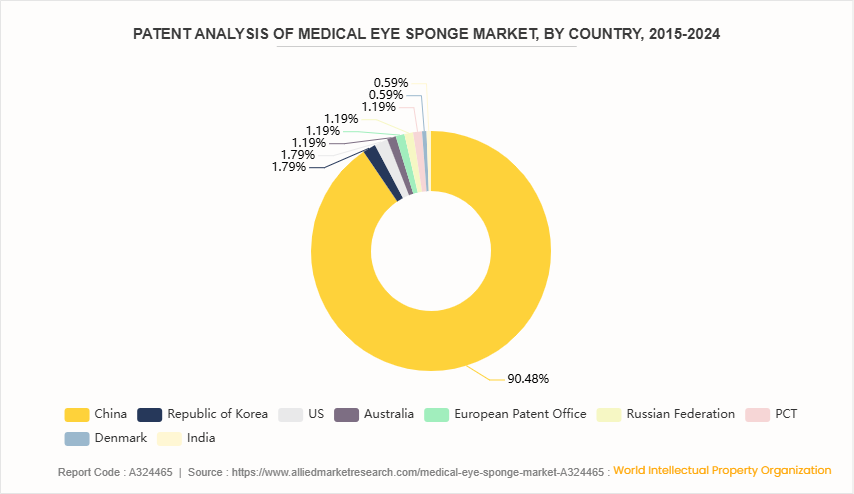
Patent Analysis, By Country, 2015-2024
China recorded the highest number of patent approvals and applications, driven by favorable government policies, technological advancements, and new product launches. In comparison, the Republic of Korea and the U.S. each account for approximately 1.8% of the total patents in this sector.
Competitive Landscape
The major medical eye sponge market share players operating in the medical eye sponge market include Alcon Inc., Bausch & Lomb Incorporated, Beaver-Visitec International (BVI) , Ambler Surgical, Katena Products, Inc., Surgistar, Inc., Asico LLC, Accutome (a Keeler brand) , FSSB Meyer-Haake GmbH, and Geuder AG. Other players in the medical eye sponge market include Sterimedix Ltd., Medtronic PLC, Rumex International Co., Duckworth & Kent Ltd., and Huaree Surgical.
How Intense Is Market Competition and What Defines Competitive Advantage?
The medical eye sponge market is moderately competitive, with key players differentiating themselves through product quality, innovation, and distribution networks. Competitive advantage is defined by factors such as material quality, absorbency, biocompatibility, and sterilization standards, which directly impact surgical precision and patient safety. Companies that offer innovative, disposable, and eco-friendly sponges gain an edge, particularly as hospitals and clinics prioritize infection control and sustainability.
Strong R&D capabilities and timely product launches allow manufacturers to meet evolving clinical needs and adopt minimally invasive surgical trends. Additionally, an extensive distribution network and reliable supply chains enhance market reach, especially in emerging regions. Regulatory compliance and approvals further strengthen a company’s credibility.
Overall, market players compete on technological innovation, quality, reliability, and alignment with global healthcare priorities, with these factors defining sustainable competitive advantage in the growing medical eye sponge market.
Key Sources Referred
- Centers for Disease Control and Prevention
- World Health Organization
- National Center for Biotechnology Information
- The Lancet
- National Perinatal Epidemiology and Statistics Unit (NPESU)
- Science Direct
- Health Resources and Services Administration (HRSA)
- Department of Health and Human Services (HHS)
- National Institutes of Health (NIH)
Key Benefits for Stakeholders
- This report provides a quantitative analysis of the medical eye sponge market segments, current trends, estimations, and dynamics of the medical eye sponge market analysis from 2023 to 2033 to identify the prevailing medical eye sponge market opportunity.?
- Market research is offered along with information related to key drivers, restraints, and opportunities.?
- Porter's five forces analysis highlights the potency of buyers and suppliers to enable stakeholders to make profit-oriented business decisions and strengthen their supplier-buyer network.?
- In-depth analysis of the medical eye sponge market segmentation assists to determine the prevailing market opportunities.?
- Major countries in each region are mapped according to their revenue contribution to the global medical eye sponge market Statistics.?
- Market player positioning facilitates benchmarking and provides a clear understanding of the present position of the market players.?
- The report includes the analysis of the regional as well as global medical eye sponge market trends, key players, market segments, application areas, and market growth strategies.?
Medical Eye Sponge Market Report Highlights
| Aspects | Details |
 Market Size By 2033 | USD 285.6 Million |
 Growth Rate | CAGR of 6.3% |
 Forecast period | 2024 - 2033 |
 Report Pages | 260 |
 By Type |
|
 By End User |
|
 By Region |
|
 Key Market Players | Alcon Inc., Ambler Surgical Company, LLC, Beaver-Visitec International (BVI), Bausch & Lomb Incorporated, Surgistar, Inc., FSSB Meyer-Haake GmbH, Geuder AG, Asico LLC, accutome, inc., katena products, inc. |
Alcon Inc., Bausch & Lomb Incorporated, Beaver-Visitec International (BVI) , Ambler Surgical, Katena Products, Inc., Surgistar, Inc., Asico LLC, Accutome (a Keeler brand) , FSSB Meyer-Haake GmbH, and Geuder AG are the top companies to hold the market share in Medical Eye Sponge.
The global medical eye sponge market was valued at $154.1 million in 2023, and is projected to reach $285.6 million by 2033, growing at a CAGR of 6.3% from 2024 to 2033.
The largest regional market for medical eye sponges is North America, driven by the high prevalence of ophthalmic surgeries, advanced healthcare infrastructure, and increased awareness about eye care. The region benefits from the significant presence of key market players and robust reimbursement policies.
The leading application of the Medical Eye Sponge Market is in ophthalmic surgeries, particularly cataract and vitreoretinal procedures. These sponges are essential for absorbing fluids and maintaining a clear surgical field, enhancing precision and safety during operations.
The global Medical Eye Sponge Market is witnessing growth driven by advancements in ophthalmic surgeries, such as cataract and vitreoretinal procedures. Key trends include the development of sponges with enhanced absorbency and biocompatibility, increasing preference for disposable sponges to reduce infection risks, and rising demand in ambulatory surgical centers. Additionally, the growing aging population and prevalence of eye disorders are boosting market expansion globally.
Loading Table Of Content...