
Newcastle Disease Vaccine Market Research, 2033
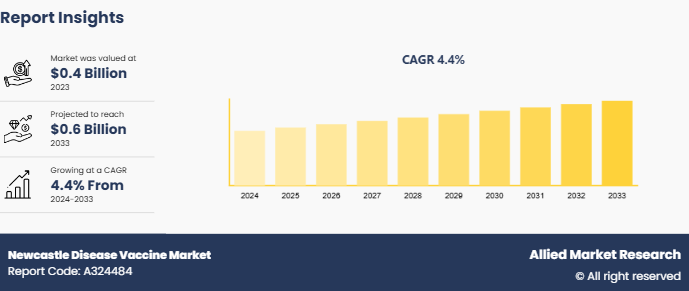
The global newcastle disease vaccine market size was valued at $0.4 billion in 2023, and is projected to reach $0.6 billion by 2033, growing at a CAGR of 4.4% from 2024 to 2033. The expanding poultry operations, especially in emerging economies, necessitate effective vaccination programs to ensure flock health and productivity and thereby newcastle disease vaccine market growth.
Market Introduction and Definition
Newcastle disease is a highly contagious viral infection that affects both domestic and wild birds. It is caused by the Newcastle disease virus (NDV) and can result in severe respiratory, gastrointestinal, and neurological symptoms. The disease poses a major threat to the poultry industry worldwide, thereby leading to substantial economic losses.
Transmission occurs rapidly through direct contact with infected birds, as well as through their droppings, and contaminated feed, water, or equipment. Because of its rapid spread and potentially high mortality rate, effective prevention is essential.
Vaccination plays a critical role in controlling Newcastle disease and protecting poultry health. Newcastle disease vaccines stimulate the immune system to develop protection against NDV, thereby reducing disease severity, limiting spread, and decreasing mortality. These vaccines are available in live attenuated, inactivated, and vector-based forms. Depending on the type of poultry, age, and production system, they may be administered by injection, through drinking water, or by aerosol spray. Vaccination remains a cornerstone of global strategies for preventing and managing Newcastle disease outbreaks
Key Takeaways
- The Newcastle Disease Vaccine Market Sharee study covers 20 countries. The research includes a segment analysis of each country in terms of value ($Billion) for the projected Newcastle Disease Vaccine Market forecast period 2024-2033.
- More than 1, 500 vaccine type literatures, industry releases, annual reports, and other such documents of major Newcastle disease vaccine industry participants along with authentic industry journals, trade associations' releases, and government websites have been reviewed for generating high-value industry insights.
- The study integrated high-quality data, professional opinions and analysis, and critical independent perspectives. The research approach is intended to provide a balanced view of global markets and to assist stakeholders in making educated decisions in order to achieve their most ambitious growth objectives.
Key Market Dynamics
Drivers
The growth of the Newcastle disease vaccine market is driven by several key factors that shape both its expansion and associated challenges. A major driver is the increasing incidence of disease outbreaks, which pose a serious threat to poultry health and the broader poultry industry. As Newcastle disease is highly contagious and often fatal in birds, outbreaks can result in substantial economic losses for farmers and commercial producers.
Consequently, there is a growing emphasis on preventive strategies, particularly the widespread adoption of vaccination programs. This demand is further reinforced by the expansion of poultry farming operations worldwide, aimed at meeting the rising global demand for poultry meat and eggs.
Restraints
However, the market faces notable challenges, particularly the issue of thermostability associated with Newcastle disease vaccines. Most available vaccines require strict cold chain storage and transportation, which can be difficult to maintain in regions with limited infrastructure or extreme climatic conditions. Failure to preserve these conditions increases the risk of vaccine degradation, thereby reducing efficacy and undermining immunization efforts.
To address this constraint, the development of thermostable vaccines has become a key area of focus. Improving vaccine stability would enhance accessibility, reduce logistical burdens, and support broader immunization coverage, especially in resource-limited settings
Opportunities
Moreover, the growing emphasis on export-oriented poultry production is significantly influencing vaccine demand. Countries with well-established poultry export industries prioritize stringent disease control measures to comply with international trade standards. As global markets enforce strict regulations concerning poultry health and safety, producers are increasingly adopting effective vaccination strategies.
Export-driven markets place strong emphasis on comprehensive immunization programs to maintain disease-free flocks and safeguard their trade reputation. This focus on biosecurity and regulatory compliance continues to provide opportunities for the Newcastle disease vaccines market.
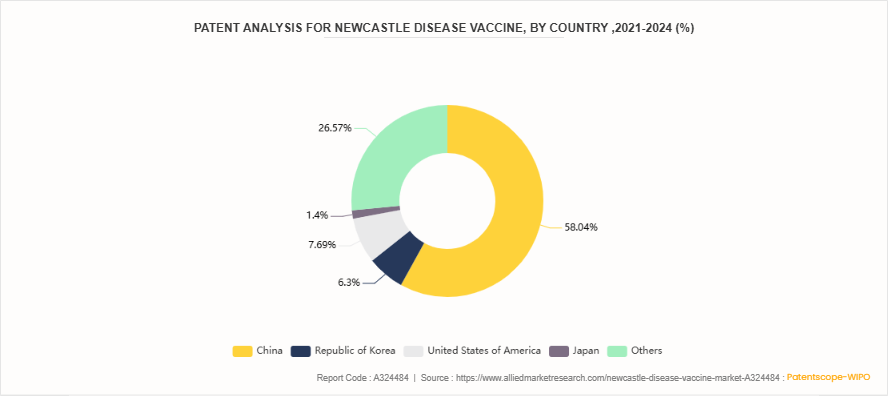
Patent analysis for Newcastle disease vaccine, by country, 2021-2024 (%)
Between 2021 and 2024, patent analysis for Newcastle disease vaccines indicated China’s dominant position, accounting for 58.04% of total filings. This substantial share reflects China’s strong investment in poultry health research and development, as well as the scale and modernization of its poultry farming sector.
The U.S. represents 7.69% of patent filings, highlighting continued innovation in vaccine technologies to support disease-free poultry production for both domestic markets and exports. The Republic of Korea follows with 6.29%, demonstrating a focus on advanced vaccine formulations and biotechnology development. Japan accounts for 1.40%, emphasizing precision research and specialized vaccine technologies despite its relatively smaller poultry industry. Other countries collectively contribute 26.57%, illustrating broad global engagement in vaccine innovation.
Overall, this patent distribution underscores regional priorities in disease control, technological advancement, and export-oriented poultry production.
Market Segmentation
The Newcastle disease vaccine industry is segmented into vaccine type, route of administration, end user, and region. On the basis of the vaccine type, the market is categorized into live vaccines, inactivated vaccines, and vectored recombinant vaccines. As per route of administration, the market is segmented into drinking water method, spray method, and others. On the basis of end user, the market is divided into poultry farms, veterinary clinics, and research institutes. Region wise, it is analyzed across North America, Europe, Asia-Pacific, and LAMEA.
Regional/Country Market Outlook
The Newcastle disease vaccine market demonstrates notable regional variation, influenced by poultry industry dynamics, disease prevalence, regulatory frameworks, and vaccination policies.
In North America, the market is supported by stringent biosecurity standards and the adoption of advanced vaccine technologies, with the United States leading due to its large-scale and highly integrated poultry industry. Europe is experiencing steady growth, driven by heightened attention to animal health, regulatory compliance, and sustainable farming practices.
The Asia-Pacific region, particularly countries such as China and India, is witnessing strong market expansion due to high poultry production volumes, frequent disease outbreaks, and government-supported immunization programs. Meanwhile, Latin America and Africa face challenges including limited vaccine access and infrastructure constraints. However, increasing poultry consumption, expanding commercial farming, and growing awareness of disease prevention are contributing to market growth in these regions.
Overall, region-specific strategies and investments play a crucial role in strengthening global efforts to control and prevent Newcastle disease.
Which Segment Holds the Largest Market Share and Why?
The live vaccine segment holds the largest market share in the Newcastle disease vaccine market. Its dominance is primarily due to strong immunogenicity, cost-effectiveness, and widespread suitability for mass vaccination programs. Live vaccines stimulate robust and long-lasting immune responses, making them highly effective in controlling outbreaks across both commercial and backyard poultry farms.
Another key advantage is their ease of administration. These vaccines can be delivered through drinking water or aerosol spray, enabling rapid immunization of large flocks with minimal labor and stress on birds. This is particularly beneficial in large-scale poultry operations where efficiency and speed are critical.
In addition, live vaccines are generally more affordable than inactivated or recombinant alternatives, making them highly attractive in price-sensitive and developing markets. Their established safety record and long history of use further contribute to strong farmer confidence and continued market leadership.
What Makes the U.S./Europe/Asia-Pacific a Key Market for Industry Players?
The United States, Europe, and Asia-Pacific represent key markets for Newcastle disease vaccine industry players due to their distinct but complementary growth drivers.
In the United States, a highly industrialized and vertically integrated poultry sector creates consistent demand for advanced vaccination programs. Strict biosecurity regulations, strong veterinary infrastructure, and export-oriented production further reinforce the need for reliable and innovative vaccines. Companies benefit from well-established distribution networks, high adoption of new technologies, and strong investment in research and development.
Europe remains a strategic market due to stringent animal health regulations and rigorous food safety standards. Compliance with regional frameworks and sustainability goals encourages the use of high-quality, effective vaccines. In addition, growing consumer awareness regarding animal welfare and disease control supports preventive healthcare measures, creating steady demand for vaccination solutions.
Asia-Pacific is witnessing high growth driven by large poultry populations, rising protein consumption, and frequent disease outbreaks. Countries such as China and India are expanding commercial poultry operations while governments implement large-scale immunization programs to protect food security. Rapid urbanization and increasing exports further strengthen the need for comprehensive disease management.
Thus, the U.S. Europe, and Asia-Pacific together offer scale, regulatory support, technological advancement, and long-term growth opportunities for vaccine manufacturers
Competitive Landscape
The major players operating in the Newcastle Disease Vaccine Market size include Zoetis, Merck & Co., Inc, CEVA Animal Health, Boehringer Ingelheim, Eli Lilly and Company, Hester Biosciences, Komipharm International, V H Group, Tianjin Ringpu Bio-technology Co., Ltd., and Indian Immunologicals Limited.
What Technological Innovations Are Creating New Growth Opportunities?
Technological innovation is playing a pivotal role in creating new growth opportunities in the Newcastle disease vaccine market. One of the most significant advancements is the development of thermostable vaccines, which reduce dependence on cold chain logistics. These formulations improve vaccine accessibility in regions with limited infrastructure and extreme climatic conditions, expanding market penetration in emerging economies.
Vector-based and recombinant vaccine technologies are also transforming the landscape. These next-generation vaccines offer improved safety profiles, stronger immune responses, and the potential for multivalent protection against multiple poultry diseases in a single dose. This reduces handling stress on birds, lowers labor costs, and increases overall farm efficiency.
Advances in molecular biology and genomic sequencing have enhanced strain identification and surveillance, enabling the development of more targeted and effective vaccines. In addition, improvements in delivery systems—such as aerosol spray and mass vaccination via drinking water—support large-scale immunization with minimal operational disruption.
Digital monitoring tools and data-driven disease surveillance systems further strengthen preventive strategies by enabling early outbreak detection and optimized vaccination schedules. Together, these innovations enhance efficacy, reduce costs, and unlock new commercial opportunities across both developed and emerging poultry markets.
How Intense Is Market Competition and What Defines Competitive Advantage?
Market competition in the Newcastle disease vaccine sector is moderately to highly intense, driven by the presence of multinational animal health companies, regional manufacturers, and emerging biotechnology firms. Established players compete on product quality, brand reputation, distribution reach, and technological innovation, while regional companies often compete on pricing and localized supply capabilities.
Competitive advantage is primarily defined by strong research and development capabilities, enabling companies to produce highly efficacious, safe, and innovative vaccine formulations, including thermostable and vector-based vaccines. Advanced manufacturing infrastructure and robust quality control systems further strengthen market positioning, particularly in regions with strict regulatory standards.
Extensive distribution networks and strategic partnerships with poultry integrators, veterinary service providers, and government agencies also play a critical role. In many markets, participation in public immunization programs and compliance with international trade standards enhance credibility and long-term contracts.
Cost efficiency is another key differentiator, especially in price-sensitive regions. Companies that balance affordability with performance gain wider adoption. Ultimately, sustained innovation, regulatory compliance, supply reliability, and strong customer relationships define long-term competitive success in this market.
How Will Emerging Trends Shape the Future of the Market?
Emerging trends are poised to significantly shape the future of the Newcastle disease vaccine market by driving innovation, expanding accessibility, and enhancing disease management strategies. One major trend is the increasing focus on thermostable vaccines, which allow broader distribution in regions with limited cold chain infrastructure. This will enable greater vaccination coverage in developing countries, reducing disease outbreaks and associated economic losses.
Another important trend is the adoption of next-generation vaccine technologies, including vector-based, recombinant, and multivalent formulations. These vaccines provide stronger, longer-lasting immunity and can protect against multiple poultry diseases simultaneously, improving operational efficiency for large-scale farms. Advances in molecular biology and genomic surveillance are also enabling more precise strain targeting, ensuring vaccines remain effective against evolving NDV variants.
Digital tools, such as data-driven disease monitoring and smart vaccination scheduling, are improving outbreak prediction and preventive strategies, allowing farmers to optimize immunization efforts. In addition, rising consumer awareness of food safety, animal welfare, and sustainable poultry production will drive demand for reliable and safe vaccination programs.
Collectively, these trends point to a more technologically advanced, accessible, and preventive-focused market, with growth opportunities in both developed and emerging regions.
Key Sources Referred
- World Health Organization (WHO)
- Indian Council of Agricultural Research (ICAR)
- National Health Service (NHS)
- Australian Department of Agriculture, Fisheries and Forestry
- Centers for Disease Control and Prevention (CDC)
- Food and Drug Administration (FDA)
- National Institutes of Health (NIH)
- International Poultry Council (IPC)
- Australian Government Department of Health
- United States Department of Agriculture (USDA)
Key Benefits for Stakeholders
- This report provides a quantitative analysis of the market segments, current trends, estimations, and dynamics of the Newcastle disease vaccine market analysis from 2024 to 2033 to identify the prevailing Newcastle Disease Vaccine Market opportunity.
- The market research is offered along with information related to key drivers, restraints, and opportunities.
- Porter's five forces analysis highlights the potency of buyers and suppliers to enable stakeholders make profit-oriented business decisions and strengthen their supplier-buyer network.
- In-depth analysis of the Newcastle disease vaccine market? segmentation assists to determine the prevailing market opportunities.
- Major countries in each region are mapped according to their revenue contribution to the global market.
- Market player positioning facilitates benchmarking and provides a clear understanding of the present position of the market players.
- The report includes the analysis of the regional as well as global Newcastle disease vaccine market trends, key players, market segments, application areas, and market growth strategies.
Newcastle Disease Vaccine Market , by Vaccine Type Report Highlights
| Aspects | Details |
 Market Size By 2033 | USD 0.6 Billion |
 Growth Rate | CAGR of 4.4% |
 Forecast period | 2024 - 2033 |
 Report Pages | 216 |
 By Vaccine Type |
|
 By Route Of Administration |
|
 By End User |
|
 By Region |
|
 Key Market Players | Boehringer Ingelheim International GmbH, Eli Lilly and Company., Merck & Co., Inc., V H Group, CEVA Animal Health, Tianjin Ringpu Bio-technology Co.,Ltd., Indian Immunologicals Limited, Komipharm International, Hester Biosciences Ltd, zoetis |
The total market value of Newcastle Disease Vaccine Market was $ 0.4 billion in 2023.
The market value of Newcastle Disease Vaccine Market is projected to reach $ 0.6 billion by 2033.
The forecast period for Newcastle Disease Vaccine Market is 2024 to 2033
The base year is 2023 in Newcastle Disease Vaccine Market.
Newcastle Disease is a highly contagious viral infection affecting domestic and wild birds, caused by the Newcastle Disease Virus (NDV). It can lead to severe respiratory, gastrointestinal, and neurological symptoms, with significant economic losses in poultry industries worldwide. The disease spreads rapidly through infected birds, their droppings, or contaminated feed and equipment.
Loading Table Of Content...