
Property Management Software Market Overview
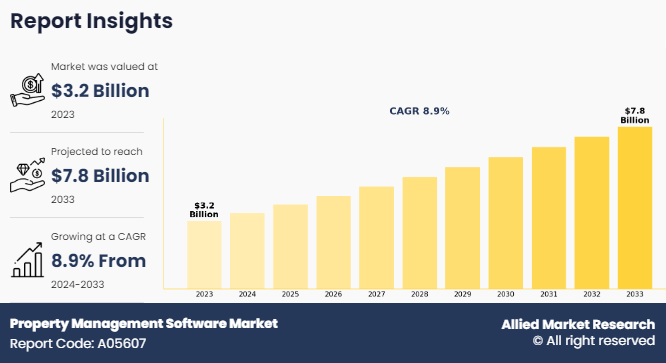
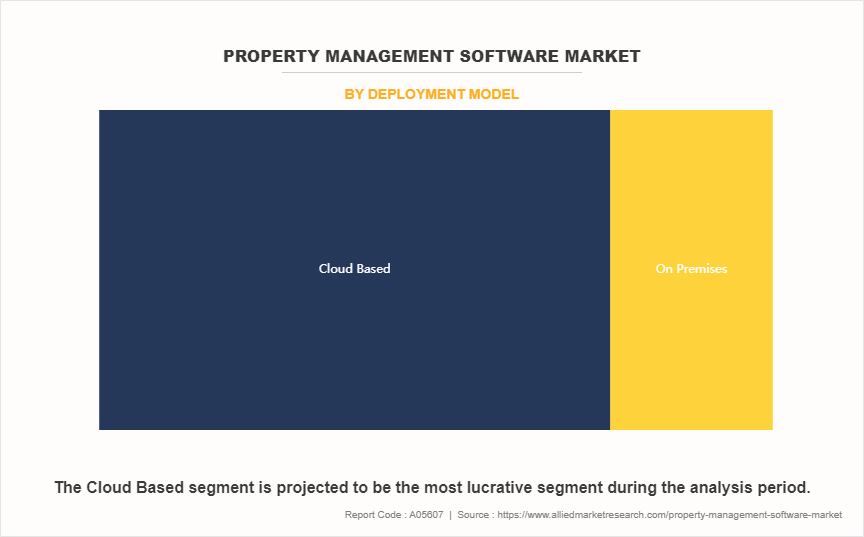
The global property management software market size was valued at USD 3.2 billion in 2023 and is projected to reach USD 7.8 billion by 2033, growing at a CAGR of 8.9% from 2024 to 2033. The adoption of artificial intelligence (AI) and machine learning, which enhance predictive maintenance, automate tenant screening, and improve customer service through chatbots is a major trend in the property management software market. Cloud-based property management solutions are also on the rise, offering greater flexibility, scalability, and remote access, which is especially important for property managers overseeing multiple properties in different locations.
Key Market Trends & Insights
- By solution, the marketing and advertising segment held the largest share in the property management software market share in 2023.
- By deployment model, the cloud held the largest share in the market for 2023.
- By property type, the residential segment is expected to show the fastest property management software market growth during the forecast period.
- Region-wise, North America held the largest property management software market share in 2023.
Market Size & Forecast
- 2033 Projected Market Size: USD 7.8 Billion
- 2023 Market Size: USD 3.2 Billion
- Compound Annual Growth Rate (CAGR) (2024-2033): 8.9%
- Asia-Pacific: Expected to witness highest CAGR during forecast period.
How to Describe Property Management Software
Property management software is a comprehensive tool that aids property managers, landlords, and real estate professionals in efficiently managing rental properties. It offers a wide range of functionalities, such as tenant management, which includes features for tenant screening, background checks, and credit reports. Lease tracking capabilities allow users to monitor lease agreements, renewal dates, and rent increases automatically. The software also typically includes financial management tools for handling rent collection, accounting, and financial reporting. Additionally, maintenance management features help track and manage repair requests and schedule regular property maintenance. Communication tools facilitate streamlined interaction with tenants, and reporting and analytics features provide insights into property performance and financial health.
In addition, the property management software market is expected to witness notable growth owing to adoption of cloud computing solutions and software-as-a-service (SaaS) platform, increase in development of smart real estate infrastructure and growth in dependency on one platform approach. Moreover, a rise in consumer demand for sustainable living and working space is expected to provide lucrative opportunity for the growth of the market during the forecast period. On the contrary, lack of awareness regarding optimal software solutions limits the growth of the market.
Key Takeaways
The property management software market share study covers 20 countries. The research includes a segment analysis of each country in terms of value for the projected period.
More than 1, 500 product literatures, industry releases, annual reports, and other such documents of major property management software industry participants along with authentic industry journals, trade associations' releases, and government websites have been reviewed for generating high-value industry insights.
The study integrated high-quality data, professional opinions and analysis, and critical independent perspectives. The research approach is intended to provide a balanced view of global markets and to assist stakeholders in making educated decisions in order to achieve their most ambitious growth objectives.
Property Management Software Market Segment Review
The property management software market is segmented into solution, deployment model, property type, and region. By solution, the market is divided into rental and tenant management, property sale and purchase solution, accounting and cash flow management software, marketing and advertising, legal and insurance consultancy, and others. By deployment model, it is divided into on-premise and Cloud-based property management software. By property type, it is segmented into residential, commercial, industrial and special purpose. Region wise, the property management software market trends are analyzed across North America (U.S. and Canada), Europe (UK, Germany, France, Italy, Spain, and rest of Europe), Asia-Pacific (China, Japan, India, Australia, South Korea, and rest of Asia-Pacific), and LAMEA (Latin America, the Middle East, and Africa).
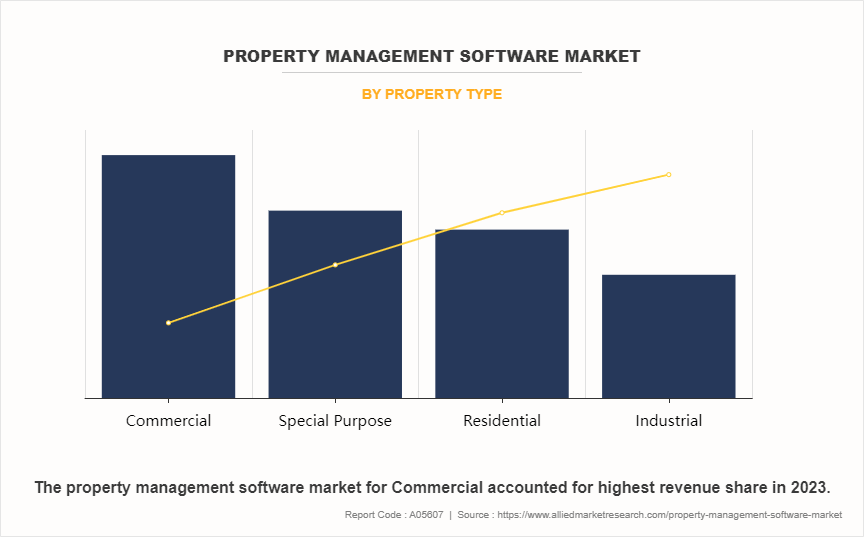
On the basis of property type, the commercial dominated the property management software market size in 2022, owing to the rise in demand for integrated solutions that cater to the unique needs of commercial property managers and tenants. This includes features such as lease management tools, tenant tracking functionalities, and financial reporting capabilities tailored specifically for commercial properties. However, residential are expected to witness the fastest growth, owing to the increasing demand for tenant-centric features and functionalities that enhance the residential tenant experience. This includes self-service portals for online rent payments, maintenance requests, and lease renewals, as well as communication tools such as messaging and notifications to facilitate seamless interactions between property managers and tenants.
Regional Outlook
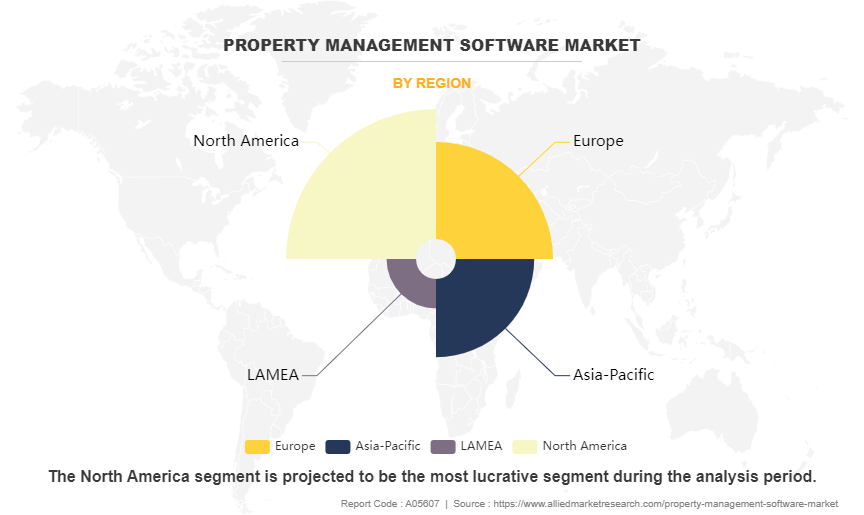
Region wise, North America dominated the property management software market in 2023 and is projected to maintain its leadership throughout the forecast period owing to rise in adoption of cloud-based solutions, fueled by demand for flexibility, scalability, and remote accessibility. Property managers are increasingly leveraging cloud platforms to streamline operations, enhance collaboration, and improve tenant satisfaction. This trend was significantly amplified by the COVID-19 pandemic, which accelerated the transition to remote work and digital transformation.
The region is also witnessing rapid integration of advanced technologies such as artificial intelligence (AI) and machine learning (ML) into property management software. These innovations enable predictive analytics, automated workflows, and personalized tenant experiences, empowering property managers to make data-driven decisions, optimize processes, and deliver superior services. The result is enhanced operational efficiency and measurable revenue growth.
Meanwhile, the Asia-Pacific region is expected to witness substantial growth during the forecast period, driven by increased digital penetration and rapid urbanization. These factors have spurred widespread adoption of SaaS-based property management platforms across diverse sectors, including educational facilities, industrial complexes, retail establishments, and IT hubs. Furthermore, software providers are emphasizing localization and customization. Thus, features and functionalities are developed as per the unique requirements and preferences of property managers and landlords in local markets across the region.
Moreover, the integration of advanced technologies such as artificial intelligence (AI) and machine learning (ML) into property management software, enabling predictive analytics, automated workflows, and personalized tenant experiences. These AI-powered features empower property managers to make data-driven decisions, optimize processes, and deliver enhanced services to tenants, ultimately driving operational efficiency and revenue growth. On the other hand, the Asia-Pacific region is anticipated to experience significant growth in the property management software market during the forecast period, owing to increased digital penetration and rapid urbanization in this region has led to rise adoption of SaaS platforms across various industries such as educational facilities, industrial units, retail supermarkets and IT hubs. Additionally, there is a growing emphasis on localization and customization in property management software for the Asia-Pacific market, with providers offering features and functionalities tailored to the specific requirements and preferences of local property managers and landlords.
Why is Demand for Property Management Software Increasing?
Demand for property management is increasing due to rapid urbanization, rising real estate investments, and the growing complexity of managing residential, commercial, and mixed-use properties. Property owners are seeking professional services to handle tenant management, maintenance, rent collection, legal compliance, and financial reporting efficiently. The expansion of rental housing, co-living spaces, and commercial properties has further boosted demand. Additionally, the adoption of digital tools, smart buildings, and data-driven decision-making has made professional property management more valuable. Investors, especially absentee and institutional owners, prefer outsourcing management to improve operational efficiency, reduce risks, and enhance tenant satisfaction while maximizing long-term returns.
AI in Property Management Software Market
Artificial intelligence (AI) is increasingly transforming property management software by improving operational efficiency, decision-making, and tenant experience. One of the most significant applications of AI is automation of routine tasks, such as rent collection reminders, lease renewals, maintenance scheduling, and document management, thereby reducing manual workload and human error.
AI-powered predictive maintenance analyzes historical data, sensor inputs, and usage patterns to identify potential equipment failures before they occur. This helps property managers reduce downtime, control maintenance costs, and extend the lifespan of building assets. In addition, AI enhances tenant engagement through chatbots and virtual assistants that handle inquiries, maintenance requests, and round the clock support services.
Another important use of AI is data analytics and forecasting. AI algorithms process large volumes of property and market data to forecast rental demand, optimize pricing, assess vacancy risks, and improve investment decisions. This enables property owners to maximize occupancy rates and revenue.
AI also strengthens security and compliance by detecting unusual activity, monitoring access systems, and ensuring adherence to regulatory requirements. Overall, the integration of AI into property management software is driving smarter operations, cost optimization, and enhanced user satisfaction, making it a key growth factor in the property management software market.
Who Are the Primary End Users Driving Market Adoption?
The primary end users driving market adoption are residential and commercial property owners, property management companies, and real estate investors. Large property management firms and institutional investors are leading adopters due to their need to manage extensive portfolios efficiently. Commercial real estate operators, including office, retail, and industrial property managers, also rely heavily on advanced solutions for lease administration, maintenance, and compliance. Additionally, housing associations, co-living operators, and short-term rental managers are increasingly adopting digital tools. Small and mid-sized landlords are contributing to growth as cloud-based platforms make property management software more affordable and accessible.
Top Impacting Factors
Adoption of cloud computing solutions and software-as-a-service (SaaS) platform
The adoption of cloud computing and Software-as-a-Service (SaaS) platforms represents a pivotal driver in the transformation of property management software. Cloud-based solutions deliver exceptional flexibility, enabling property managers to access and oversee operations from any location with internet connectivity. This remote accessibility proves especially advantageous for organizations managing diverse property portfolios across multiple geographic areas.
SaaS platforms eliminate the necessity for expensive on-premises infrastructure while significantly reducing the operational burden associated with software maintenance and updates, as these responsibilities are handled by the service provider. This approach not only minimizes upfront capital expenditure but also ensures users maintain continuous access to the latest features, functionality improvements, and security enhancements.
Moreover, cloud computing enables real-time data synchronization and collaboration, facilitating seamless communication among property managers, tenants, maintenance teams, and service providers. The inherent scalability of SaaS solutions allows businesses to expand organically, accommodating growing property portfolios and user bases without requiring substantial additional investment in infrastructure or technology.
Additionally, cloud-based platforms offer robust integration capabilities, allowing smooth connectivity with other critical business systems such as accounting software, customer relationship management (CRM) tools, and financial reporting platforms. This interoperability creates a unified and efficient management ecosystem that streamlines workflows, reduces data silos, and enhances overall operational effectiveness.
Increase in development of smart real estate infrastructure
Development of smart building optimizes operational performance through wireless connectivity, integrated information systems, and cloud-based real-time communication networks. By adopting property management software, building operators can deploy intelligent sensing and monitoring systems that minimize human error and proactively address operational issues. Through connected property management solutions, managers can establish cost-effective wireless zones while simultaneously enhancing tenant satisfaction and building efficiency.
Consequently, as nations including the U.S., the UK, Japan, Germany, China, and India prioritize smart city initiatives, there has been a notable surge in investment toward green and intelligent building infrastructure, thereby driving the demand for advanced property management solutions. For instance, in India, the Gujarat state government is actively developing Smart City Ahmedabad Development Limited (SCADL) as part of its urban transformation agenda. Through the implementation of smart technologies in residential developments—including sensor-based monitoring systems, property management software (PMS), and asset tracking and management solutions—the Ministry of Housing and Urban Affairs is pioneering smart infrastructure development at the local level.
The convergence of smart building technology and urban digitalization creates lucrative opportunities for integrated management platforms and drives the growth of the real estate management solution market.
Which are the Leading Companies in Property Management Software
IQware Inc.
Microsoft Corporation
Oracle Corporation
PropertyMe Pty. Ltd.
REI Master Pty. Ltd.
AppFolio, Inc.
Yardi Systems, Inc.
Entrata, Inc.
Alibaba Group Holding
Console Australia Pty. Ltd.
Recent Developments and Strategies by Key Players
On June 2022, Reapit, backed by Accel-KKR, acquired Console Group Pty Ltd., a leading provider of Property Management and Trust Accounting Software in Australia and New Zealand. The acquisition broadens Reapit's portfolio, including Agentbox and Agentpoint, and enables the company to offer a market-first end-to-end real estate solution for the ANZ region.
On March 2022, Reapit, backed by Accel-KKR, agreed to acquire Console Group Pty Limited, a leading provider of Property Management and Trust Accounting software in Australia and New Zealand. Console's flagship product, Console Cloud, has over 2,000 businesses. Reapit's acquisition deepens its commitment to delivering innovative solutions, extending AgentBox's CRM and AgentPoint's Digital Marketing solutions with Console Cloud's Property Management software.
Key Benefits For Stakeholders
property management industry report provides a quantitative analysis of the market segments, current real estate management software trends, estimations, and dynamics of the property management software market analysis from 2023 to 2033 to identify the prevailing property management software market forecast.
The real estate management solution market research is offered along with information related to key drivers, restraints, and opportunities.
Porter's five forces analysis highlights the potency of buyers and suppliers to enable stakeholders make profit-oriented business decisions and strengthen their supplier-buyer network.
In-depth analysis of the market report segmentation assists to determine the prevailing property management software market opportunities.
Major countries in each region are mapped according to their revenue contribution to the global property management software market.
Property management software market player positioning facilitates benchmarking and provides a clear understanding of the present position of the market players.
The report includes the analysis of the regional as well as global property management software market trends, key players, market segments, application areas, and global property management software growth strategies.
Property Management Software Market Report Highlights
| Aspects | Details |
 Market Size By 2033 | USD 7.8 billion |
 Growth Rate | CAGR of 8.9% |
 Forecast period | 2023 - 2033 |
 Report Pages | 279 |
 By Solution |
|
 By Deployment Model |
|
 By Property Type |
|
 By Region |
|
 Key Market Players | MRI Software LLC, Oracle Corporation, Microsoft Corporation, Yardi Systems, Inc., Console Australia Pty. Ltd., REI Master Pty. Ltd., PropertyMe Pty. Ltd., IQware Inc., AppFolio, Inc., Entrata, Inc. |
Analyst Review
To efficiently satisfy the requirements of the real estate managers, property management software has evolved through decades. To obtain a large market share, developers of property management software are increasingly implementing artificial intelligence (AI), big data analytics and cloud computing solutions. Business intelligence assists a wide range of operations, from automating renter contact and lead creation to screening of pre-qualified and interested prospective customers.
Property management software providers, who have access to extensive technical and financial resources, are anticipated to gain a competitive edge over their rivals, as they have the capacity to cater to the market requirements. The competitive environment in this market is expected to further intensify with an increase in technological innovations, product extensions, and different strategies adopted by key vendors. Rise in demand for smart networking systems is anticipated to propel the property management software market share during the forecast period. The industry has expanded as a result of the increase in development of smart real estate infrastructure, as well as adoption cloud computing solutions and software-as-a-service (SaaS) platform. On the other hand, increased reliance on one platform approach and consumer demand for sustainable living and working spaces is anticipated to increase market penetration, which is projected to fuel the expansion of the property management software market during the forecast period.
The global property management software market size was valued at USD 3.2 billion in 2023, and is projected to reach USD 7.8 billion by 2033
The global property management software market is projected to grow at a compound annual growth rate of 8.9% from 2024-2033 to reach USD 7.8 billion by 2033
The key players that operate in the property management software market are IQware Inc., Microsoft Corporation, Oracle Corporation, PropertyMe Pty. Ltd., REI Master Pty. Ltd., AppFolio, Inc., Yardi Systems, Inc., Entrata, Inc., Alibaba Group Holding, and Console Australia Pty. Ltd.
North America dominated in 2023 and is projected to maintain its leading position throughout the forecast period.
Adoption of cloud computing solutions & software-as-a-service (SaaS) platform and Increase in development of smart real estate infrastructure
Loading Table Of Content...
Loading Research Methodology...