
Sports Events Market Overview
The global sports events market was valued at USD 184.61 billion in 2021, and is projected to reach USD 609.07 billion by 2031, growing at a CAGR of 10.5% from 2022 to 2031. An athletic activity involving skill or physical prowess is referred to as a sporting event. These activities are typically competitive in nature and are supervised by a set of regulations established by a nationally recognized sanctioning body. Sports events are a beneficial, gratifying way to boost local economic activity, increase tax revenue, and highlight a host city on a regional or national scale. Hosting a sporting event can enhance the local economy and can attract sponsors to advertise their products which adds revenue to the sport events.
Market Size & Forecast
- 2021 Market Size: USD 184.61 Billion
- 2031 Projected Market Size: USD 609.07 Billion
- Compound Annual Growth Rate (CAGR) (2022–2031): 10.5%

According to the sports events market analysis, the market is segmented into revenue source, age group and region. By revenue source, it is segregated into ticket sale, sponsorship and others. On the basis of age group, the market is categorized into Below 20 years, 21–40 years and 41 years & above. On the basis of region, it is analyzed across North America (the U.S., Canada, and Mexico), Europe (Germany, France, UK, Italy, Spain, Russia, Netherlands and Rest of Europe), Asia-Pacific (China, Japan, India, Australia and Rest of Asia-Pacific), and LAMEA (Brazil, Argentina, Saudi Arabia, South Africa and Rest of LAMEA).
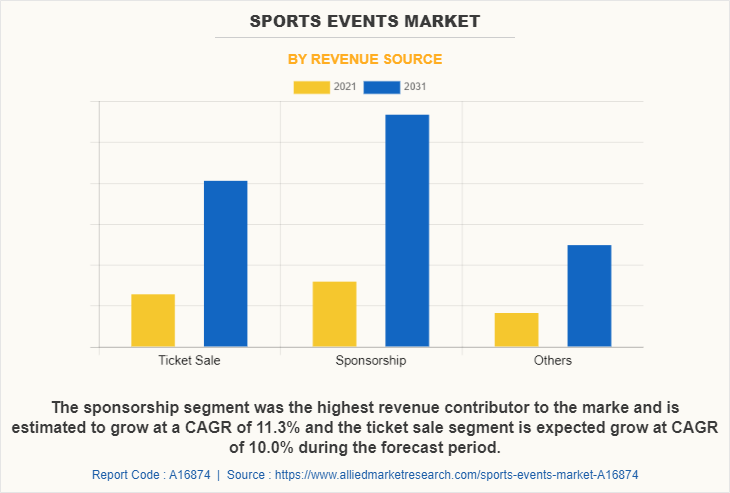
According to the sports events market trends, on the basis of revenue source, the sponsorship segment was the highest contributor to the market, with $79,572.4 million in 2021, and is estimated to reach $282,962.2 million by 2031, at a CAGR of 11.3% during the forecast period. Sponsorship is a crucial source of funding for all types of sporting events. Sports event sponsorships involve businesses, non-profit organizations, and other organizations contributing money or other benefits in exchange for visibility and exposure for their brands. Many event planners work with sponsors to provide the funds they need to provide more engaging programming and pay for escalating costs. Additionally, it works as a potent and successful marketing strategy to strengthen and expand brand recognition among certain niche markets. Thus, increase in number sports events and attendees or viewership for the particular sports event are likely to attracts more sponsors, which leads to increase the sports events market growth during the forecast period.
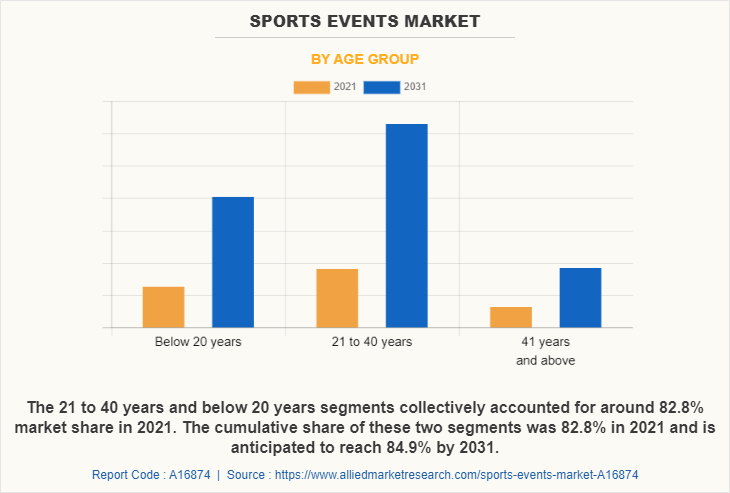
On the basis of age group, 21–40 years segment was the highest contributor to the sports events market size and is estimated to reach $314,883.3 million by 2031, at a CAGR of 11.1% during the forecast period. This group of people are more inclined towards sports and music concerts events. In addition, increase in interest toward choosing sport as carrier option is anticipated to positively impact the growth of the sport event industry. Rise in participation of the 21–40 years age group people in sporting activities will generate more viewership for the live sports events. Thus, growing popularity for sports and population the age growup of 21–40 years are likley to contribute for the growth of the sports events market size.
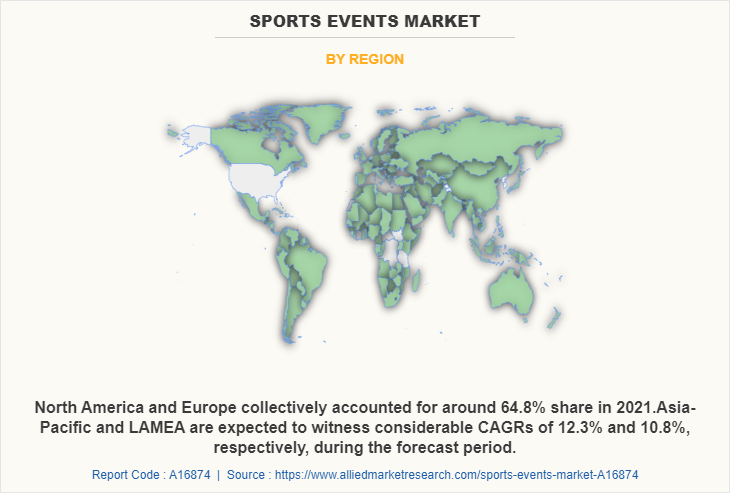
According to the sports events market opportunity, region wise, Asia-Pacific garnered the major sports events market share in 2021, and is expected to maintain its market share throughout sports events market forecast period. Asia-Pacific has some of the most in-demand destinations for sports events that involves countries such as Thailand, Singapore, China, South Korea, Hong Kong, and Indonesia. China is a major event market in Asia-Pacific that plays a crucial role in the development of the Asia-Pacific sports events market. In addition, social media has made it possible to have better networks, authentic information, and keep people updated about the upcoming sports events. This has helped companies to maximize the chances of sports event success in the Asia-Pacific region. Thus, above mentioned factors are likly to spur the growth of the Asia-Pacific sports events market demand during the forecast period.
Competitive Landscape
The sports events market comprises a mix of global ticketing platforms, event management companies, and digital engagement service providers. Major players in this market include Ace Ticket Worldwide, Inc., GooTickets.com, Razorgator LLC, SeatGeek, StubHub, Ticket City, Inc., Tickets.com, LLC, Ticketek Pty Ltd, Ticketmaster, and TickPick LLC. Other notable participants include regional platforms and emerging digital innovators.
These organizations provide end-to-end solutions for ticketing, event promotion, venue management, and fan engagement across live sports, e-sports, and hybrid events. Market participants focus on technological innovation, strategic partnerships, dynamic pricing, and global distribution to enhance event accessibility, audience reach, and operational efficiency. The adoption of mobile ticketing apps, real-time analytics, and immersive digital experiences is helping players improve customer satisfaction, maximize revenue, and maintain competitive positioning in an increasingly digital and globalized sports events market.
Which key stakeholders are driving growth in the sports events market?
The growth of the sports events market is primarily driven by sports franchises and leagues, event organizers, and sponsors. Sports franchises and leagues hold a significant share, leveraging stadiums, broadcasting rights, and merchandising to host large-scale sporting events, tournaments, and competitions. Event organizers contribute through planning, promotion, ticketing, and logistical management for both live and hybrid events. Sponsors, including corporate brands and non-profit organizations, support sports events financially and through in-kind contributions, enhancing event quality, fan engagement, and marketing reach. Collectively, these stakeholders drive the expansion and professionalization of the sports events industry.
What are the major trends shaping the sports events industry?
A key trend in the sports events market is the integration of digital engagement tools, hybrid event formats, and immersive fan experiences. Advancements in live streaming, mobile ticketing, virtual reality (VR), and augmented reality (AR) are enhancing accessibility and audience interaction. Another trend is the increasing adoption of data analytics and fan engagement platforms, enabling personalized experiences, real-time insights, and targeted promotions. Growing interest in niche sports, e-sports, and sustainability-focused events is also shaping the industry by attracting younger audiences and environmentally conscious consumers.
How is artificial intelligence influencing the sports events market?
Artificial intelligence (AI) is increasingly applied to sports events management to optimize operations, enhance fan engagement, and improve predictive planning. AI-powered analytics platforms can track attendance patterns, forecast ticket demand, and analyze social media trends to inform marketing and operational decisions. Machine learning algorithms enable dynamic pricing, personalized content delivery, and real-time event monitoring, improving overall fan experience and operational efficiency. AI-driven tools also help organizers detect security risks, manage crowd flow, and monitor digital engagement, ensuring safer and more successful events.
What technological advancements are strengthening the sports events market?
Technological innovation in the sports events market focuses on immersive experiences, digital infrastructure, and operational efficiency. Advanced broadcasting technologies, high-definition streaming platforms, and VR/AR fan experiences enhance spectator engagement. Innovations in mobile ticketing, cashless payment systems, and venue management software streamline operations and improve convenience. Integration with cloud-based analytics, CRM systems, and real-time performance monitoring platforms enables organizers to optimize resource allocation, measure fan satisfaction, and ensure regulatory compliance. These advancements are enhancing the scalability, profitability, and sustainability of sports events worldwide.
Recent Industry Developments
In 2021, Ticketmaster focused on expanding its digital ticketing and mobile app capabilities to enhance fan engagement and reduce fraud. The company emphasized mobile-first ticketing solutions and dynamic pricing models to maximize revenue and improve customer experience.
In 2021, SeatGeek leveraged AI-powered seat recommendation engines and dynamic pricing algorithms to optimize ticket sales and enhance fan experience. These technologies allowed users to find the best seats at competitive prices while helping event organizers increase attendance and revenue.
Key Benefits for Stakeholders
This report offers a comprehensive quantitative analysis of the sports events market, covering market segments, current trends, forecasts, and dynamics from 2021 to 2031 to identify emerging opportunities.
The study provides detailed insights into key market drivers, constraints, and growth opportunities.
A Porter's Five Forces analysis evaluates the influence of buyers and suppliers, helping stakeholders make profit-oriented decisions and strengthen their supply chain relationships.
In-depth segmentation analysis highlights the prevailing market opportunities across different event types, revenue streams, and audience demographics.
Key countries within each region are mapped based on their revenue contribution to the global sports events market.
Market player positioning enables benchmarking and offers a clear view of the current standing of leading players in the industry.
The report also includes an examination of both regional and global sports events industry trends, major market players, segment performance, application areas, and strategic growth initiatives.
Sports Events Market Report Highlights
| Aspects | Details |
 By Revenue Source |
|
 By Age Group |
|
 By Region |
|
 Key Market Players | StubHub, Ticketmaster, GooTickets.Com, Ace Ticket Worldwide, Inc., Razorgator LLC, Ticketek Pty Ltd, SeatGeek, Ticket City, Inc., TickPick LLC, Tickets.com, LLC |
Analyst Review
According to the perspective of the top-level CXOs, the sports events industry is growing at a significant pace, and is anticipated to continue this trend in the coming years. It has been witnessed that events of the recent years are equally interesting than the past decade, driving shifts in choice and pressurizing event planners and owners. This industry is witnessing the entry of new and independent players who are leveraging technology to gain a competitive advantage in the today’s consolidated environment.
Recent years have seen a major increase in the awareness of consumers regarding health, fitness, and sports activities. This increase in awareness has caused an upsurge in the number of people who partake in such activates and also choose such activities as a profession. This indicate that people have been taking interest in the sport, which is expected to increase the viewership for the sports events. Football is one of the most well-known sports in the world, and it has recently become quite popular in developing nations such as China, India, Vietnam, and Indonesia. As a result, the popularity of football in India and China is likely to boost the fan base for the sport in Asia-Pacific, which will have a major impact on the expansion of sporting events in the region.
Rural fans have been drawn to regional games that are presented in engaging league systems. This pattern is widespread among emerging sports leagues as well. The potential for rural sports offerings is indicated by the high levels of interest in rural communities. The introduction of new, independent players into this market is being facilitated by their use of technology to obtain a competitive edge in the highly consolidated environment of today. However, businesses in this sector struggle to handle live inventories for straightforward and modest sports events. On the other hand, businesses want to improve the tournament experience and ensure that it goes off without a hitch. High operational cost in organizing sports events and rise in terrorism and political influence in sport activities are expected to hamper the growth of the market during the forecast period.
The sports events market size was valued at $184,612.2 million in 2021.
10.5% is the CAGR of sports events market over the forecast period
You can request sample report of sports events Market from www.alliedmarketresearch.com or call our sales representatives on +1-800-792-5285 ( U.S. - Canada toll free ), Int'l : +1-503-894-6022, + 44-845-528-1300 ( Europe ). You can drop us an email at help@alliedmarketresearch.com for sample.
2022-2031 is the forecast period in the market report.
Ace Ticket Worldwide, Inc., GooTickets.Com, Razorgator LLC, SeatGeek, StubHub and Ticket City, Inc. some of the top companies in the sports events Market.
The market is segmented on the basis of revenue source, age Group, and region.
Increasing in female sports viewers worldwide and easy availability of the online tickets for the sports events are likely spur the growth of the market during the forecast period.
By revenue source, sponsorship segment will dominate the market by the end of 2031.
The outbreak of the Coronavirus disease (COVID-19) has acted as a massive restraint on the sports events market in 2020 as governments globally imposed lock downs and restricted domestic and international travel.
Loading Table Of Content...