
Thermal Energy Storage Market Overview
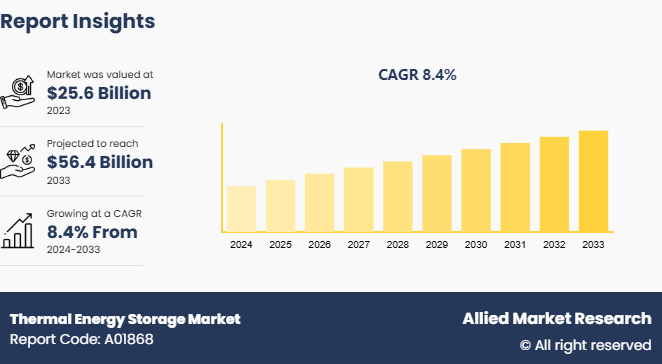
The global thermal energy storage market size was valued at USD 25.6 billion in 2023, and is projected to reach USD 56.4 billion by 2033, growing at a CAGR of 8.4% from 2024 to 2033.
The global thermal energy storage market is driven by rising demand for reliable power backup solutions, as well as increasing applications in cooling and heating systems. Growing integration of renewable energy sources further accelerates market growth by creating the need for efficient energy storage solutions.
Market Introduction and Definition
Thermal energy storage (TES) is a technology that stores thermal energy by heating or cooling a storage medium. This process is critical for balancing the demand & supply of energy, particularly in systems where the energy source is intermittent such as solar or wind power. TES helps improve energy efficiency and reliability by storing excess thermal energy when it is abundant and release during periods of high demand or when the energy source is unavailable.
Thermal energy storage (TES) systems are widely used across power generation, commercial, industrial, and residential sectors. In power plants, TES supports renewable energy integration by storing excess heat from solar thermal systems for electricity generation during non-sunny hours. In commercial buildings, it is applied in heating, ventilation, and air conditioning (HVAC) systems to reduce peak electricity demand and lower energy costs. Industrial facilities use TES for process heating and waste heat recovery. Additionally, district heating and cooling networks rely on TES to enhance energy efficiency, improve grid stability, and ensure a continuous and reliable energy supply.
Key Takeaways
The thermal energy storage market study covers 20 countries. The research includes a segment analysis of each country in terms of value for the projected period.
More than 1,500 product literatures, industry releases, annual reports, and other such documents of major thermal energy storage industry participants along with authentic industry journals, trade associations' releases, and government websites have been reviewed for generating high-value industry insights.
The study integrated high-quality data, professional opinions and analysis, and critical independent perspectives. The research approach is intended to provide a balanced view of global markets and to assist stakeholders in making educated decisions to achieve their most ambitious growth objectives.
Key Market Dynamics
Thermal energy storage (TES) solutions play a vital role in advancing sustainability goals by supporting the large-scale adoption of renewable energy technologies. Since renewable sources such as solar and wind are intermittent and variable, they create challenges for grid stability and reliability. Integrating TES systems into renewable energy infrastructure allows excess energy generated during favorable conditions to be stored and used later, thereby balancing supply and demand fluctuations and enhancing overall system performance. These factors are expected to drive the growth of the thermal energy storage market during the forecast period.
However, declining costs and improving efficiency of alternative energy storage technologies present a significant challenge to TES competitiveness. As economies of scale reduce the prices of batteries and other storage systems, the cost advantage of TES solutions narrows, especially in applications requiring short-duration storage or high power output. Furthermore, continuous research and development efforts aimed at enhancing the performance and durability of alternative storage technologies may gradually limit the market share of TES systems, restraining overall market growth.
On the other hand, supportive government policies and financial incentives are stimulating demand for TES technologies and encouraging private sector investment. Incentives such as tax credits, grants, subsidies, and low-interest loans help lower upfront costs and reduce financial barriers associated with TES deployment. By promoting energy efficiency and renewable energy integration, these initiatives are accelerating TES adoption across residential, commercial, industrial, and utility sectors, thereby creating new growth opportunities for the market.
Market Segmentation
The global thermal energy storage market is segmented into technology, storage material, application, end use, and region. On the basis of technology, the market is divided into latent heat storage, sensible heat storage and others. By storage material, the market is segmented into water, molten salt, phase change material (PCM) , and others. On the basis of application, the market is categorized into power generation, heating, and cooling. By end use, the market is segmented residential, commercial & industrial, and utilities. Region-wise the market is analyzed across North America, Europe, Asia-Pacific, and LAMEA.
Regional Market Outlook
The Asia-Pacific region is witnessing rapid growth in the adoption of renewable energy sources, including solar and wind power. However, the intermittent and variable nature of these resources presents challenges to grid stability and reliability. Thermal energy storage (TES) systems provide an effective solution by capturing surplus energy generated during peak production periods and releasing it when demand is high or generation is low. By integrating TES with renewable energy infrastructure, the region can ensure a more stable and continuous power supply, strengthen grid resilience, and accelerate its transition toward a cleaner and more sustainable energy mix.
Governments across the Asia-Pacific region are implementing supportive policies and incentive programs to promote energy storage technologies, including thermal energy storage (TES). For instance, China’s ambitious energy storage targets and initiatives such as India’s National Solar Mission highlight the strategic importance of storage solutions in achieving renewable energy objectives.
Technological advancements in TES, including the development of phase change materials (PCMs) and molten salt storage systems, are enhancing efficiency, reliability, and cost-effectiveness. These innovations are making TES increasingly suitable for large-scale and grid-integrated applications.
In addition, industries across the Asia-Pacific region are progressively adopting TES for process heating and cooling to optimize energy consumption and reduce operational expenses. Fluctuating and rising energy prices further encourage businesses and residential consumers to invest in alternative energy storage solutions to better manage energy costs and improve long-term energy security.
Which Segment Is Expected to Grow at the Fastest Rate in the Thermal Energy Storage Market?
The molten salt segment is expected to grow at the fastest rate in the thermal energy storage (TES) market. This growth is primarily driven by its widespread use in concentrated solar power (CSP) plants, where molten salt enables efficient large-scale heat storage and extended power generation hours. Molten salt systems offer high thermal stability, strong heat transfer properties, and cost-effectiveness for long-duration storage applications. In addition, increasing investments in renewable energy projects and grid-scale storage solutions further accelerate segment growth. As countries focus on decarbonization and energy reliability, demand for molten salt-based TES systems is anticipated to rise significantly.
How Do Government Policies and Regulations Impact Regional Market Growth?
Government policies and regulations play a pivotal role in shaping regional growth of the thermal energy storage (TES) market. Supportive policy frameworks—such as renewable energy targets, decarbonization mandates, and energy efficiency standards—create a favorable environment for TES adoption. Financial incentives including tax credits, grants, subsidies, and low-interest loans reduce upfront capital costs and encourage utilities, industries, and commercial facilities to invest in storage solutions. In many regions, grid modernization initiatives and mandates for renewable integration further accelerate TES deployment by addressing intermittency challenges.
Regulatory mechanisms such as carbon pricing, emissions trading systems, and clean energy standards also indirectly stimulate demand for TES by increasing the cost of fossil fuel-based generation. Conversely, the absence of clear storage regulations, lengthy permitting processes, or inconsistent policy implementation can hinder market growth and delay project development.
Overall, stable, transparent, and long-term policy support enhances investor confidence, drives technological innovation, and strengthens regional competitiveness, making government action a key determinant of TES market expansion.
How Are AI, Automation, or Advanced Analytics Enhancing Efficiency and Outcomes?
Artificial intelligence (AI), automation, and advanced analytics are significantly enhancing the efficiency and performance of thermal energy storage (TES) systems. AI-driven forecasting tools analyze weather patterns, energy demand trends, and renewable generation data to optimize charging and discharging cycles. This ensures that stored thermal energy is utilized at the most cost-effective and operationally efficient times, reducing energy waste and improving system reliability.
Automation technologies further streamline TES operations by enabling real-time monitoring, predictive maintenance, and automated control of storage processes. Sensors and Internet of Things (IoT) devices continuously collect performance data—such as temperature, pressure, and flow rates—allowing operators to detect anomalies early and prevent equipment failures. This minimizes downtime and extends system lifespan.
Advanced analytics platforms process large volumes of operational data to identify performance patterns and recommend system improvements. These insights support better capacity planning, load management, and integration with renewable energy sources. In large-scale industrial and utility applications, digital twins—virtual replicas of physical TES assets—simulate various operating scenarios to enhance decision-making and optimize design.
Together, AI, automation, and analytics improve operational efficiency, reduce costs, enhance grid stability, and maximize the overall value of TES investments.
Which Regions Are Emerging as High-Growth Markets?
Several regions are emerging as high-growth markets for thermal energy storage (TES) due to increasing renewable energy adoption, industrialization, and supportive policy frameworks. The Asia-Pacific region is a clear leader, driven by rapid expansion of solar and wind power in countries such as China, India, Japan, and South Korea. Government initiatives, such as China’s ambitious energy storage targets and India’s National Solar Mission, alongside rising industrial energy demand, are fueling TES deployment for both grid-scale and industrial applications. Additionally, fluctuating energy prices in the region are encouraging businesses and residential users to adopt TES solutions for cost-effective energy management.
Europe is also a significant growth market, supported by stringent decarbonization targets, strong renewable energy policies, and government incentives promoting energy storage technologies. Countries like Germany, Spain, and France are integrating TES with solar thermal plants and district heating systems, boosting regional demand.
North America is witnessing steady growth, particularly in the U.S., where TES is used to complement solar and wind installations, enhance grid reliability, and support utility-scale energy storage programs. The combination of regulatory support, technological innovation, and increasing renewable energy capacity is creating lucrative opportunities across these regions, positioning them as the fastest-growing markets for TES over the forecast period.
Competitive Landscape
The major players operating in the thermal energy storage industry include Aalborg CSP, Abengoa, Cartesian, Enel Spa, EVAPCO, Inc, Kraftblock GmbH, Lumenion GmbH, Magaldi Green Energy, Man energy solutions, PCM products ltd., Phelas GmbH, Spirax sarco limited., Sunamp Ltd., and Thermofin.
Industry Trends
Thermal energy storage (TES) systems are becoming increasingly integral to renewable energy projects, particularly solar and wind installations, as they enable the storage of excess energy generated during peak production periods for use when generation is low.
The growing integration of renewable energy sources is significantly driving demand for TES solutions. According to the International Energy Agency, global renewable electricity capacity is projected to increase by more than 60% from 2020 levels to exceed 4,800 GW by 2026.
Supportive government policies and financial incentives aimed at promoting energy storage and renewable energy adoption are further accelerating TES market growth.
Many countries are introducing regulatory frameworks that encourage the deployment of storage technologies. Moreover, TES plays a vital role in decarbonization strategies by facilitating renewable energy utilization and reducing dependence on fossil fuels, aligning with global efforts to lower greenhouse gas emissions.
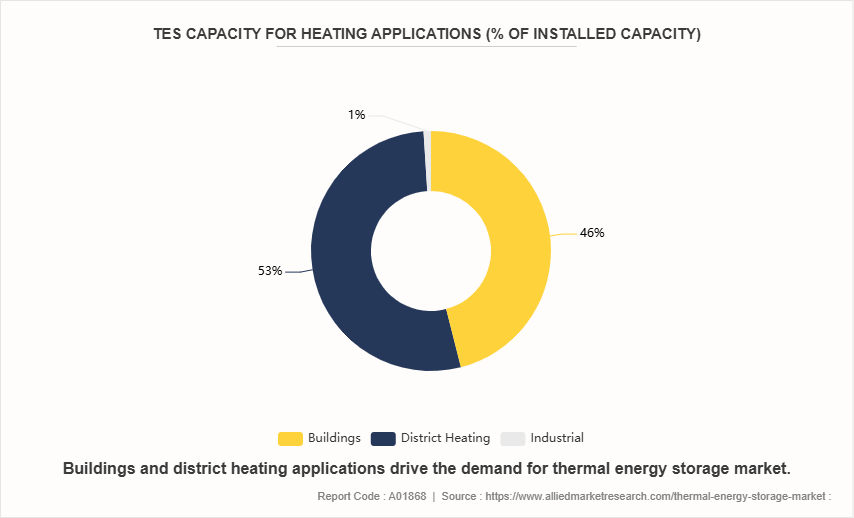
TES Capacity for Heating Applications (% of Installed capacity)
The installed thermal energy storage capacity with 46% dedicated to buildings, 53% to district heating, and 1% to industrial applications, highlights a strategic emphasis on enhancing heating efficiency across residential, commercial, and large-scale district systems. This distribution reflects a concerted effort to manage and optimize heating loads in buildings, which reduces energy consumption and heating costs while improving comfort. The substantial investment in district heating systems underscores a commitment to efficient, centralized heat distribution, potentially lowering emissions and operational costs. However, the minimal focus on industrial applications suggests an opportunity for growth in this sector, where increased thermal energy storage leads to better energy management and sustainability.
Key Sources Referred
International Energy Agency
U.S. Department of Energy
Renewable Thermal Collaborative
International Renewable Energy Agency (IRENA)
Asian Development Bank
The American Clean Power Association
Key Benefits for Stakeholders
This report provides a quantitative analysis of the market segments, current trends, estimations, and dynamics of the thermal energy storage market analysis from 2024 to 2033 to identify the prevailing thermal energy storage market opportunities.
The market research is offered along with information related to key drivers, restraints, and opportunities.
Porter's five forces analysis highlights the potency of buyers and suppliers to enable stakeholders make profit-oriented business decisions and strengthen their supplier-buyer network.
In-depth analysis of the thermal energy storage market forecast and segmentation assists to determine the prevailing market opportunities.
Major countries in each region are mapped according to their thermal energy storage market share in the global market.
Market player positioning facilitates benchmarking and provides a clear understanding of the present position of the market players.
The report includes the analysis of the regional as well as global thermal energy storage market trends, key players, market segments, application areas, and market growth strategies.
Thermal Energy Storage Market Report Highlights
| Aspects | Details |
 Market Size By 2033 | USD 56.4 Billion |
 Growth Rate | CAGR of 8.4% |
 Forecast period | 2024 - 2033 |
 Report Pages | 420 |
 By Technology |
|
 By Storage Material |
|
 By Application |
|
 By End Use |
|
 By Region |
|
 Key Market Players | EVAPCO, Inc, PCM Products Ltd., Lumenion GmbH, Kraftblock GmbH, Sunamp Ltd., Phelas GmbH, Cartesian, Abengoa, Thermofin, Aalborg CSP, Enel Spa, Man Energy Solutions, Spirax Sarco limited., Magaldi Green Energy |
Analyst Review
Thermal energy storage, also known as heat energy, is utilized to store energy for later use. It is mature energy storage technology, currently gaining popularity in commercial & institutional building applications. It is simple & highly efficient method of transferring energy, and is one of the most feasible eco-friendly solutions for energy saving. It is extensively adopted to stock cold winter air for air conditioning purposes in summers and to store solar energy for space heating in winters. It has gained popularity as an advanced energy technology for thermal applications such as space heating and cooling & air conditioning. It is used for balancing the supply & demand of energy and routinely cater to the varying energy demands.
In 2016, the sensible heat storage segment accounted for more than half share of the total market. Sensible heat storage is most commonly used method for heat & cold storage, owing to its low heat losses. It is used in various end-use industries, owing to its cost benefits. In 2016, the water segment accounted for more than one-third share of the total market. The residential end-use segment is estimated to grow at the highest CAGR of 12.2% from 2017 to 2023.
North America is expected to be the most significant market for thermal energy storage from 2017 to 2023. U.S. dominated the North America thermal energy storage market in 2016. North America witnessed the highest demand for thermal energy storage, owing to the high energy storage capacity and increase in penetration of thermal storage particularly in the U.S. In addition, rapid penetration of renewable energy has changed the energy landscape in this region. In addition, Asia-Pacific is expected to grow at the highest CAGR of 11.6% during the forecast period.
The global thermal energy storage market was valued at $25.6 billion in 2023, and is projected to reach $56.4 billion by 2033, growing at a CAGR of 8.4% from 2024 to 2033.
Favorable government initiatives and regulations is the upcoming trends of Thermal Energy Storage Market in the globe.
Heating is the leading application of Thermal Energy Storage Market.
Europe is the largest regional market for Thermal Energy Storage,
The major players operating in the thermal energy storage market include Aalborg CSP, Abengoa, Cartesian, Enel Spa, EVAPCO, Inc, Kraftblock GmbH, Lumenion GmbH, Magaldi Green Energy, Man energy solutions, PCM products ltd., Phelas GmbH, Spirax sarco limited., Sunamp Ltd., and Thermofin.
Loading Table Of Content...