
Vacuum-assisted Biopsy Devices Market Research, 2033
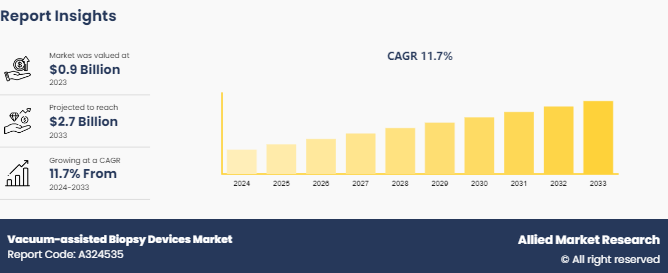
The global vacuum-assisted biopsy devices market size was valued at $0.9 billion in 2023, and is projected to reach $2.7 billion by 2033, growing at a CAGR of 11.6% from 2024 to 2033. Vacuum-assisted biopsy devices refer to advanced medical instruments that are used to collect tissue samples for cancer detection and evaluation of other diagnostics. They help improve diagnostic accuracy compared to traditional core needle biopsy methods. They use vacuum-powered system to extract tissue samples through a single insertion.
Market Introduction and Definition
The major factors driving the vacuum-assisted biopsy devices market are advancements in technology, increase in incidences of breast cancer and surge in prevalence of other chronic diseases. Furthermore, rise in awareness among healthcare professionals and patients about the benefits of early detection and minimally invasive procedures further contributes toward the market growth.
Vacuum-assisted biopsy devices are majorly used in breast biopsy procedures. These are also being used in lung, liver, prostate, and other soft-tissue diagnostics. There is a rise in prevalence of cancer, which surges the importance of vacuum-assisted biopsy devices. Breast cancer, in particular, remains one of the most commonly diagnosed cancers. Early detection programs and routine screening initiatives have increased the number of suspicious lesions identified through mammography, ultrasound, and MRI. This increases the demand for vacuum-assisted biopsy systems.
Region-wise, North America leads the vacuum-assisted biopsy devices market. This is attributed to advancements in healthcare infrastructure and early adoption of innovative medical technologies. Europe also witnesses growth in the market. This is supported by presence of structured cancer screening programs. The Asia-Pacific region is experiencing rapid growth due to rise in healthcare investments, increase in prevalence of cancer, and expansion of access to diagnostic services.
Healthcare providers favor vacuum-assisted biopsy systems. This is majorly because they align with the global shift toward minimally invasive procedures. Further, the patients also prefer less invasive diagnostic options that offer faster recovery and fewer complications. These preferences contribute toward steady growth in procedure volumes across hospitals, diagnostic centers, and outpatient clinics. In addition to clinical demand, usage of advanced imaging compatibility, ergonomic designs, and automation features into newer systems also boost the vacuum-assisted biopsy devices market growth. Integration of artificial intelligence and digital technologies help support image interpretation and procedural guidance. These advancements enhance workflow efficiency and expand the potential applications of vacuum-assisted biopsy devices.
Key Takeaways
- The vacuum-assisted biopsy devices market share study covers 20 countries and includes a segment analysis of each country in terms of value ($Million) for the projected period.
- It offers high-value industry insights to the stakeholders and helps them make informed decisions.
- The study integrates high-quality data, professional opinions and analysis, and critical independent perspectives.
- The research approach is intended to provide a balanced view of global markets and to assist stakeholders in making educated decisions in order to achieve their most ambitious growth objectives.
Key Market Dynamics
Drivers
Rise in global incidence of cancer, particularly breast cancer is a major factor that boosts the growth of the vacuum-assisted biopsy devices market. The number of patients undergoing diagnostic imaging has increased with rise in number of cancer screening programs and surge in awareness of early detection. This leads to a higher number of biopsy procedures, directly supporting demand for vacuum-assisted systems. Further, rise in preference for minimally invasive procedures also fosters the growth of the market. Vacuum-assisted biopsy offers reduced pain, smaller incisions, shorter recovery times, and fewer complications, when compared with surgical biopsies. Healthcare providers and patients both favor procedures that minimize risk while maintaining diagnostic accuracy. The ability to obtain larger tissue samples through a single insertion improves diagnostic reliability and reduces repeat biopsies. This, in turn, fuels the growth of the vacuum-assisted biopsy devices market.
Technological advancements also contribute significantly to market expansion. Modern vacuum-assisted biopsy devices are compatible with ultrasound, MRI, and 3D mammography, which enhances precision and supports real-time guidance during procedures. Improvements in device ergonomics, automation, and sample retrieval systems increase clinician efficiency and patient comfort. This also fuels the vacuum-assisted biopsy devices market growth.
Restraints
High cost of equipment and disposable components limits the growth of the market. Vacuum-assisted biopsy systems require significant initial capital investment, and consumables add to ongoing operational expenses. This is projected to limit adoption in smaller hospitals and low-resource settings. Further, certain countries also have reimbursement limitations, which further poses a challenge for the vacuum-assisted biopsy devices market. In regions where reimbursement policies are unclear or insufficient, healthcare providers may hesitate to adopt advanced biopsy systems due to financial concerns. There is a need for trained healthcare professionals to handle vacuum-assisted biopsy devices. This also deters adoption of vacuum-assisted biopsy devices.
Opportunities
Technological innovation and integration of artificial intelligence and advanced analytics into imaging and biopsy systems are anticipated to be opportunistic for the growth of the market. AI can help improve lesion detection, enhance targeting precision, and support clinical decision-making. AI-powered tools also reduce procedural errors and improve overall efficiency. This further drives the vacuum-assisted biopsy devices market growth during the forecast period. Moreover, robotics and automation also present promising opportunities. Automated guidance systems can standardize procedures, reduce variability, and enhance accuracy. These innovations may increase adoption in high-volume clinical settings.
What Is the Current Market Size and How Is the Market Expected to Grow?
The global vacuum-assisted biopsy devices market is expanding rapidly, driven by technological advancements, increase in incidence of chronic diseases like cancer, and a surge in preference for minimally invasive diagnostic procedures.
Vacuum-assisted biopsy devices are specialized tools designed to extract larger tissue samples through a single, minimally invasive insertion. This method helps improve diagnostic accuracy and reduces patient discomfort when compared with traditional core needle biopsy techniques. Further, advancements in screening programs and early detection initiatives increase the number of biopsies performed each year, further accelerating demand for vacuum-assisted biopsy systems.
Beyond breast cancer, these devices are also used in diagnosing lung, prostate, and other soft tissue malignancies, contributing to broader vacuum-assisted biopsy devices market adoption. Their integration with imaging technologies like ultrasound, MRI, and tomosynthesis enhances precision and workflow efficiency in both hospital and outpatient settings.
Top 10 Cancer by Type
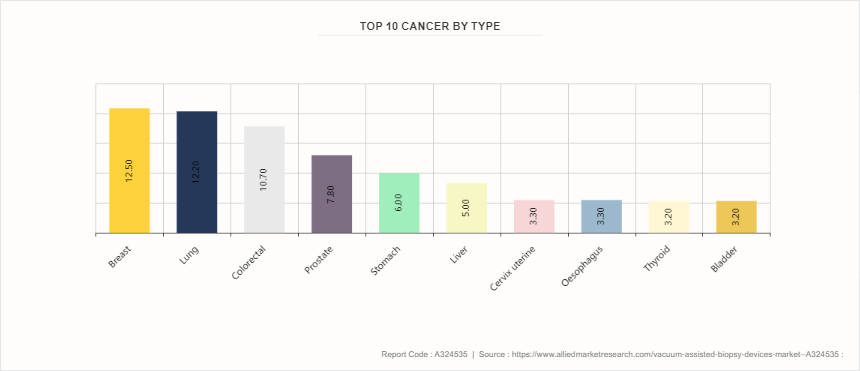
The top ten types of cancer, listed by their prevalence, highlight a significant health burden worldwide. Breast cancer is the most common, accounting for 12.5% of cases. It is closely followed by lung cancer, which constitutes 12.2% of cases. Colorectal cancer is the third most prevalent, with 10.7% of cases. Prostate cancer, primarily affecting men, represents 7.8% of cancer diagnoses. Stomach cancer is also notable, comprising 6% of cases, while liver cancer makes up 5%. Both cervix uterine cancer and oesophageal cancer each account for 3.3% of cases, indicating a considerable impact on the global population. Thyroid and bladder cancers each have a prevalence of 3.2%. According to vacuum-assisted biopsy devices market trends analysis, as cancer rates increase globally, there is a growing demand for effective diagnostic tools that can accurately detect and characterize suspicious lesions. Vacuum-assisted biopsy devices have emerged as an efficient diagnostic option, offering advantages over traditional biopsy methods such as core needle biopsy. Vacuum-assisted biopsy devices allow for more precise targeting of tissue samples, minimizing the need for repeated procedures and reducing patient discomfort. Moreover, vacuum-assisted biopsy devices enable clinicians to obtain larger tissue samples, which can improve diagnostic accuracy and facilitate molecular testing for personalized treatment approaches.
How Is the Market Performing Compared to Previous Years?
The vacuum-assisted biopsy devices market has shown steady and notable growth in recent years. This is due to its growing clinical acceptance and technological innovation. Historically, the biopsy devices sector was dominated by core needle and fine needle aspiration technologies. However, vacuum-assisted systems have steadily gained market share due to their improved diagnostic accuracy and patient-friendly profiles. Several factors boost the growth of the vacuum-assisted biopsy devices market. Breast cancer screening and early detection efforts are one of the most significant factors that drive the market growth. Clinicians identify suspicious lesions that require precise tissue sampling, as mammography and advanced imaging adoption increases. This increases the demand for vacuum-assisted biopsy devices.
Technological advancements also play an important role. Modern devices are compatible with improved imaging technologies and thus help provide better visualization and control during procedures. These innovations have improved clinician confidence in vacuum-assisted systems and encouraged broader clinical use. Compared to traditional core needle biopsies, vacuum-assisted systems offer larger, more contiguous tissue samples with fewer insertions. This advantage not only improves diagnostic yield but also enhances patient comfort and reduces procedure complications, contributing to higher adoption in both hospitals and diagnostic centers.
Overall, the vacuum-assisted biopsy devices market is performing strongly compared to previous years, with rising adoption, technological innovation, and expanding clinical applications driving continued expansion. Its current trajectory reflects a mature and growing segment within the broader medical diagnostics landscape.
Market Segmentation
The vacuum-assisted biopsy devices industry is segmented into by product, type, technique, applications, end user, and region. By product, the vacuum-assisted biopsy devices market is divided into vacuum-assisted biopsy systems and vacuum-assisted biopsy needles. By type, the market is divided into 9-12G, <9G, >12G. By technique, the market is divided into ultrasound-guided biopsy, stereotactic, guided biopsy, MRI-guided biopsy, and others. As per application, the market is divided into breast biopsy, lung biopsy, colorectal biopsy, prostate biopsy, and others. By end users, the market is divided into hospitals, academic and research institutes, diagnostic and imaging centers, and others. Region wise, the vacuum-assisted biopsy devices market is analyzed across North America, Europe, Asia-Pacific, and LAMEA.
What are the key factors driving the market growth?
According to Vacuum-assisted biopsy devices market analysis, key factors driving vacuum-assisted biopsy devices market growth are rising incidence of cancer, technological advancements in cancer diagnostic, preference for minimally invasive procedures, and advantages over traditional biopsy methods. The rising incidence of cancer has emerged as a significant catalyst propelling the vacuum-assisted biopsy devices market. According to an article by World Health Organization, in 2022, there were 2.3 million women diagnosed with breast cancer globally. As cancer rates continue to escalate globally, there's an increasing demand for more accurate and minimally invasive diagnostic techniques. Vacuum-assisted biopsy devices offer a sophisticated solution, allowing for precise sampling of tissues with minimal patient discomfort and reduced risk of complications. This technology enables clinicians to obtain larger tissue samples compared to traditional biopsy methods, thereby improving the accuracy of cancer diagnosis and subsequent treatment planning. Thus, the rising incidence of cancer globally and technological advancement in the vacuum-assisted biopsy devices is expected to drive the vacuum-assisted biopsy devices market growth.
Furthermore, according to the vacuum-assisted biopsy devices vacuum-assisted biopsy devices market forecast analysis the rise in demand for minimally invasive procedures is expected to drive the growth of the market. The growing preference towards the minimally invasive procedures is owing to reduced patient discomfort, shorter recovery times, and lower risks of complications compared to traditional surgical methods. Minimally invasive procedures typically involve smaller incisions or entry points, leading to less tissue trauma and scarring. Vacuum-assisted biopsy devices allow clinicians to collect larger tissue samples with greater precision and control, thereby enhancing diagnostic accuracy while minimizing patient discomfort. Moreover, the ability to perform biopsies using vacuum assistance often enables clinicians to target lesions more effectively, especially in challenging anatomical locations. Thus, the rise in preference towards minimally invasive procedures is expected to drive the growth of the vacuum-assisted biopsy devices vacuum-assisted biopsy devices market size.
Regional/Country Market Outlook
North America dominated the vacuum-assisted biopsy devices market share owing to surge in prevalence of cancer, presence of robust healthcare infrastructure, significant investments in research and development, and strong presence of major key players. However, according to vacuum-assisted biopsy devices market opportunity analysis the Asia-Pacific region is witnessing rapid growth, propelled by increasing healthcare expenditure, a rising geriatric population, and growing awareness of cancer.
- In a 2024 article published by National Centre for Disease Informatics and Research, it was estimated that the projected cancer burden in India is expected to rise from 26.7 million DALYs (Disability-adjusted life year) in 2021 to 29.8 million in 2025.
- According to 2024 article by National Breast Cancer Foundation, Inc, in 2024, an estimated 310, 720 women and 2, 800 men will be diagnosed with invasive breast cancer.
- In an article published by European Commission, it was reported that in 2021, cancer was the second leading cause of death in the Europe, with 1.1 million deaths
Industry Trends
- In a 2023 article published by National Library of Medicine, it was reported that vacuum-assisted biopsy system offers valuable insights to optimize patients’ surgical options and decrease the incidence of malignant outcomes.
- In a 2021 article published by National Library of Medicine it was reported that vacuum-assisted breast biopsy is a safe and efficient procedure for the diagnosis and management of indeterminate and suspicious breast lesions.
- In January 2023, vacuum-assisted breast biopsy and excision technology that has been used at Sri Ramachandra Medical Centre has helped remove benign breast tumors without any surgery in a day care procedure. It has also greatly improved accurate diagnosis for cancer compared to the widely used traditional core needle biopsy.
Competitive Landscape
The major players operating in the vacuum-assisted biopsy devices market include Becton, Dickinson and Company, Cook Medical, Devicor Medical Products, Inc., Argon Medical., B. Braun Melsungen AG, Cardinal Health, Olympus Corporation, Boston Scientific Corporation, Medtronic Plc, and Inrad Inc.
Other players in vacuum-assisted biopsy devices market includes Fujifilm Corporation, and Hologic, Inc.
Recent Key Strategies and Developments
- In February 2021, Medtronic announced the launch of the Achieve Advanced Enabling Technology for its Achieve Advanced Steerable Sheath. This technology provides enhanced control and access during vacuum-assisted biopsy procedures.
- In June 2022, Medtronic Plc received FDA 510 (k) clearance and CE Mark approval for the integration of advanced INVOS regional oximetry and Micro stream capnography technologies on the CARESCAPE precision monitoring platform. Micro stream capnography (CO2) technology captures evolving respiratory compromise, while INVOSTM regional oximetry (rSO2) technology helps clinicians predict and prevent perioperative complications faster than traditional peripheral measurement.
- In March 2021, IZI Medical Products, LLC launched The Quick-Core Auto Biopsy System ("Quick-Core Auto") for soft tissue biopsy. Quick-Core Auto is a lightweight, fully automatic biopsy system that offers the precision, dependability, and quality of IZI's Quick-Core semi-automatic biopsy system
Key Sources Referred
- World Health Organization
- Cancer Research UK
- Center of Disease Control and Prevention
- National Library of Medicine
- American Cancer Society
- Indian Cancer Society
- European Cancer Organization
Key Benefits for Stakeholders
- This report provides a quantitative analysis of the market segments, current trends, estimations, and dynamics of the vacuum-assisted biopsy devices market analysis from 2024 to 2033 to identify the prevailing vacuum-assisted biopsy devices market opportunities.
- The market research is offered along with information related to key drivers, restraints, and opportunities.
- Porter's five forces analysis highlights the potency of buyers and suppliers to enable stakeholders make profit-oriented business decisions and strengthen their supplier-buyer network.
- In-depth analysis of the vacuum-assisted biopsy devices market segmentation assists to determine the prevailing market opportunities.
- Major countries in each region are mapped according to their revenue contribution to the global market.
- Market player positioning facilitates benchmarking and provides a clear understanding of the present position of the market players.
- The report includes the analysis of the regional as well as global vacuum-assisted biopsy devices market trends, key players, market segments, application areas, and market growth strategies.
Vacuum-assisted Biopsy Devices Market Report Highlights
| Aspects | Details |
 Market Size By 2033 | USD 2.7 Billion |
 Growth Rate | CAGR of 11.7% |
 Forecast period | 2024 - 2033 |
 Report Pages | 280 |
 By Product |
|
 By Type |
|
 By Technique |
|
 By Application |
|
 By End User |
|
 By Region |
|
 Key Market Players | Inrad Inc, Cook Group, Argon Medical Devices, Inc., Devicor Medical Products Inc, Becton, Dickinson and Company, Cardinal Health, Boston Scientific Corporation, Olympus Corporation, B. Braun Melsungen AG, Medtronic plc |
The forecast period for Vacuum-assisted biopsy devices market is 2024-2033.
The global vacuum-assisted biopsy devices market size was valued at $0.9 billion in 2023
The market value of vacuum-assisted biopsy devices market is projected to reach $2.7 Billion by 2033.
The base year is 2023 in Vacuum-assisted biopsy devices market
Major key players that operate in the vacuum-assisted biopsy devices market are Becton, Dickinson and Company, Cook Medical, Devicor Medical Products, Inc., and Argon Medical.
Loading Table Of Content...