
Virtual And Augmented Reality In Healthcare Market Research, 2033
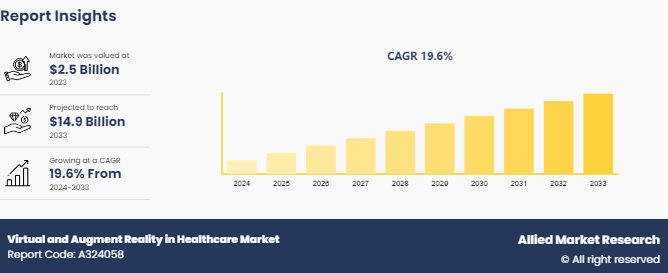
The global VR and AR in healthcare market size was valued at $2.5 billion in 2023, and is projected to reach $14.9 billion by 2033, growing at a CAGR of 19.6% from 2024 to 2033. The major factors driving the growth of the virtual and augmented reality in healthcare are high adoption of digital healthcare technology, rise in the healthcare expenditure, and technological advancement in the virtual and augmented reality technology.
Virtual reality and augmented reality help transform the healthcare industry by creating immersive, interactive experiences that enhance clinical care, medical education, and patient engagement. These technologies help remove traditional barriers by merging digital content with the physical world, helping clinicians and patients visualize information.
Virtual reality involves complete immersion in a computer‑generated environment. Users wear a virtual reality headset that substitutes the real world with a virtual space. In contrast, augmented reality overlays digital content onto the real world through smart glasses or mobile screens. This enhances real‑time perception without full immersion.
Market Introduction and Definition
Virtual and augmented reality (VR and AR) are shaping the growth of the healthcare industry by offering innovative solutions that enhance medical training and patient care. Virtual reality immerses users in simulated environments, allowing medical professionals to practice procedures in a risk-free setting. Surgeons can perform virtual surgeries to refine their skills and explore new techniques before operating on real patients. This helps reduce errors and improve outcomes. Augmented reality helps use digital information onto the real world. This provides real-time guidance during medical procedures. Surgeons visualize patient anatomy through augmented reality headsets, which enhance precision during surgeries by displaying critical information directly in their field of view. Augmented reality aids in medical education by overlaying educational content onto physical objects, making complex concepts more accessible and enhancing learning outcomes for students and professionals alike.
Key Takeaways
- The VR and AR in healthcare market share study covers 20 countries. The research includes a segment analysis of each country in terms of value for the projected period.
- More than 1, 500 product literatures, industry releases, annual reports, and other such documents of major virtual and augmented reality in healthcare industry participants along with authentic industry journals, trade associations' releases, and government websites have been reviewed for generating high-value industry insights.
- The study integrated high-quality data, professional opinions and analysis, and critical independent perspectives. The research approach is intended to provide a balanced view of global markets and assist stakeholders in making educated decisions to achieve their most ambitious growth objectives.
One of the most compelling uses of VR and AR in healthcare is in clinical treatment and rehabilitation. VR has been widely adopted in pain management, especially for burn victims or individuals undergoing painful procedures. Immersive environments distract patients from pain signals, leading to measurable reductions in perceived pain. VR is also used to treat anxiety disorders and post‑traumatic stress disorder. AR technology supports surgical planning and real‑time guidance. Surgeons can overlay 3D reconstructions of anatomy onto a patient during operations, enabling precision and reducing errors. For example, AR smart glasses can display critical vital signs, imaging data, or step‑by‑step instructions without forcing surgeons to divert their gaze to monitors. This improves ergonomics, safety, and workflow efficiency.
Medical students used to learn through textbooks and used to get limited hands‑on experiences. VR changes this by providing simulated learning environments where students can practice procedures in lifelike scenarios without risk to real patients. VR simulators replicate surgeries, emergency responses, and anatomy labs with high fidelity. AR also enhances education through interactive overlays of physiological processes and anatomical structures on real or synthetic models. Learners can view internal organs, blood flow, or muscle function layered onto a real body, deepening understanding and retention.
VR and AR create engaging, personalized rehabilitation programs for patients recovering from strokes, orthopedic injuries, or neurological disorders. Interactive VR exercises motivate patients while tracking performance metrics, improving adherence and outcomes. AR apps remind patients how to perform exercises correctly at home, bridging clinic visits with continuous care. These technologies can reduce isolation and encourage cognitive engagement.
Key Market Dynamics
Virtual Reality (VR) and Augmented Reality (AR) are among the fastest?growing technologies in healthcare, driven by innovation, clinical demand, and surge in use cases. However, their adoption also faces challenges. Understanding the key drivers, restraints, and opportunities provides a comprehensive view of the current and future landscape.
Drivers
Healthcare providers increasingly seek tools that improve patient outcomes while reducing cost and risk. The effectiveness of VR in pain management, anxiety reduction, PTSD therapy, and physical rehabilitation drives clinical adoption. These technologies offer non?pharmacological alternatives, especially important amid concerns surrounding opioid use or medication side effects. Traditional medical training is resource?intensive, limited by cadaver availability, lab access, and clinical exposure. VR and AR provide scalable, repeatable, and safe environments for surgical simulation, procedural training, and anatomy visualization. As medical schools and teaching hospitals invest in technology?enabled learning, VR/AR usage continues to rise.
Progress in hardware affordability, graphics processing, sensors, and software tools has lowered barriers to adoption. Modern VR headsets and AR glasses are lighter, more immersive, and easier to use, making them suitable for clinical settings. Cloud computing and AI integration enhance real?time performance and data analytics. Healthcare delivery increasingly emphasizes patient engagement, personalization, and remote care. VR programs create interactive rehabilitation and educational experiences, motivating patients to adhere to treatment plans. AR features support at?home care, reducing clinic visits and healthcare costs.
Restraints
Clinically validated VR/AR applications require substantial investment in hardware, software, and content development. Healthcare institutions may hesitate to adopt these solutions without demonstrated return on investment (ROI), particularly amid competing budget priorities. Implementing VR/AR into existing clinical workflows can be complex. Integration with electronic health records (EHRs), imaging systems, or clinical protocols requires tailored solutions and interoperability standards. Resistance to change from staff unfamiliar with immersive tech can also slow adoption.
Opportunities
Emerging markets present substantial opportunities for VR and AR adoption. Regions with expanding healthcare infrastructure and digital health initiatives are beginning to invest in advanced technologies, creating new demand for immersive solutions. Combining VR/AR with AI enhances diagnostic accuracy, personalization, and adaptability. AI?driven simulations can tailor training or therapy based on user performance, while computer vision and natural language processing expand AR’s real?time utility in clinical environments. The rise of remote care and telehealth creates opportunities for VR/AR to support virtual consultations, remote rehabilitation, and home?based patient monitoring. With global interest in decentralized care models growing, VR/AR technologies can bridge distance gaps and enhance continuity of care.
What Is the Current Market Size and How Is the Market Expected to Grow?
The virtual and augmented reality (VR & AR) in healthcare market is currently in a strong growth phase, driven by expanding clinical applications and broader digital adoption across medical sectors. According to Allied Market Research, the combined VR and AR healthcare market was valued at $2.5 billion in 2023. This figure reflects the increasing integration of immersive technologies into healthcare workflows, including surgical planning, medical training, rehabilitation, therapy, and diagnostic support. VR systems allow clinicians and students to simulate medical procedures and patient interactions in safe virtual environments, while AR tools overlay digital information onto real?world clinical settings, assisting surgeons and care teams with real?time guidance.
Surge in digital transformation trends within healthcare foster the growth of the market during the forecast period. Increase in healthcare expenditure, rise in need for cost?effective training and treatment tools, and technological advancements in VR/AR hardware and software further fuel the growth of the market.
Recent Funding for Virtual Reality (VR) and Augmented Reality (AR) Technology
According to the VR and AR in healthcare market trends analysis funding for startups and key players is expected to contribute significantly to the growth of the market. The funding enables the development of more sophisticated and tailored VR/AR solutions, addressing various medical needs such as surgical training, patient rehabilitation, pain management, and mental health therapy. With increased funding, startups can attract top talent, invest in cutting-edge technology, and refine their products to better meet the rigorous standards of the healthcare sector. Moreover, well-funded companies can conduct comprehensive clinical trials to validate the efficacy and safety of their VR/AR applications. Additionally, financial support will facilitate the scaling of VR/AR technologies, making them more accessible to a broader range of healthcare providers and patients. This could lead to cost reductions and the development of affordable solutions that can be deployed in various settings, from large hospitals to remote clinics. Collaborations between funded startups and established healthcare institutions can also drive the integration of VR/AR into existing medical systems, ensuring seamless adoption and utilization.
Recent Funding for Virtual Reality (VR) and Augmented Reality (AR) Technology
According to the VR and AR in healthcare market trends analysis funding for startups and key players is expected to contribute significantly to the growth of the market. The funding enables the development of more sophisticated and tailored VR/AR solutions, addressing various medical needs such as surgical training, patient rehabilitation, pain management, and mental health therapy. With increased funding, startups can attract top talent, invest in cutting-edge technology, and refine their products to better meet the rigorous standards of the healthcare sector. Moreover, well-funded companies can conduct comprehensive clinical trials to validate the efficacy and safety of their VR/AR applications. Additionally, financial support will facilitate the scaling of VR/AR technologies, making them more accessible to a broader range of healthcare providers and patients. This could lead to cost reductions and the development of affordable solutions that can be deployed in various settings, from large hospitals to remote clinics. Collaborations between funded startups and established healthcare institutions can also drive the integration of VR/AR into existing medical systems, ensuring seamless adoption and utilization
Recent funding for virtual reality (VR) and augmented reality (AR) technology
Company | Round Raised | Amount Raised | Funding Date |
Avatar Medical | Seed | $5.39 million | February 2024 |
Pixee Medical | Series B | $15.1 million | February 2024 |
Innerspace | Series A | $6.17 million | February 2024 |
Immersive Tech | Series A | $3.64 million | January 2024 |
Oxford Medical Simulation | Series A | $12.6 million | January 2024 |
Market Segmentation
The VR and AR in healthcare industry is segmented into component, technology, end user, and region. By component, the market is divided into hardware, software, and services. By technology, it is categorized into augmented reality and virtual reality. By end user, the market is classified into hospitals, research institutions, diagnostic centers, and clinics. Region wise, the market is analyzed across North America, Europe, Asia-Pacific, and LAMEA.
Regional/Country Market Outlook
North America dominated the VR and AR In healthcare market share in 2023 owing to substantial research and development activities, a strong presence of major technology firms, and widespread adoption of advanced healthcare technologies. However, according to the VR and AR In healthcare market forecast analysis, the Asia-Pacific region is expected to witness rapid market expansion owing to rise in healthcare expenditure, increase in awareness of virtual and augmented reality benefits in the healthcare sector, and surge in technology startups focusing on virtual and augmented reality in healthcare.
Some of the major players in North America are CAE (Canada) , GE Healthcare (U.S.) , Intuitive Surgical (U.S.) , Eon Reality, Inc (U.S.) , Bioflight VR (U.S.) , TheraSim Inc (U.S.) , Vuzix Corporation (U.S.) .
Government of India has introduced various funding programs for startups. For instance, The Startup India Seed Fund Scheme (SISFS) , a flagship initiative launched by the Department for Promotion of Industry and Internal Trade (DPIIT) on April 19, 2021. The scheme aims to provide financial assistance to startups at their early stages, including proof of concept, prototyping, product trials, market entry, and commercialization. The financial incentives, tax exemptions, and streamlined regulatory processes provided by the initiative have reduced the entry barriers for startups, allowing them to focus on developing and refining their VR/AR technologies. As a result, the healthcare industry has witnessed a surge in the adoption of these technologies, leading to improved diagnostic tools, enhanced surgical precision, and better patient outcomes
Industry Trends
- According to 2023 article by National Library of Medicine, virtual reality (VR) is increasingly used in healthcare settings as recent technological advancements create possibilities for diagnosis and treatment.
- In February 2024, Pixee Medical, a France-based company providing reality navigation technologies for orthopedic surgery, raised $15 million in funding.
- According to 2023 article by National Library of Medicine, integration of virtual reality (VR) and augmented reality (AR) technologies in surgical practices not only plays crucial role in training of surgical trainees, offering immersive and interactive experiences but are also enhancing the surgical precision of seasoned professionals in the operating room.
Competitive Landscape
The major players operating in the VR and AR in healthcare industry include CAE, GE Healthcare, Koninklijke Philips N.V., Intuitive Surgical, Siemens Ltd, Eon Reality, Inc, Bioflight VR, WorldViz, TheraSim Inc, and Mindmaze. Other players in the Virtual and Augmented Reality in Healthcare market are Radboudumc and Vuzix Corporation.
Recent Key Strategies and Developments
- In December 2022, Vuzix Corporation announced a new partnership with TechSee, a leader in intelligent visual assistance technology, to deliver a remote visual assistance solution to field service technicians using AR and computer vision on Vuzix M400 M4000 Smart Glasses
- In July 2021, Radboudumc and SyncVR Medical signed a collaboration agreement to boost virtual reality in healthcare. They aim to provide better care with the help of virtual reality applications, Radboudumc will collaborate intensively with startup SyncVR Medical.
Key Sources Referred
- Government of India
- National Library of Medicine
- Center of Disease Control and Prevention
- American Cancer Society
- Clinical Trials
- World Health Organization
Key Benefits for Stakeholders
- This report provides a quantitative analysis of the market segments, current trends, estimations, and dynamics of the virtual and augmented reality in healthcare market analysis from 2024 to 2033 to identify the prevailing virtual and augmented reality in healthcare market opportunities.
- The market research is offered along with information related to key drivers, restraints, and opportunities.
- Porter's five forces analysis highlights the potency of buyers and suppliers to enable stakeholders make profit-oriented business decisions and strengthen their supplier-buyer network.
- In-depth analysis of the virtual and augmented reality in healthcare market segmentation assists to determine the prevailing market opportunities.
- Major countries in each region are mapped according to their revenue contribution to the global market.
- Market player positioning facilitates benchmarking and provides a clear understanding of the present position of the market players.
- The report includes the analysis of the regional as well as global virtual and augmented reality in healthcare market trends, key players, market segments, application areas, and market growth strategies.
Virtual and Augmented Reality in Healthcare Market Report Highlights
| Aspects | Details |
 Market Size By 2033 | USD 14.9 Billion |
 Growth Rate | CAGR of 19.6% |
 Forecast period | 2024 - 2033 |
 Report Pages | 280 |
 By Component |
|
 By Technology |
|
 By End User |
|
 By Region |
|
 Key Market Players | Bioflight VR, WorldViz, Koninklijke Philips N.V., TheraSim Inc, Eon Reality, Inc, MindMaze, CAE, Intuitive Surgical, Inc., GE Healthcare, Siemens Ltd |
The forecast period for virtual and augmented reality in healthcare market is 2024-2033.
The total market value of virtual and augmented reality in healthcare market is $2.5 billion in 2023.
The market value of virtual and augmented reality in healthcare market is projected to reach $14.9 Billion by 2033.
The base year is 2023 in virtual and augmented reality in healthcare market
Major key players that operate in the virtual and augmented reality in healthcare market are GE Healthcare, Koninklijke Philips N.V., and Intuitive Surgical, Siemens Ltd
Loading Table Of Content...