
Virtual Rehabilitation and Telerehabilitation Systems Market Research, 2033
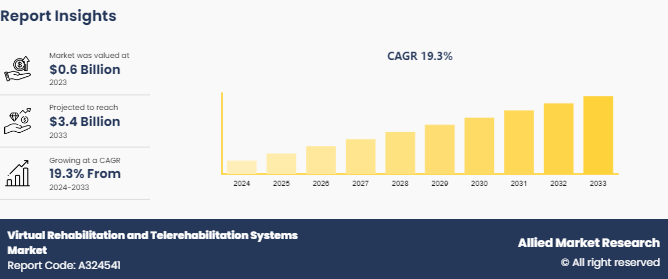
The global virtual rehabilitation and telerehabilitation systems market size was valued at $0.6 billion in 2023, and is projected to reach $3.4 billion by 2033, growing at a CAGR of 19.3% from 2024 to 2033. Advancements in technology, rise in adoption of the digital healthcare technologies and surge in prevalence of chronic diseases are the major factors that drive the growth of the virtual rehabilitation and telerehabilitation systems market.
Virtual rehabilitation and telerehabilitation systems are used to provide remote, interactive, and personalized rehabilitation services. Virtual rehabilitation makes use of different technologies to offer rehabilitation programs to the patients. These tools allow patients to interact with virtual objects and receive real-time feedback on posture, speed, and accuracy. Telerehabilitation refers to remote rehabilitation through telecommunication. Therapists conduct live therapy sessions, monitor progress, and adjust treatment plans using different digital platforms. They also use wearable sensors to track the progress of the treatment.
Traditional rehabilitation exercises can be monotonous. Thus, there is a need to motivate patients. This can be done by using scoring systems and interactive environments. This helps patients complete the prescribed sessions. Also, the immersive nature of virtual reality helps promote patient engagement. Further, telerehabilitation helps eliminate distance barriers through remote consultations. This is beneficial for individuals with mobility limitations or chronic conditions that need long-term therapy.
Market Introduction and Definition
Virtual rehabilitation and telerehabilitation systems are innovative approaches that deliver therapy and rehabilitation services remotely. Virtual rehabilitation helps therapists monitor progress, adjust exercises in real-time, and provide immediate feedback. This helps personalize treatment plans effectively. Telerehabilitation involves remote rehabilitation services that can include not only VR/AR but also teleconferencing, mobile apps, and wearable devices.
Virtual and telerehabilitation systems also help with data-driven care. They use software platforms that collect performance metrics, which allow clinicians to track progress and tailor interventions. Artificial intelligence algorithms are incorporated to personalize exercise difficulty levels based on patient performance trends.
Key Takeaways
- The virtual rehabilitation and telerehabilitation systems market share study covers 20 countries. The research includes a segment analysis of each country in terms of value for the projected period.
- More than 1, 500 product literatures, industry releases, annual reports, and other such documents of major virtual rehabilitation and telerehabilitation systems industry participants along with authentic industry journals, trade associations' releases, and government websites have been reviewed for generating high-value industry insights.
- The study integrated high-quality data, professional opinions and analysis, and critical independent perspectives. The research approach is intended to provide a balanced view of global markets and assist stakeholders in making educated decisions to achieve their most ambitious growth objectives
Key Market Dynamics
Drivers
Increase in prevalence of chronic diseases and neurological disorders is one of the major factors that fosters the growth of the virtual rehabilitation and telerehabilitation systems market. Further, advancements in technology that make way for improvements in virtual reality hardware, wearable sensors, high-speed internet connectivity, and cloud computing increase the feasibility and reliability of remote rehabilitation. Insurers and governments also use digital rehabilitation to optimize healthcare spending.
Restraints
High initial investment costs for advanced VR equipment and secure telehealth infrastructure limit the growth of the market. Further, lack of digital literacy also affects usability and engagement. This, in turn, deters the growth of the market.
Opportunities
Integration of artificial intelligence and machine learning is opportunistic for the growth of the market. Artificial intelligence makes way for predictive analytics. This helps personalize treatment pathways and forecast recovery trajectories. This is anticipated to boost the growth of the virtual rehabilitation and telerehabilitation systems market in the upcoming years.
Why Is Demand Increasing in The Virtual Rehabilitation and Telerehabilitation Market?
There is a rise in demand for virtual rehabilitation and telerehabilitation systems due to increase in aging global population. Older adults are likely to experience mobility issues and chronic conditions that require ongoing therapy, making remote and technology-enabled solutions a practical alternative to frequent clinic visits. Also, chronic diseases such as stroke, arthritis, and neurological disorders have become more prevalent. These conditions often require extended rehabilitation programs, and virtual systems allow for continuous therapeutic engagement without geographical constraints. Technological advancements also play a key role. Improvements in VR, AR, AI, wearable sensors, and telecommunication have made remote rehabilitation more effective, reliable, and interactive. This has increased both clinician confidence and patient acceptance of virtual therapy models.
Who Are the Primary End Users Driving Market Adoption?
The hospitals and clinics sector currently hold a significant share of the market, as these institutions invest in digital tools to improve clinical outcomes, reduce readmissions, and optimize care efficiency. Care homes and long-term care facilities also adopt these systems to manage chronic conditions among residents and reduce dependency on external therapy visits. Additionally, home care users—patients receiving therapy at home—represent a rapidly growing segment as consumer preference shifts toward remote and convenient care models. Healthcare providers such as physical therapists, occupational therapists, and speech-language pathologists are key professional users. These clinicians leverage virtual systems to extend their reach, monitor progress remotely, and adjust therapy plans dynamically.
Parent Market Overview- Digital Health Market
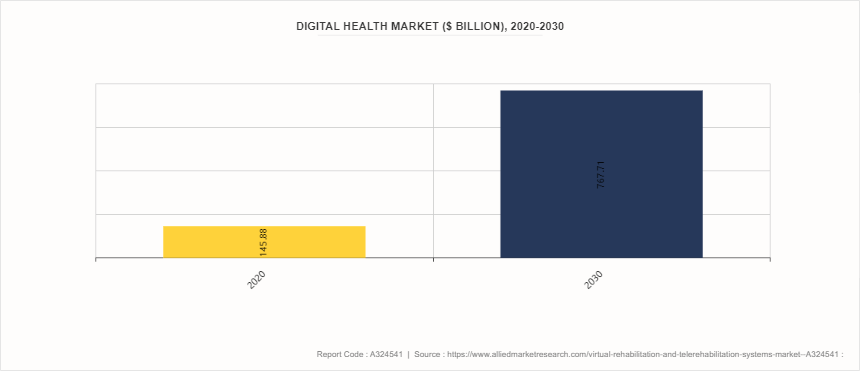
Digital health market is parent market of virtual rehabilitation and telerehabilitation systems market. The global digital health market size was valued at $145, 884.3 million in 2020, and is projected to reach $767, 718.9 million by 2030, registering a CAGR of 17.9% from 2021 to 2030. Digital health products and services encompass a broad range of technologies and applications aimed at improving healthcare delivery, patient outcomes, and overall health management through digital means. These include telemedicine platforms, mobile health applications (mHealth) , wearable devices, and health information technology systems. Telemedicine allows patients to consult healthcare professionals remotely, increasing access to care and convenience, particularly in underserved areas. Mobile health apps enable users to track their health metrics, manage chronic conditions, and access health information, promoting proactive health management. Wearable devices, such as fitness trackers and smartwatches, monitor physical activity, heart rate, sleep patterns, and other vital signs, providing real-time health data to users and healthcare providers. Health information technology systems, including electronic health records (EHRs) and health information exchanges (HIEs) , facilitate the efficient storage, retrieval, and sharing of patient information among healthcare providers, enhancing coordination and continuity of care.
Virtual rehabilitation utilizes virtual reality (VR) and augmented reality (AR) technologies to create immersive environments for physical and cognitive therapy, offering patients interactive and engaging ways to complete their rehabilitation exercises. These systems can simulate real-world scenarios, providing a safe and controlled setting for patients to practice and improve their skills. Telerehabilitation, however, extends traditional rehabilitation services to remote settings through telecommunication technologies. This approach enables therapists to deliver treatment plans, monitor progress, and provide feedback to patients in real time, regardless of their location. Both virtual rehabilitation and telerehabilitation enhance accessibility to rehabilitation services, reduce the need for in-person visits, and support continuous patient engagement, contributing to better recovery outcomes and improved quality of life for patients.
Market Segmentation
The virtual rehabilitation and telerehabilitation systems industry is segmented into type, end user, and region. By type, the market is divided into physical rehabilitation, neuro rehabilitation, cognitive rehabilitation, and other rehabilitations. By end user, the market is classified into hospitals, care homes, and others. Region wise, the market is analyzed across North America, Europe, Asia-Pacific, and LAMEA.
Regional/Country Market Outlook
North America dominated the virtual rehabilitation and telerehabilitation systems market share in 2023, owing to substantial research and development activities, a strong presence of major technology firms, and widespread adoption of advanced healthcare technologies. According to the virtual rehabilitation and telerehabilitation systems market opportunity analysis Asia-Pacific region is expected to witness rapid market expansion owing to rising healthcare expenditure, increasing awareness of virtual rehabilitation and telerehabilitation technology, and rise in geriatric population.
Some of the major players in North America are Reflexion Health, Inc (U.S.) , 270 Vision Ltd., Hinge Health, Inc, Bridgeway Senior Healthcare, and Virtualware Group.
- According to 2021 article by National Library of Medicine, 73% of U.S. hospitals had at least one telehealth capability. More than half of these hospitals invested in telehealth consultation services and stroke care.
- According to United Nations Population Fund the elderly population (aged 60 and above) in India is 153 million as of 2023 and is expected to reach 347 million by 2050
What Are the Strategies Adopted by the Key Players in the Market?
The competitive landscape of the Virtual Rehabilitation and Telerehabilitation Systems market is shaped by diverse strategies adopted by key players to strengthen their positioning, expand global presence, and enhance product offerings. Companies invest in research and development to integrate technologies such as artificial intelligence, machine learning, virtual reality, and motion-sensing devices into their platforms. These investments enhance the personalization of therapy plans, improve real-time feedback, and increase patient engagement. AI-driven analytics and immersive VR environments are differentiators that help firms deliver more effective and tailored rehabilitation experiences.
Strategic partnerships with hospitals, healthcare systems, and technology partners allow companies to embed their solutions into broader care delivery workflows. Through collaborations, players connect with clinical networks and accelerate adoption. These partnerships often focus on interoperability with existing electronic health records (EHR) and telehealth infrastructure, which supports seamless integration into standard clinical routines and enhances long-term sustainability.
Acquisition and alliance strategies also play a significant role in strengthening market presence. Firms seek to acquire complementary technology, expand product portfolios, and enhance their technological capabilities. Such moves also bring new intellectual property, enable access to larger customer bases, and consolidate market share.
How Intense Is Market Competition and What Defines Competitive Advantage?
The virtual rehabilitation and telerehabilitation systems market is moderately competitive, with a mix of specialized technology innovators and established healthcare technology companies vying for market share. This competition is shaped by several defining factors that influence how companies differentiate themselves and compete effectively.
Competitive advantage in this market is largely defined by technology sophistication. Solutions that incorporate AI-based personalization, advanced motion tracking, immersive VR/AR environments, and real-time remote monitoring tools tend to gain higher adoption among clinicians and patients. Firms that can demonstrate measurable improvements in rehabilitation outcomes, patient engagement levels, or efficiency gains are often preferred by healthcare providers.
Healthcare institutions place a high value on products with strong clinical evidence and regulatory clearances. Companies investing in rigorous clinical trials and achieving certifications or approvals gain credibility, helping their platforms become part of standard care pathways. This focus on clinical validation also supports insurance reimbursement discussions, which can impact purchasing decisions.
Industry Trends
- According to 2023 article by National Library of Medicine, Telerehabilitation (TR) is a viable and feasible solution to face the rehabilitative challenges posed by neurological impairments and to improve patients’ quality of life (QoL) . This recognition is expected to catalyze substantial growth within the virtual rehabilitation and telerehabilitation systems market size.
- The American Physical Therapy Association (APTA) in 2024 has published a new clinical practice guideline (CPG) titled "Telerehabilitation in Physical Therapist Practice" in its science journal PTJ: Physical Therapy & Rehabilitation.
- According to 2021 article by Now Health International, an international private medical insurance provider, 80% of people have accessed care via telemedicine at least once in their lives. Telemedicine's acceptance reflects a growing comfort with remote healthcare delivery, leveraging technology to enhance patient care accessibility and convenience. This trend is likely to boost demand for virtual rehabilitation systems, which offer remote monitoring, therapy, and rehabilitation services through digital platforms. Thus, the rise in the adoption of the virtual rehabilitation systems and telemedicine is expected to drive the growth of the virtual rehabilitation systems market.
Which Region Dominates the Global Market and What Drives Its Leadership?
The global market for virtual rehabilitation and telerehabilitation systems is currently led by North America. The dominance of the region is largely supported by its advanced healthcare infrastructure, particularly in the United States and Canada. Healthcare providers in these countries have both the financial resources and technical capabilities to integrate digital health technologies such as virtual reality, augmented reality, and telehealth platforms into rehabilitation protocols. Hospitals, outpatient clinics, and rehabilitation centers have been early adopters of remote care models, a trend that accelerated significantly during the COVID-19 pandemic. Telemedicine and digital therapy are now widely accepted, and telerehabilitation has become a practical solution for extending care to patients at home while reducing hospital visit burdens.
Competitive Landscape
The major players operating in the virtual rehabilitation and telerehabilitation systems market include Reflexion Health, Inc, 270 Vision Ltd, CoRehab srl, Hinge Health, Inc, SWORD Health, S.A., MIRA Rehab Limited, Bridgeway Senior Healthcare, Motekforce Link, GestureTek Inc, and Virtualware Group. Other players in the virtual rehabilitation and telerehabilitation systems market are Motorika Medical Ltd., LiteGait, and Mindmaze.
How Do Government Policies and Regulations Impact Regional Market Growth?
Government regulation plays a central role in shaping regional adoption patterns. In North America and Europe, supportive policies and reimbursement frameworks encourage integration of virtual care into mainstream healthcare delivery. Data protection laws, such as the General Data Protection Regulation in Europe and HIPAA standards in the United States, influence product development and deployment by requiring strong privacy and cybersecurity safeguards. Although compliance can increase operational complexity, it also builds trust among providers and patients. In emerging markets, regulatory frameworks are still evolving. Some countries are expanding telemedicine guidelines and digital health policies, but reimbursement clarity and standardized oversight remain works in progress. Where governments provide funding, pilot programs, and national digital health strategies, adoption tends to accelerate.
Recent Key Strategies and Developments
- In February 2021, EvolvRehab, a developer of rehabilitation technology solutions, launched a virtual therapy software platform called EvolvRehab and a hardware unit called RehabKit that connects to a television. This system allows patients to perform video game-like activities called exercise games, which are prescribed by therapists who can remotely monitor patient compliance and performance through the system.
Key Sources Referred
- Government of India
- National Library of Medicine
- Center of Disease Control and Prevention
- United Nations Population Fund
- Now Health International
- World Health Organization
- American Physical Therapy Association
Key Benefits for Stakeholders
- This report provides a quantitative analysis of the Virtual rehabilitation and telerehabilitation systems market segments, current trends, estimations, and dynamics of the virtual rehabilitation and telerehabilitation systems market analysis from 2023 to 2033 to identify the prevailing Virtual rehabilitation and telerehabilitation systems market opportunities.
- The market research is offered along with information related to key drivers, restraints, and opportunities.
- Porter's five forces analysis highlights the potency of buyers and suppliers to enable stakeholders make profit-oriented business decisions and strengthen their supplier-buyer network.
- In-depth analysis of the virtual rehabilitation and telerehabilitation systems market segmentation assists to determine the prevailing market opportunities.
- Major countries in each region are mapped according to their revenue contribution to the global Virtual rehabilitation and telerehabilitation systems market statistics.
- Market player positioning facilitates benchmarking and provides a clear understanding of the present position of the market players.
- The report includes the analysis of the regional and global virtual rehabilitation and telerehabilitation systems market trends, key players, market segments, application areas, and market growth strategies
Virtual Rehabilitation and Telerehabilitation Systems Market , by Type Report Highlights
| Aspects | Details |
 Market Size By 2033 | USD 3.4 Billion |
 Growth Rate | CAGR of 19.3% |
 Forecast period | 2024 - 2033 |
 Report Pages | 280 |
 By Type |
|
 By End User |
|
 By Region |
|
 Key Market Players | CoRehab srl, 270 Vision Ltd, Hinge Health, Inc, Motekforce Link, MIRA Rehab Limited, Bridgeway Senior Healthcare, Virtualware Group, Sword Health, S.A, Reflexion Health, Inc, GestureTek Inc. |
The total market value of Triamcinolone Market is $0.6 billion in 2023.
The market value of Triamcinolone Market in 2033 is $3.4 billion.
The forecast period for Triamcinolone Market is 2024-2033.
The base year is 2023 in Triamcinolone Market
Major key players that operate in the Triamcinolone Market are Reflexion Health, Inc, 270 Vision Ltd, CoRehab srl, and Hinge Health, Inc
Loading Table Of Content...