
Wedding Services Market Overview
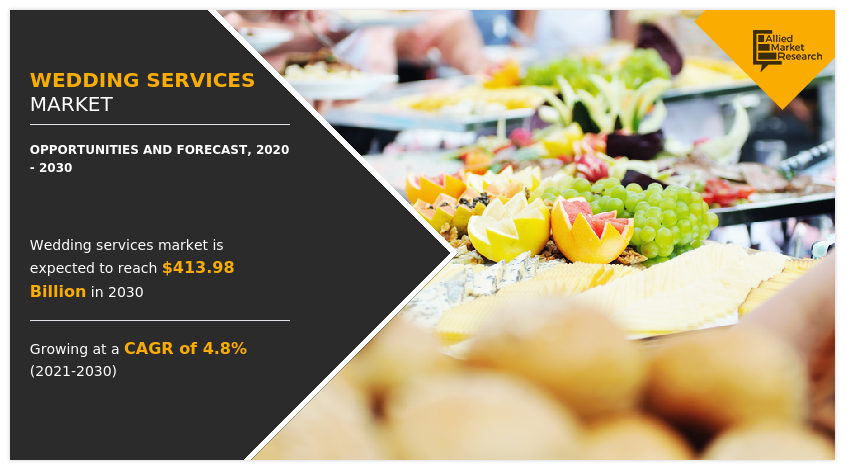
The global wedding services market size was valued at USD 160.5 billion in 2020, and is projected to reach USD 414.2 billion by 2030, growing at a CAGR of 4.8% from 2021 to 2030. The global wedding services market is experiencing growth due to rising demand for destination weddings, increasing spending on luxury and customized wedding experiences, and growing influence of digital platforms for wedding planning and bookings.
Market Size & Forecast
- 2020 Market Size: USD 160.5 Billion
- 2030 Projected Market Size: USD 414.2 Billion
- Compound Annual Growth Rate (CAGR) (2021–2030): 4.8%
Wedding services encompass a broad range of professional offerings designed to facilitate and enhance the planning, organization, and execution of weddings. These services include venue selection, catering, décor, photography and videography, entertainment, wedding attire, invitation design, transportation, and coordination of ceremonies. The market also increasingly includes digital services such as online planning platforms, AI-driven vendor matching, virtual venue tours, and e-invitation solutions, reflecting the growing reliance on technology in wedding management.
Wedding services are applied across multiple stages of the wedding process. Pre-wedding services involve planning, budgeting, vendor selection, and pre-event ceremonies. During the wedding, services include event coordination, catering, décor, music, photography, and guest management. Post-wedding services may involve honeymoon planning, thank-you gifts, and photo/video album creation. Destination weddings, a major application, require additional services such as travel arrangements, accommodation, and local event coordination. Another application is luxury and multi-day weddings, which demand extensive customization and high-end services to create memorable experiences.
Who Are the Primary End Users Driving Market Adoption?
The primary end users driving adoption in the wedding services market are engaged couples, who seek personalized, convenient, and memorable wedding experiences. Millennials and Gen Z couples, in particular, are increasingly tech-savvy and rely on online platforms, social media, and AI-driven tools for planning. Family members, especially parents, also play a significant role by contributing financially and influencing vendor and service choices. In addition, corporate clients occasionally utilize wedding services for large-scale or themed events. The combination of couples’ desire for unique experiences and families’ involvement in planning and budgeting is a key factor propelling market growth globally.
In addition, event planners occasionally leverage wedding services for themed celebrations or large-scale ceremonies, particularly in luxury or destination weddings. Vendors and service providers, such as florists, photographers, and caterers, also indirectly benefit by partnering with wedding platforms and planners to reach end users.
Segment review
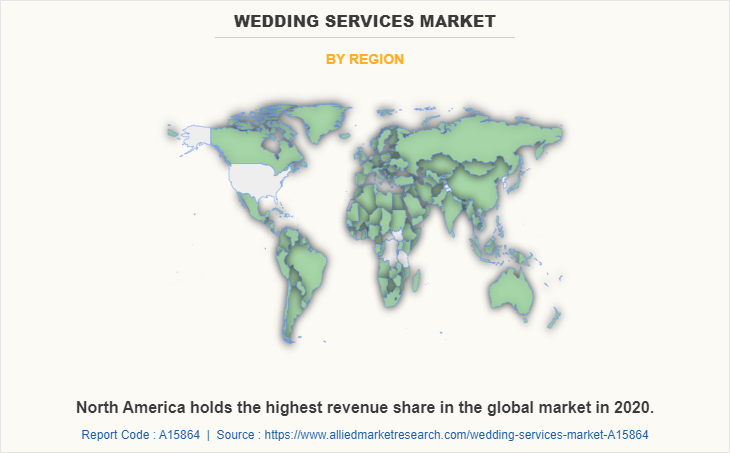
The report is analyzed by booking type, which includes online booking and offline booking. The report further segments the market on the basis of planning type such as full planning service, partial planning services and day of coordination. Based on service type, the market is further classified into videography/photography services, catering services, decoration services, transport services, wedding planning services and others. On the basis of wedding type, the Wedding services market share is bifurcated into destination wedding and local wedding. Furthermore, it includes revenue generated from the wedding services across North America, Europe, Asia-Pacific and LAMEA.
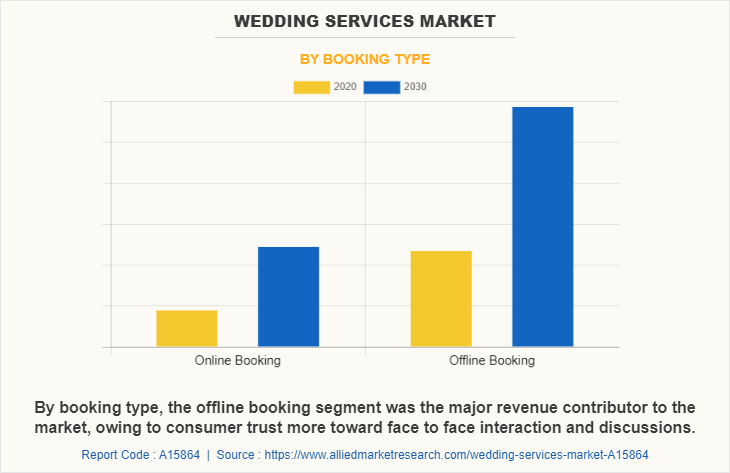
By booking type, the offline booking segment was the major revenue contributor to the market, owing to consumer trust more toward face to face interaction and discussions.
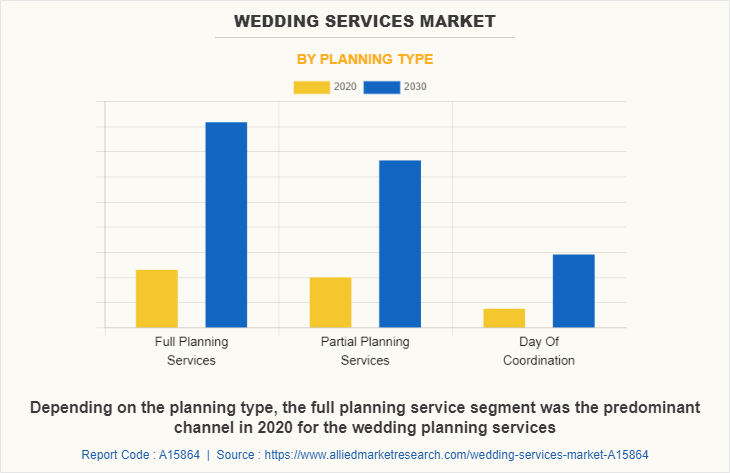
Depending on the planning type, the full planning service segment was the predominant channel in 2020 for the wedding planning services and is expected to exhibit the highest growth rate during the forecast period.
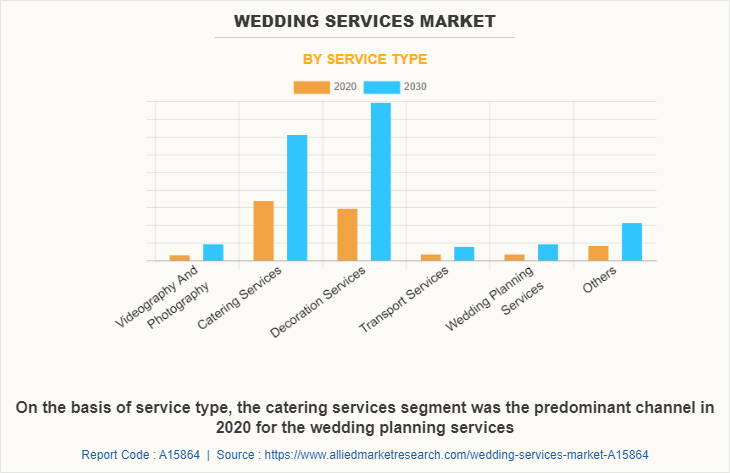
On the basis of service type, the catering services segment was the predominant channel in 2020 for the wedding planning services; however photography/videography segment is expected to exhibit the highest growth rate during the forecast period.
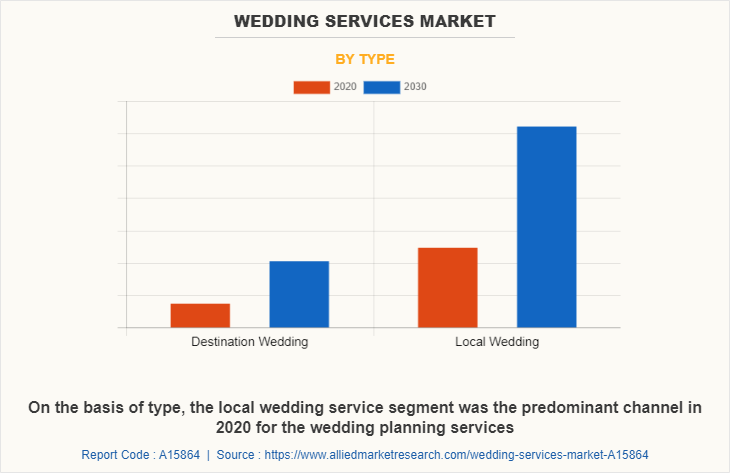
On the basis of type, the local wedding service segment was the predominant channel in 2020 for the wedding planning services; however, destination wedding services segment is expected to exhibit the highest growth rate during the forecast period.
The report focuses on the Wedding services Market share, growth prospects, restraints, and opportunities of the global wedding services market. The study provides Porter’s five forces analysis to understand the impact of various factors such as competitive intensity of competitors, bargaining power of suppliers, threat of substitutes, threat of new entrants, and bargaining power of buyers in the global wedding services market.
The players operating in the global wedding services market have adopted various developmental strategies to increase their market share, gain profitability, and remain competitive in the market. The key players operating in the wedding services market include- Augusta Cole Events, Colin Cowie, David Stark, Fallon Carter, A Charming Fête, Nordic, Adventure Weddings, JZ Events, Lindsay, Landman, Eventures Asia (Bali), and BAQAA Glamour Weddings & Events.
Key Market Dynamics
The demand for wedding services is driven by cultural and social significance attached to weddings, increasing disposable incomes, and the desire for personalized, memorable experiences. In addition, digital adoption and social media influence are encouraging couples to invest in creative, unique, and highly curated wedding experiences. This has created opportunities for both traditional service providers and tech-enabled platforms to cater to diverse customer preferences, ranging from budget-friendly local weddings to extravagant, multi-day destination celebrations.
The wedding services market is primarily driven by the increasing preference for personalized and memorable wedding experiences. Rising disposable incomes, especially among millennials and Gen Z, enable higher spending on décor, photography, entertainment, and luxury services. Social media influence encourages couples to invest in shareable, visually appealing events, further fueling demand. The growing trend of destination weddings, multi-day celebrations, and themed ceremonies is also boosting the adoption of comprehensive wedding services. In addition, digital platforms, AI-driven planning tools, and online booking systems offer convenience and efficiency, attracting tech-savvy couples.
Restraints
High costs associated with destination and luxury weddings remain a significant market restraint, limiting adoption among budget-conscious couples. Dependence on multiple vendors and coordination challenges can create complexity and delays, discouraging some users. Traditional preferences in certain regions may also slow the adoption of modern, technology-enabled wedding services.
Opportunities
The increasing adoption of digital solutions, including AI, AR/VR, and online booking platforms, presents significant growth opportunities. Emerging trends like eco-friendly weddings, intimate ceremonies, and customizable multi-day events offer potential for service differentiation. Expanding markets in Asia-Pacific, particularly Southeast Asia and India, provide lucrative prospects due to cultural emphasis on elaborate celebrations. Collaborations between tech platforms and vendors can further enhance personalized offerings, boosting revenue potential.
How Are Consumer Preferences Shaping Market Trends?
Consumer preferences are a major driver of evolving trends in the wedding services market. Today’s couples increasingly prioritize personalization and unique experiences over traditional ceremonies. This shift has fueled demand for customized décor, themed weddings, curated entertainment, and multi-day celebrations that reflect individual tastes and cultural influences. Social media plays a significant role, as couples seek Instagram-worthy venues, photography, and event designs to share with a broader audience, influencing vendors to offer visually striking, creative solutions.
Millennials and Gen Z couples are tech-savvy, relying heavily on online platforms, mobile apps, and AI-driven tools to research, compare, and book wedding services. This preference for convenience, transparency, and efficiency has accelerated the growth of digital planning platforms, virtual venue tours, and online vendor marketplaces.
In addition, there is a growing trend toward destination weddings and intimate, eco-friendly ceremonies, driven by sustainability concerns and the desire for memorable experiences. Couples increasingly value services that combine luxury, convenience, and innovation, encouraging vendors to offer integrated solutions such as AI-assisted planning, AR/VR visualization, and all-in-one wedding packages.
Overall, consumer preferences for personalization, technology adoption, and immersive experiences are shaping the market toward highly customized, tech-enabled, and experience-driven wedding services, creating opportunities for innovation and growth across the sector.
What Technological Innovations Are Creating New Growth Opportunities?
Technological innovations are significantly reshaping the wedding services market, creating new growth opportunities by enhancing convenience, personalization, and efficiency. Artificial intelligence (AI) tools are being used to match couples with vendors, suggest décor themes, and optimize wedding planning based on budgets and preferences. This reduces planning time and improves decision-making. Augmented reality (AR) and virtual reality (VR) enable virtual venue tours, digital décor visualization, and even virtual try-ons for wedding attire, helping couples make confident choices without physically visiting multiple locations.
Online booking platforms and integrated mobile apps streamline the coordination of multiple services, from catering and photography to entertainment and transportation, creating a seamless experience for couples and vendors. Cloud-based management systems allow event planners to manage logistics, schedules, and budgets efficiently, even for multi-day or destination weddings.
Social media analytics, data-driven insights, and e-invitations also enable targeted marketing and personalized experiences, allowing service providers to better understand customer preferences. Collectively, these innovations expand market reach, reduce operational challenges, and cater to the growing demand for unique, tech-enabled, and hassle-free wedding experiences worldwide.
Which Regions Are Emerging as High-Growth Markets?
The wedding services market is witnessing rapid growth across several regions, with Asia-Pacific, the Americas, and parts of the Middle East emerging as high-potential markets. Asia-Pacific, particularly countries like India, China, and Southeast Asian nations, is experiencing significant expansion due to a large population, high marriage rates, and cultural emphasis on elaborate, multi-day celebrations. Rising disposable incomes, urbanization, and increased social media influence are encouraging couples to spend more on personalized and luxury wedding experiences, driving demand for professional wedding services and planners.
In the Americas, especially the United States and Canada, the popularity of destination weddings and the growing preference for unique, experience-driven ceremonies are fueling market growth. Couples increasingly rely on digital platforms and AI-enabled tools for planning, boosting adoption of tech-driven wedding services.
The Middle East, with countries like the UAE and Saudi Arabia, is also witnessing growth due to high spending on opulent weddings, increasing tourism, and investment in luxury hospitality infrastructure. Collectively, these regions represent lucrative opportunities for vendors, planners, and digital platforms to expand their offerings and cater to evolving customer preferences.
How Is Artificial Intelligence Transforming This Market?
Artificial Intelligence (AI) is revolutionizing the wedding services market by enhancing personalization, efficiency, and decision-making throughout the wedding planning process. AI-driven tools can analyze couples’ preferences, budget constraints, and past behavior to recommend suitable vendors, venues, décor styles, and entertainment options, helping create highly customized and memorable weddings. This reduces planning time and minimizes decision fatigue, particularly for tech-savvy millennials and Gen Z couples.
AI-powered chatbots and virtual assistants provide real-time support, answering queries, scheduling appointments, and coordinating multiple vendors, streamlining communication and reducing the risk of errors. Predictive analytics helps service providers forecast demand for specific services, optimize pricing, and manage inventory, leading to more efficient operations.
In addition, AI is increasingly integrated with augmented reality (AR) and virtual reality (VR) technologies, allowing couples to visualize venue layouts, décor arrangements, and wedding themes before making final decisions. Platforms leveraging AI also facilitate data-driven marketing by analyzing social media trends, online reviews, and customer behavior, enabling vendors to offer tailored promotions and packages.
Overall, AI is transforming the wedding services market by delivering more personalized, efficient, and data-driven solutions, enhancing the customer experience, and providing vendors with tools to optimize operations and expand their market reach globally.
What Are the Major Risks and Challenges Facing the Market?
The wedding services market faces several risks and challenges that could impact growth and profitability. High costs remain a significant barrier, particularly for destination and luxury weddings, limiting adoption among budget-conscious couples. Multi-day celebrations and elaborate ceremonies require substantial financial and logistical commitments, which can deter participation in some regions.
Operational complexity is another challenge. Weddings involve coordination among multiple vendors, including caterers, decorators, photographers, and entertainment providers. Miscommunication, delays, or service inconsistencies can negatively affect customer satisfaction and reputation. In emerging markets, the lack of standardized service quality and regulatory oversight may exacerbate these issues.
Technological adoption risks also exist. While digital platforms, AI tools, and online booking systems drive growth, reliance on technology introduces challenges such as cybersecurity threats, data privacy concerns, and potential system failures. Some couples and vendors may also prefer traditional, in-person interactions, slowing adoption of tech-enabled services.
In addition, external factors like economic fluctuations, geopolitical instability, and travel restrictions (particularly for destination weddings) can impact spending patterns. Social and cultural sensitivities, such as traditional practices and expectations, may also restrict the implementation of modern or non-traditional services.
Overall, balancing cost, operational efficiency, technology adoption, and cultural preferences remains critical for mitigating risks and sustaining market growth.
What Is the Long-Term Outlook for the Market?
The long-term outlook for the wedding services market is highly positive, driven by evolving consumer preferences, technological advancements, and rising disposable incomes globally. Weddings are increasingly viewed as personalized, experience-driven events, prompting couples to invest in professional services, luxury venues, and customized experiences. This trend is expected to sustain demand across both traditional and destination weddings over the next decade.
Digital transformation is also shaping the market’s future. AI-driven planning tools, online booking platforms, and AR/VR visualization are likely to become standard offerings, making wedding planning more efficient and tailored to individual preferences. Social media and influencer trends will continue to encourage spending on elaborate décor, photography, and entertainment, further expanding the market.
Asia-Pacific is expected to remain a key growth region due to cultural emphasis on multi-day weddings and increasing affluence, while North America and Europe will continue to see growth driven by destination weddings and tech-enabled services.
Challenges such as high costs, operational complexity, and regulatory constraints will persist but can be mitigated through innovation, digital adoption, and vendor collaboration. Overall, the market is poised for steady growth, driven by demand for personalization, experiential weddings, and technology-enhanced solutions, making it a lucrative sector for both established and emerging players.
Competitive Landscape
The players operating in the global wedding services market have adopted various developmental strategies to increase their market share, gain profitability, and remain competitive in the market. The key players operating in the wedding services market include- Augusta Cole Events, Colin Cowie, David Stark, Fallon Carter, A Charming Fête, Nordic, Adventure Weddings, JZ Events, Lindsay, Landman, Eventures Asia (Bali), and BAQAA Glamour Weddings & Events.
The report focuses on the wedding services market share, growth prospects, restraints, and opportunities of the global wedding services market. The study provides Porter’s five forces analysis to understand the impact of various factors such as competitive intensity of competitors, bargaining power of suppliers, threat of substitutes, threat of new entrants, and bargaining power of buyers in the global wedding services market.
KEY BENEFITS FOR STAKEHOLDERS
This report provides an in-depth wedding services market analysis of the global to identify the potential investment pockets.
It outlines the current trends and future scenarios to determine the overall market potential and gain a stronger market foothold.
It discusses the key drivers, restraints, and opportunities and their detailed impact analysis.
Quantitative analysis of the market from 2020 to 2030 is highlighted to recognize the financial competency of the market.
The Porter’s five forces model illustrates the threat of new entrants, threat of substitutes, and strength of the buyers & suppliers.
Wedding Services Market Report Highlights
| Aspects | Details |
 By Planning Type |
|
 By Service Type |
|
 By Type |
|
 By Booking Type |
|
 By Region |
|
 Key Market Players | Lindsay Landman, A Charming Fête, BAQAA Glamour Weddings and Events, Fallon Carter, Augusta Cole Events, JZ Events, Nordic Adventure Weddings, Colin Cowie, David Stark, Eventures Asia (Bali) |
Analyst Review
The wedding services industry is growing at a significant pace, and is anticipated to continue this trend in the coming years. Wedding events are playing a vital role in revenue generation and brand equations for corporates and associations. This industry is witnessing the entry of new and independent players who are leveraging technology to gain a competitive advantage in the today’s consolidated environment. Conversely, the focus of companies is to enhance attendee experience and witness successful completion of a wedding services without any hindrance, thus driving the growth of the wedding services industry.
In addition, a new products have been launched in the market in order to provide more realistic experience to the couples planning virtual weddings. In comparison to traditional photos and videos of a wedding venue, these products give couples the most realistic experience next to physically standing in an event space. With today’s sheltering recommendations in place, this resource allows couples to take a real-life walk-through of a venue property completely virtually on any screen from home. Therefore, the industry is becoming dynamic in nature and is adapting the changing trends, which is propelling the market growth.
5.0-5.9% is the market growth of emerging countries.
2021-2030 would be forecast period in the market report.
$271.5 billion is the market value of wedding services market in 2021.
The top companies hold the market share in wedding services market are Augusta Cole Events, Colin Cowie, David Stark, Fallon Carter, A Charming Fête, Nordic, and Adventure Weddings.
Videography/Photography services is the most influencing segment growing in the wedding services market report.
Rise in customer inclination towards destination wedding and big budget weddings are the key trends in the wedding services market report.
2020 is base year calculated in the wedding services market report.
Loading Table Of Content...