
Dental Market Research, 2033
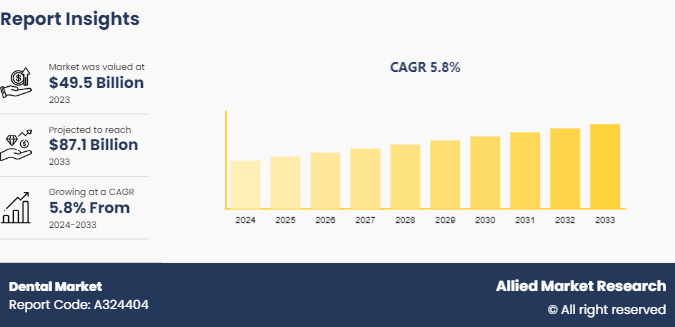
The global dental market size was valued at $49.5 billion in 2023, and is projected to reach $87.1 billion by 2033, growing at a CAGR of 5.8% from 2024 to 2033. Growing awareness of oral health, increasing demand for cosmetic dentistry, and technological advancements such as digital imaging and CAD/CAM systems are the major factors which drive the dental market growth.
Market Introduction and Definition
Dental market refers to the comprehensive ecosystem of products, services, and technologies focused on the prevention, diagnosis, and treatment of oral health conditions. It encompasses a wide range of dental equipment, consumables, restorative materials, orthodontic solutions, and cosmetic dentistry products used by dental professionals across clinics, hospitals, and laboratories. The market also includes dental implants, prosthetics, endodontic instruments, and preventive care products designed to improve oral hygiene and overall dental outcomes.
The dental market plays a significant role in maintaining oral health and enhancing aesthetic appearance. It supports the management of conditions such as dental caries, periodontal diseases, malocclusion, and tooth loss. Technological advancements such as digital dentistry, 3D printing, laser dentistry, and CAD/CAM systems have significantly transformed treatment procedures, enabling greater precision, efficiency, and patient comfort. These innovations allow for faster diagnostics, customized restorations, and minimally invasive procedures.
The market serves both therapeutic and cosmetic purposes, with increasing demand for procedures such as teeth whitening, veneers, clear aligners, and dental implants. Growing awareness about oral hygiene, rising disposable income, and expanding access to dental care services further contribute to market expansion. In addition, the integration of advanced imaging systems and dental practice management software enhances clinical workflow and patient outcomes, strengthening the overall growth and development of the dental market globally.
Key Takeaways
- The dental market study covers 20 countries. The research includes a segment analysis of each country in terms of value for the projected period.
- More than 1, 500 product literatures, industry releases, annual reports, and other such documents of major dental industry participants along with authentic industry journals, trade associations' releases, and government websites have been reviewed for generating high-value industry insights.
- The study integrated high-quality data, professional opinions and analysis, and critical independent perspectives. The research approach is intended to provide a balanced view of global markets and to assist stakeholders in making educated decisions in order to achieve their most ambitious growth objectives.
Key Market Dynamics
The dental market is evolving rapidly, supported by technological advancements, rising awareness of oral health, and increasing demand for aesthetic and restorative procedures.
Drivers
Growing prevalence of dental disorders such as dental caries, periodontal diseases, and tooth loss is one of the major factors driving the growth of the dental market. Changing dietary habits, increasing consumption of sugary foods, tobacco use, and aging populations contribute significantly to oral health issues worldwide. In addition, the global shift toward preventive healthcare encourages regular dental check-ups and early diagnosis, supporting consistent demand for dental services and products.
Rising demand for cosmetic dentistry further accelerates dental market growth. Procedures such as teeth whitening, veneers, clear aligners, and dental implants are increasingly popular due to heightened aesthetic awareness and social media influence. Technological advancements, including digital imaging systems, CAD/CAM technology, 3D printing, and laser dentistry, enhance precision, reduce treatment time, and improve patient comfort. These innovations increase clinical efficiency and encourage adoption among dental professionals. Furthermore, expanding dental insurance coverage and growth in dental tourism in emerging economies contribute to increased patient access to advanced treatments.
Opportunities
Integration of digital dentistry with artificial intelligence and cloud-based practice management systems offers significant growth opportunities. AI-powered diagnostics, digital impressions, and teledentistry platforms improve treatment planning and patient engagement. Growing investments in minimally invasive and biomaterial-based restorative solutions also create opportunities for manufacturers. Increasing awareness campaigns and school-based oral health programs further expand preventive care markets globally.
Restraints
High costs associated with advanced dental procedures and equipment limit adoption, particularly in low- and middle-income regions. Initial investment in digital systems and specialized training can be substantial for small clinics. In addition, lack of reimbursement policies in certain regions and limited access to skilled dental professionals may hinder market growth during the forecast period.
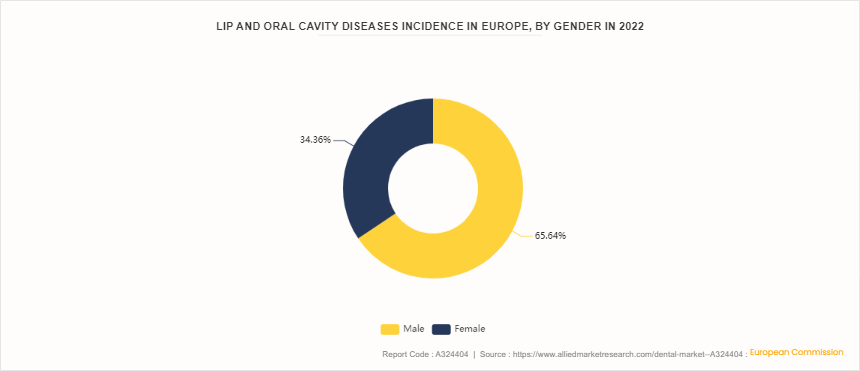
Lip and oral Cavity Diseass Incidence in Europe, by Gender in 2022
According to European Commission, in 2022, the incidence of lip and oral cavity cancers in Europe demonstrates a notable gender disparity, with males accounting for 66% of cases compared to females at 34%. This discrepancy reflects a higher prevalence of these cancers among men, which could be attributed to higher rates of risk factors such as tobacco and alcohol use traditionally more common among males.
This data emphasizes the urgent need for targeted prevention and treatment strategies in the dental and oral health sectors. Given the significant incidence among males, there is an increased demand for early detection, diagnostic services, and effective treatment options. The dental market, therefore, plays a crucial role in addressing these needs by offering advanced diagnostic tools, therapeutic solutions, and preventive care aimed at reducing the incidence and impact of oral cavity cancers. As awareness and screening programs continue to evolve, the dental industry's innovations and efforts will be vital in improving outcomes and managing the burden of these conditions effectively.
Market Segmentation
The dental market is segmented into product type, end user, and region. On the basis of product type, the market is segmented into dental consumables and dental equipment. The dental consumables segment is further classified into dental restoration products, orthodontics, endodontics, and others. The dental equipment segment is further divided into dental laser equipment, dental radiology equipment, dental software and imaging, mechanical systems, and others. By end user, the market is divided into hospitals and dental clinics, academic institute and research centers, and others. By region, it is analyzed across North America, Europe, Asia-Pacific, and LAMEA.
Regional/Country Market Outlook
North America is expected to have a significant dental market share uring the forecast period owing to high adoption rates of advanced dental technologies. These regions benefit from well-established healthcare systems, reimbursement policies, and a large pool of skilled dental professionals, driving market growth. Moreover, the presence of key market players and ongoing research and development activities contribute to market expansion.
- In March 2023, Canadian Dental Association received $13.0 billion funding from government to improve the oral health of Canadians and?expand access to dental care solutions. This investment enables the expansion of dental care facilities, the integration of advanced technologies, and the development of new dental programs thereby supports the market growth.
- The World Health Organization (WHO) Europe calls for urgent action on oral disease as the highest rates globally are recorded in European Region in 2019.
- According to the 2022 National Dental Epidemiology Program survey (UK) , it was reported that prevalence of children with enamel and/or dentinal decay was 29.3%. This significant prevalence led to the urgent need for advanced dental diagnostic tools, driving the growth of the dental market.
In emerging countries such as China, India, and Brazil, the market for dental products is witnessing rapid growth fueled by factors such as increasing healthcare expenditure, rising dental tourism, and growing awareness about advanced dental treatments. These countries are investing in upgrading their healthcare infrastructure and adopting digital dentistry solutions to improve patient care and outcomes, creating opportunities for market players to expand their presence.
- According to 2023 article by the National Library of Medicine, it was reported that overall prevalence of periodontal disease was 50% in southern part of India. This high prevalence drives the growth of the dental market in India by highlighting the critical need for precise and early diagnosis of periodontal conditions.
Industry Trends
- According to the World Health Organization (WHO) in 2023, about 2 billion people worldwide suffer from dental cavities. This widespread prevalence of dental cavities drives the growth of the dental market by increasing the need for precise and efficient diagnostic tools.
- According to 2023 article by World Health Organization (WHO) , it was reported that oral diseases affect nearly 3.5 billion people globally, thereby driving the demand for dental products.
- According to 2023 article by American Dental Association, 17% of dentists uses 3D printer. Furthermore, among nonusers, 21% of dentists were considering investing in a 3D printer. This drives the dental market by increasing demand for 3D printers and related materials, promoting innovation in dental procedures such as custom prosthetics and orthodontics.
Key End-User Segments Fueling Market Growth
The dental market is driven by several primary end users. Dental clinics represent the largest end-user segment, serving as the main point of care for preventive, restorative, orthodontic, and cosmetic procedures. General dentists and specialists, including orthodontists, periodontists, prosthodontists, and endodontists—use a broad portfolio of dental consumables, imaging systems, implant solutions, and CAD/CAM technologies to improve treatment precision and patient outcomes. The rapid shift toward digital dentistry within private practices and group clinics continues to accelerate technology adoption.
Hospitals and multispecialty healthcare centers also contribute significantly to market demand. These facilities handle complex dental surgeries, trauma management, and oral-maxillofacial procedures that require advanced imaging systems, surgical tools, and implant technologies. The integration of specialized dental departments within larger healthcare institutions further strengthens demand for sophisticated equipment and high-performance materials.
Dental laboratories are another vital segment, supporting restorative and prosthetic procedures. They rely on digital impression systems, 3D printing technologies, milling machines, and advanced biomaterials to produce crowns, bridges, dentures, and clear aligners. Increasing automation and chairside CAD/CAM adoption continue to reshape laboratory workflows and boost investments in innovative manufacturing solutions.
Academic institutions and research centers also drive adoption by incorporating advanced technologies into clinical training and oral health research programs. Government funding and private-sector investments promote innovation in regenerative dentistry, biomaterials, and minimally invasive procedures. In addition, dental service organizations (DSOs) are emerging as influential adopters by consolidating practices and standardizing advanced technology across networks.
Patent Analysis for the Dental Market
According to the World Intellectual Property Organization (WIPO) patent analysis spanning 2022 to 2024, China accounted for 36.5% of global dental-related patents, followed by the U.S. at 20.2%. The Patent Cooperation Treaty (PCT) represented 14.4%, while the European Patent Office and Japan contributed 10.1% and 9.3%, respectively. Other contributors included the Republic of Korea and Germany. This patent distribution reflects concentrated innovation in digital imaging, implant systems, orthodontic devices, and dental biomaterials. China’s strong patent activity highlights its expanding manufacturing and technological capabilities, while the U.S. and European regions remain leaders in research-driven, high-value dental product development.
Impact of Evolving Consumer Preferences on Dental Market Trends
Consumer preferences are playing a pivotal role in transforming trends within the dental market. One of the most significant shifts is the growing demand for cosmetic and aesthetic dentistry. Patients increasingly seek treatments such as teeth whitening, clear aligners, veneers, and minimally invasive smile enhancement procedures. Social media influence, virtual interactions, and heightened awareness of personal appearance have expanded the market beyond therapeutic care to include elective aesthetic solutions.
Consumers are also prioritizing convenience and comfort in dental care. There is rising demand for painless procedures, shorter treatment durations, and digitally enabled services. Technologies such as digital impressions, same-day crowns using CAD/CAM systems, and laser dentistry are gaining popularity due to improved efficiency and reduced chair time. Clinics offering flexible scheduling, online appointment booking, and transparent pricing structures gain competitive advantages.
Another key trend is the preference for preventive and holistic oral care. Patients are increasingly aware of the link between oral health and overall well-being, prompting regular check-ups and early intervention. This supports demand for preventive products, routine diagnostics, and minimally invasive treatments.
Digital integration further shapes market growth. Consumers favor dental practices that provide digital treatment planning, virtual consultations, and access to electronic records. Teledentistry platforms and mobile communication tools enhance patient engagement and follow-up care. In addition, growing sensitivity to data privacy and safety standards influences trust and provider selection. Collectively, these evolving preferences continue to redefine service delivery models and technology adoption across the global dental market.
Competitive Landscape
The major players operating in the dental market include Henry Schein Inc., PLANMECA OY, Envista, Dentsply Sirona, BIOLASE, Inc., OSSTEM IMPLANT CO., LTD., Koninklijke Philips N.V., 3M, Zimmer Biomet, Align Technology, Inc. Other players in the dental market include Ivoclar Vivadent Institut Straumann AG, Carestream Dental LLC, 3Shape, and so on.
Leading Companies and Strategic Initiatives Shaping the Dental Market
Key players operating in the dental market include Henry Schein Inc., PLANMECA OY, Envista, Dentsply Sirona, BIOLASE, Inc., OSSTEM IMPLANT CO., LTD., Koninklijke Philips N.V., 3M, Zimmer Biomet, and Align Technology, Inc. Other notable participants include Ivoclar Vivadent, Institut Straumann AG, Carestream Dental LLC, and 3Shape. These companies hold significant market shares due to their comprehensive product portfolios, global distribution networks, and continuous investments in innovation.
A central strategy among leading firms is technological advancement and digital integration. Companies such as Dentsply Sirona and PLANMECA OY focus on digital imaging systems, CAD/CAM solutions, and chairside technologies that enhance workflow efficiency and clinical precision. Align Technology emphasizes clear aligner innovation and digital orthodontic platforms to strengthen its leadership in aesthetic dentistry.
Strategic acquisitions and partnerships are also widely adopted to expand geographic presence and product capabilities. Henry Schein and Envista leverage strong distribution networks and portfolio diversification to support dental professionals globally. Meanwhile, BIOLASE invests in advanced laser dentistry systems to promote minimally invasive procedures. Implant-focused companies such as OSSTEM IMPLANT and Institut Straumann AG prioritize research-driven product development and premium implant solutions. Collectively, these strategies reinforce competitive positioning and drive sustained growth across the global dental market.
Recent Key Strategies and Developments in Dental Industry
- In February 2024, 3Shape expanded treatment opportunities for dental practices with TRIOS-meets-prime and 3Shape Automate. 3Shape will showcase its latest solutions for dental practices, including the award-winning TRIOS 5 intraoral scanner, 3Shape Unite platform, and value-bringing integrations.
- In December 2021, Carestream Dental LLC announced that it has entered into an agreement to sell Carestream Dental’s Scanning Technology business to Envista Holding Corporation (“Envista”) , a leading global dental products company for $600 million. The Scanning Technology business is composed of Carestream Dental’s intraoral scanner equipment (CS 3600, CS 3700, and CS 3800) and related software.
Key Sources Referred
- National Center for Biotechnology and Information (NCBI)
- Centers for Medicare & Medicaid Services (CMS)
- National Health Service (NHS)
- Australian Government Department of Health and Aged Care
- Government of Canada's Health and Wellness
- Ministry of Health and Family Welfare (MoHFW)
- National Health Mission (NHM)
- Ayushman Bharat - Health and Wellness Centers (AB-HWCs)
- Centers for Disease Control and Prevention (CDC)
- Food and Drug Administration (FDA)
- National Institutes of Health (NIH)
- World Health Organization (WHO)
Key Benefits for Stakeholders
- This report provides a quantitative analysis of the market segments, current trends, estimations, and dynamics of the dental market analysis from 2024 to 2033 to identify the prevailing dental market opportunities.
- The Dental market research is offered along with information related to key drivers, restraints, and opportunities.
- Porter's five forces analysis highlights the potency of buyers and suppliers to enable stakeholders to make profit-oriented business decisions and strengthen their supplier-buyer network.
- In-depth analysis of the dental market segmentation assists to determine the prevailing market opportunities.
- Major countries in each region are mapped according to their revenue contribution to the global market.
- Market player positioning facilitates benchmarking and provides a clear understanding of the present position of the market players.
- The report includes the analysis of the regional as well as global dental market trends, key players, market segments, application areas, and market growth strategies.
Dental Market , by Product Type Report Highlights
| Aspects | Details |
 Market Size By 2033 | USD 87.1 Billion |
 Growth Rate | CAGR of 5.8% |
 Forecast period | 2024 - 2033 |
 Report Pages | 250 |
 By Product Type |
|
 By End User |
|
 By Region |
|
 Key Market Players | PLANMECA OY, 3M , BIOLASE, Inc. , Zimmer Biomet, OSSTEM IMPLANT CO., LTD. , Henry Schein Inc., Envista , Align Technology, Inc., Koninklijke Philips N.V.,, Dentsply Sirona |
The total market value of dental market is $49.5 billion in 2023.
The market value of dental market in 2033 is $87.1 billion.
The forecast period for dental market is 2024 to 2033.
The growth is driven by the rising prevalence of dental diseases, increasing awareness about oral health, advancements in dental technology, a growing demand for cosmetic dentistry, and an expanding geriatric population.
The dental market encompasses the global industry focused on the diagnosis, prevention, and treatment of oral health issues. It includes products and services such as dental equipment, implants, orthodontics, and cosmetic dentistry.
Loading Table Of Content...