
Esports Industry Overview
The global esports market size was valued at USD 1.3 billion in 2023, and is projected to reach USD 9.2 billion by 2033, growing at a CAGR of 21.2% from 2024 to 2033.
Rise in the number of live streaming platforms such as Twitch and YouTube gaming has expanded audience reach, making Esports industry growth more accessible to a global audience. Mobile gaming is also becoming a dominant force, particularly in regions such as Asia-Pacific, due to increased smartphone penetration. Another significant trend is the professionalization of esports, with growing investments from traditional sports teams, media companies, and brands. In addition, advancements in virtual reality (VR) and augmented reality (AR) are creating new immersive gaming experiences, enhancing player engagement and spectator interaction.
Key Market Insights
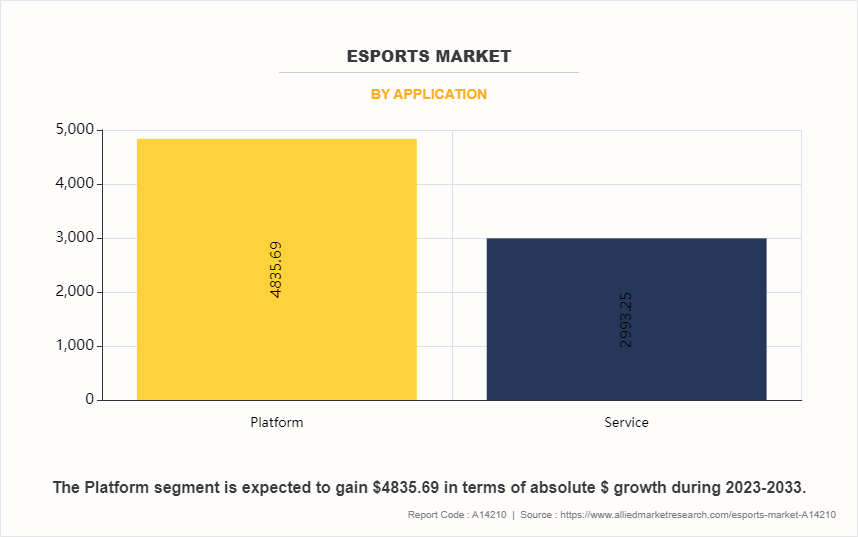
By application, the platform segment accounted for the largest market share in 2023.
By streaming type, the on demand segment accounted for the largest market share in 2023.
By device type, the smart phone segment accounted for the largest esports market share in 2023.
By revenue stream, the sponsorship segment accounted for the largest market share in 2023.
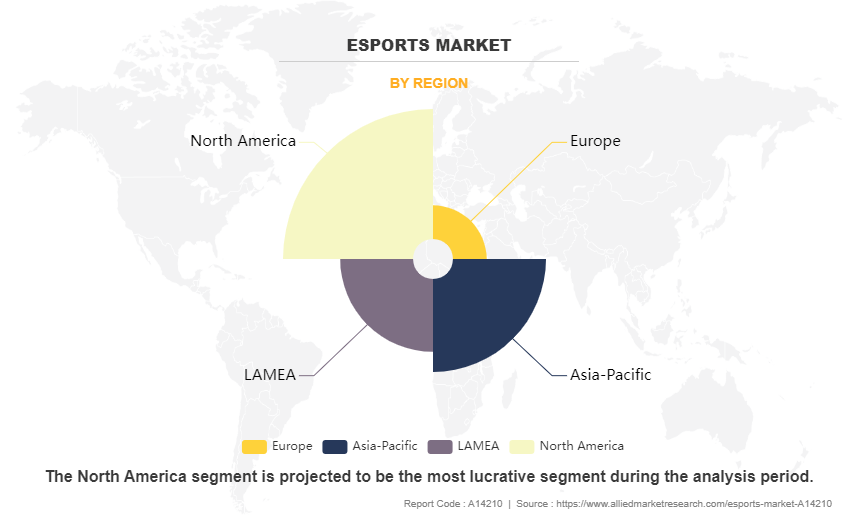
Region-wise, North America generated the highest revenue in 2023.
Market Size & Forecast
- 2033 Market Size: USD 9.2 Billion
- 2023 Projected Market Size: USD 1.3 Billion
- Compound Annual Growth Rate (CAGR) (2024-2033): 21.2%
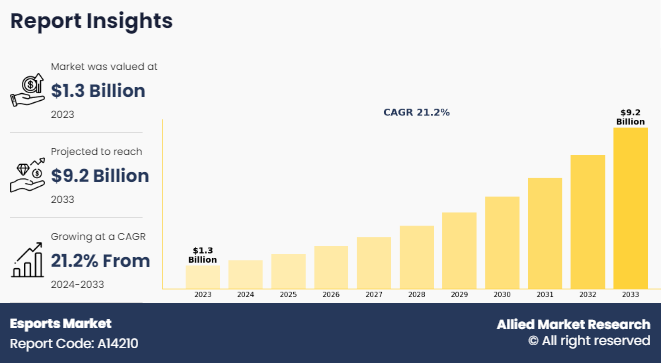
Electronic sports, commonly known as esports or eGames, refer to organized and competitive video gaming in which individual players or teams compete in structured tournaments for prize money, titles, and recognition. Similar to traditional sports, professional esports athletes train extensively and compete at elite levels to secure top rankings in their respective games.
Esports applications span professional tournaments, live streaming, team management, player training, event hosting, sponsorship activation, and fan engagement. They are also used in collegiate competitions, brand marketing campaigns, data analytics, betting platforms, and mobile gaming ecosystems, supporting both competitive play and commercial growth worldwide.
The rapid growth of esports has been fueled by continuous technological advancements and the expansion of digital and streaming platforms. High-speed internet, cloud gaming, and interactive broadcasting have enhanced both player performance and spectator engagement. In addition, the increasing number of smartphone users has significantly improved accessibility, enabling consumers to play and watch esports from virtually any location. Gamers are no longer confined to desktop setups, as mobile devices now provide seamless participation and live-stream viewing experiences. In addition, widespread adoption of advanced technologies and online platforms drive the global expansion and mainstream acceptance of the esports industry.
Esports Market Segment Review
The esports market size is segmented on the basis of application, streaming type, device type, revenue stream, and region. By application, it is bifurcated into platform and service. By streaming type, it is divided into live and on demand. By device type, it is categorized into smart phone, smart TV, desktop-laptop-tablets, gaming console. By revenue stream, it is classified into media rights, game publisher fee, sponsorship, digital advertisement, tickets, and merchandise. Region-wise, it is analysed across North America, Europe, Asia-Pacific, and LAMEA.
On the basis of application, the platform segment dominated the esports market in 2023. The platform segment includes various online platforms that enable gamers, audiences, and organizers to engage with esports events. These platforms facilitate live streaming, player communication, tournament hosting, and audience interaction, making them integral to the growing popularity and commercialization of esports market demand. However, the¯services segment is projected to attain the highest CAGR during the forecast period, owing to rise in demand for professional esports services such as event management, talent acquisition, marketing, and player training.
By region, North America dominated the esports market share in 2023, driven by the region's well-established gaming infrastructure, widespread adoption of digital technologies, and a large base of esports enthusiasts. The region has seen significant investments from media companies, gaming firms, and brands looking to capitalize on the rapidly growing esports ecosystem. However, the Asia-Pacific is projected to attain the highest CAGR during the forecast period. This growth is driven by the increasing popularity of esports in countries like China, South Korea, and Japan, where gaming culture is deeply embedded. The region is also witnessing significant investments in esports infrastructure, tournaments, and sponsorships.
For instance, on March 19, 2025, ExitLag partnered with Talon Esports to enhance esports connectivity across Asia. This collaboration aims to provide Talon's teams with optimized network performance, reducing lag and ensuring a stable gaming experience. ExitLag's technology support Talon's competitive lineups in games like League of Legends, Valorant, Dota 2, and Arena of Valor. This partnership focused on improving the performance and experience of professional esports players.
What are the Top Impacting Factors in Esports Market:
Key Market Drivers
Increase in popularity of online video games
- Increase in popularity of online video games is a major factor driving the growth of the esports market. As more players engage with competitive multiplayer games, especially on digital platforms, the demand for organized tournaments and esports events has surged. The accessibility of online gaming, coupled with advancements in internet connectivity and gaming technologies, has allowed a broader audience to participate in and view esports events. Popular games like League of Legends, Fortnite, and Dota 2 have contributed significantly to the video gaming trend. This in turn is expected to propel the growth of active esports communities, global audience, sponsorship, and investment. Surge in online gaming popularity is creating a robust ecosystem for esports, driving its continuous expansion of the global esports market growth.
Restraint
Data privacy and security concerns
- Data privacy and security concerns are significant factors hampering the growth of the global esports market. As more businesses and consumers rely on digital platforms, the risk of data breaches, cyberattacks, and unauthorized access to sensitive information has increased. These concerns create hesitation among users and organizations in adopting new technologies, especially in sectors like financial services, healthcare, and e-commerce, where data privacy is critical. Government regulations, such as GDPR and CCPA, further complicate compliance, adding costs and complexity to operations. As a result, data security challenges are acting as a barrier to the adoption and growth of the global esports market trends.
Opportunity
Growing sponsorship and investment strategies
The esports market report shows that the market is expected to offer several opportunities for new players in esports market. The increase in the sponsorship landscape within esports presents a tremendous opportunity for companies looking to tap into a highly engaged and dynamic audience. Esports viewership has experienced tremendous growth, with millions of fans around the globe engaging with live events, tournaments, and content on various platforms. This surge has made esports an appealing option for brands aiming to reach younger, tech-savvy audiences. Sponsorship opportunities within the esports realm can manifest in various ways, including event sponsorships, team partnerships, and branded content along with digital activations. Businesses in industries like technology, gaming, consumer products, and energy drinks have already started to invest significantly in esports sponsorships, tapping into the increasing popularity of competitive gaming.
For instance, on January 14, 2025, a America partnered with Cloud9 to become the naming partner for their League of Legends team. The team now competes as Cloud9 Kia, reflecting the shared values of excellence, resilience, and innovation between the two brands. This partnership includes dynamic integrations of the Kia EV9 within the team's branding, content creation, and live events. This development enhances the visibility and engagement of both Kia and Cloud9 within the esports community.
One significant opportunity exists in the partnership between esports organizations and traditional brands. As esports continues to gain recognition, many well-established companies are beginning to see the advantages of engaging with the gaming audience. Sponsorship arrangements can vary from jersey sponsorships to joint content creation, boosting a brand’s visibility and aligning it with the values and culture of the gaming community. Furthermore, the digital nature of esports allows sponsors to monitor engagement metrics and customize their campaigns to enhance both reach and effectiveness, ultimately improving the return on investment for brands.
For instance, on October 21, 2024, Sony Electronics partnered with Cloud9 to enhance Call of Duty performance using cutting-edge technology. As part of this collaboration, Sony provided Cloud9's New York Call of Duty team with state-of-the-art INZONE monitors, designed specifically for competitive gaming. These monitors offer exceptional visual clarity, responsiveness, and performance, giving Cloud9 a competitive edge. This partnership aimed to improve the gaming experience and performance of professional esports players.
Investment in esports also presents significant opportunities. As the industry matures, investors are eager to fund esports organizations, tournament platforms, game developers, and content creators. The financial backing helps these entities scale operations, improve infrastructure, and deliver more engaging experiences to fans. Esports investment can take various forms, including equity investments, venture capital, and even private equity, with some major investors also showing interest in esports media rights and broadcasting deals.
For instance, on January 16, 2025, Logitech partnered with Gen.G to develop an optimal gaming environment for professional play. This collaboration aims to enhance the gaming experience for Gen.G's professional players, academy students, and fans by providing innovative products like the PRO X SUPERLIGHT 2 DEX wireless gaming mouse and customized solutions tailored to each team. This partnership focused on improving the performance and experience of competitive gamers. Moreover, as esports becomes a mainstream phenomenon, the development of new markets and regions, especially in Asia, Europe, and North America, offers further opportunities. Investors and sponsors can capitalize on emerging esports ecosystems, bringing innovative gaming experiences to new audiences and creating sustainable, long-term growth.
For instance, on July 29, 2024, Talon Esports partnered with Certified Saudi Arabia to launch a limited-edition streetwear collection for the 2024 Esports World Cup in Riyadh. This collaboration featured designs inspired by Talon's bird logo and Saudi Arabia's national bird, the falcon, symbolizing strength and national pride. This enhances the visibility and branding of both Talon Esports and Certified Saudi Arabia within the esports community.
Regional/Country Outlook
The regional outlook for the esports market shows varied growth dynamics. North America remains a mature market, supported by franchised leagues, strong sponsorship networks, and advanced digital infrastructure. Europe follows closely, driven by diverse gaming communities and increasing publisher-led tournaments. Asia-Pacific is the fastest-growing region, fueled by large gaming populations in China, South Korea, and Japan, along with expanding mobile esports adoption. Latin America and the Middle East & Africa are emerging markets, benefiting from rising internet penetration and smartphone usage. Continued infrastructure investment, government support, and brand participation will shape country-level growth trajectories worldwide.
What Are the Major Risks and Challenges Involved in the Esports Market?
The esports market faces several key risks and challenges that could impact its growth and sustainability. Monetization and profitability remain major concerns, as many teams and organizations struggle to balance high operational costs, player salaries, and tournament expenses with revenue from sponsorships, advertising, and media rights. Regulatory and legal issues also pose risks, including content restrictions, gaming-hour limits, data privacy laws, and varying regulations across countries, which can hinder participation and operations. Talent management is challenging due to burnout, short career spans, and limited post-competition opportunities, requiring investment in training and wellness.
Market saturation and competition present additional challenges. Rapid growth has led to an influx of games, teams, and platforms, intensifying competition for viewers, sponsorships, and media attention. Emerging technologies, such as AR, VR, and mobile esports, require constant adaptation, making it difficult for smaller players to stay competitive.
Cybersecurity threats and platform reliability are critical, as online tournaments and streaming rely heavily on stable, secure digital infrastructure. Addressing these challenges is essential for sustainable growth in the esports ecosystem.
What Role Do Digital Technologies Play in Improving Products and Services?
Digital technologies are central to enhancing esports products and services by improving performance, engagement, and accessibility. High-speed internet, cloud gaming, and streaming platforms enable seamless live tournaments and real-time interactions between players and audiences. Data analytics and AI tools optimize player training, performance monitoring, and strategy development, while personalized content and recommendation systems enhance fan experiences. Mobile technologies and AR/VR integration expand accessibility, creating immersive viewing and interactive gameplay. In addition, digital platforms allow sponsors and organizers to track engagement metrics, customize campaigns, and monetize content efficiently, driving innovation and elevating the overall quality and reach of esports offerings.
What Technological Innovations are Creating New Growth Opportunities?
Technological innovations are driving significant growth opportunities in the esports market by enhancing both gameplay and audience engagement. Cloud gaming and 5G connectivity enable low-latency, high-quality experiences across devices, allowing more players to participate without high-end hardware. Artificial intelligence and data analytics improve player performance, strategy optimization, and personalized fan experiences, while AI-driven content moderation ensures safe and inclusive platforms. Augmented reality (AR) and virtual reality (VR) are creating immersive viewing formats, making esports more interactive and appealing to new audiences. Blockchain and NFTs offer innovative monetization models, including digital collectibles, fan tokens, and transparent in-game transactions. In addition, advancements in streaming technology and interactive platforms expand global reach, facilitate live audience engagement, and provide sponsors with real-time metrics, collectively opening new revenue streams and professionalizing the esports ecosystem worldwide.
What are the Market Trends and Insights in the Esports Market?
The esports market exhibits several key trends that highlight its rapid growth and mainstream appeal. Over the past decade, esports has evolved into a multi-billion-dollar industry driven by competitive gaming, game developers, sponsorships, and advertising. Tournaments remain the cornerstone of this ecosystem, attracting millions of participants and viewers worldwide. Titles such as League of Legends, Counter-Strike 2, and Fortnite have transformed competitive gaming into a global spectacle, with professional players competing for substantial prize pools.
Game developers, particularly organizations such as Riot Games, host major international tournaments and establish specialized leagues. Their investment in infrastructure has enhanced production quality, professionalized events, and expanded the audience base.
Rising prize pools offer players significant earning potential while providing sponsors and brands opportunities to engage with a highly engaged, youthful audience. Sponsorships and advertising, from technology companies to consumer brands, have become vital revenue streams. Collaboration among developers, organizers, and sponsors continues to drive innovation, audience engagement, and long-term expansion of the esports industry.
What is the Long-Term Outlook for the Esports Market?
The long-term outlook for the esports market is highly positive, driven by growing global audiences, technological innovation, and mainstream acceptance. Franchised leagues, mobile esports, and streaming platforms continue to expand reach, while AR/VR, cloud gaming, and AI analytics enhance both player performance and fan engagement. Sponsorships, media rights, merchandising, and in-game monetization are diversifying revenue streams, attracting institutional investment. Asia-Pacific, North America, and Europe are expected to remain key growth regions, with emerging markets contributing to expansion. As the ecosystem matures, esports is poised to evolve from a niche entertainment sector into a globally recognized, commercially sustainable industry.
Where are the Most Attractive Investment Opportunities in the Market?
The esports market offers multiple attractive investment opportunities across teams, platforms, events, and technology. Team ownership and professional leagues remain highly appealing, as franchised structures in games like League of Legends and Valorant provide recurring revenue streams from sponsorships, media rights, and merchandise sales. Investing in tournament organizers and platforms is also promising, particularly those hosting large-scale or mobile esports events, as they generate global viewership and monetization opportunities.
Streaming and content creation platforms represent another key area, offering opportunities through advertising, subscription services, and fan engagement tools. With rising demand for immersive experiences, investments in AR/VR technologies, cloud gaming, and AI-driven analytics can differentiate products, enhance engagement, and create new monetization models.
In addition, sponsorship facilitation, marketing agencies, and esports service providers, including player management, coaching, and event logistics, present stable growth potential as the ecosystem matures. Collectively, these segments provide investors with diversified entry points, combining audience growth, technological innovation, and professionalization to capture long-term returns in the expanding esports industry.
Technological Advancements
Technological advancements, particularly the rise of smart technologies, are transforming the esports industry by reducing risks and offering innovative solutions for both players and audiences. Smart games like security systems, and motion detectors, provide real-time monitoring and alerts, allowing players to experience real-time gaming activities. Rise in advancements in technologies such as AR and VR in digital gaming is further creating lucrative opportunities for the growth of the global esports market opportunities.
Which are the Leading Companies in Esports
The following are the leading companies in the esports market.These major players have adopted various key development strategies such as business expansion, new product launches, and partnerships, which help to drive the growth of the future of esports industry.
Tencent
Activision Blizzard, Inc.
Modern Times Group
NVIDIA Corporation
Electronic Arts
Gameloft SE
FACEIT
CJ Corporation
Kabam
Gfinity.
What are the Current Market Trends and Insights
The esports market research outlines several noteworthy trends in the market. Over the past decade, it has become a multi-billion-dollar industry driven by competitive gaming, game developers, sponsorships, and advertising. Esports tournaments are the cornerstone of this thriving market, attracting millions of viewers and participants globally. Games like League of Legends, Counterstrike: Global Offensive, and Fortnite have transformed competitive gaming into a mainstream spectacle, with top players and teams competing for substantial prize pools.
Game developers, especially organizations such as Riot Games, have been instrumental in influencing the esports environment. Riot Games, recognized for its legendary game League of Legends, has raised the standard for esports events by hosting some of the biggest and most profitable tournaments globally. Their commitment to building infrastructure, which includes specialized esports leagues and international championships, has contributed to making esports more attractive to a wider audience.
For instance, on December 14, 2024, Tata Communications made an investments in the gaming and esports market. The company has developed new products and strengthening partnerships with sports federations to capitalize on the rapid growth in this sector. Their media and entertainment revenue has seen substantial growth, driven by their expanding global footprint and involvement in broadcasting major sports events. This aims to enhance the gaming and esports experience through advanced technology and strategic partnerships.
Prize pools for significant tournaments have soared, presenting competitors with the chance to win millions. These extensive competitions allow players to demonstrate their talents while giving brands and sponsors an opportunity to connect with the swiftly expanding esports audience. The financial support from sponsors is crucial for the continuity of esports tournaments, allowing them to provide considerable prize money and enhance the overall production quality of the events.
Sponsorships and advertising have emerged as crucial sources of income for esports organizations and event planners. Major brands, ranging from technology firms to beverage manufacturers, are increasingly pouring money into esports to reach the young, engaged audience. As the market keeps growing, the collaboration among game developers, tournament organizers, and sponsors will promote additional innovation and growth in the esports sector.
The report focuses on growth prospects, restraints, and trends of the esports market analysis. The study provides Porter’s five forces analysis to understand the impact of various factors, such as the bargaining power of suppliers, competitive intensity of competitors, threat of new entrants, the threat of substitutes, and bargaining power of buyers, on the esports market forecast.
What are the Recent Developments in the Esports Industry
In January 2025, Logitech partnered with Gen.G to optimize the professional gaming environment, providing products such as the PRO X SUPERLIGHT 2 DEX wireless gaming mouse and customized solutions for players, academy students, and fans.
In January 2025, Kia America became the naming partner for Cloud9’s League of Legends team, now competing as Cloud9 Kia, reflecting shared values of excellence, resilience, and innovation.
In December 2024, Tata Communications invested in the gaming and esports market, developing new products and strengthening partnerships with sports federations to capitalize on sector growth. Their media and entertainment revenue has grown significantly, driven by a global footprint and involvement in broadcasting major sports events.
In July 2024, Talon Esports partnered with Certified Saudi Arabia to launch a limited-edition streetwear collection for the 2024 Esports World Cup in Riyadh. The designs drew inspiration from Talon’s bird logo and Saudi Arabia’s national bird, the falcon, symbolizing strength and national pride, boosting brand visibility within the esports community.
Report Coverage & Deliverables
The esports market report covers an in-depth analysis, covering global and regional statistics on esports estimations, growth forecasts, and emerging industry trends. It delves into the main drivers, challenges, and opportunities shaping the esports sector, with a deep focus on shifting consumer behavior, technological advancements, and the impact of evolving regulatory frameworks. The report highlights critical aspects of the industry, including the rise of mobile esports, the growing influence of streaming platforms, and the increase in the integration of esports into mainstream media.
Key deliverables include robust market projections, offering both short-term and long-term forecasts, along with a deep dive into competitive strategies adopted by major market players. The report also provides valuable insights into strategic alliances, sponsorship deals, and investments driving market consolidation, along with mergers and acquisitions that are reshaping the competitive landscape. A central focus is on the market share distribution of leading players, the increasing role of cross-platform gaming, and regional variations in market performance.
What are the Key Benefits for Stakeholders
This report provides a quantitative analysis of the market segments, current trends, estimations, and dynamics of the ai in insurance market analysis from 2021 to 2031 to identify the prevailing ai in insurance market opportunities.
The market research is offered along with information related to key drivers, restraints, and opportunities.
Porter's five forces analysis highlights the potency of buyers and suppliers to enable stakeholders make profit-oriented business decisions and strengthen their supplier-buyer network.
In-depth analysis of the ai in insurance market outlook segmentation assists to determine the prevailing market opportunities.
Major countries in each region are mapped according to their revenue contribution to the global ai in insurance market opportunity.
Market player positioning facilitates benchmarking and provides a clear understanding of the present position of the players.
The report includes the analysis of the regional as well as global ai in insurance market trends, key players, market segments, application areas, and ai in insurance market forecast strategies.
Esports Market Report Highlights
| Aspects | Details |
 Forecast period | 2023 - 2033 |
 Report Pages | 300 |
 By Revenue Stream |
|
 By Application |
|
 By Streaming type |
|
 By Device Type |
|
 By Region |
|
 Key Market Players | CJ Corporation, Nintendo Co. Ltd., FACEIT, Kabam Inc., Gfinity, Gameloft SE, Electronic Arts, Modern Times Group, FACEIT Ltd., Activision Blizzard, Inc., NVIDIA Corporation |
The global esports market size was valued at USD 1.3 billion in 2023, and is projected to reach USD 9.2 billion by 2033
The global esports market is projected to grow at a compound annual growth rate of 21.2% from 2024-2033 to reach USD 9.2 billion by 2033
The key players in the esports market are Electronic Arts, Gfinity, Modern Times Group, Nintendo Co. Ltd., FACEIT, CJ Corporation, FACEIT Ltd., Activision Blizzard, Inc., NVIDIA Corporation, Gameloft SE, Kabam Inc.
The Asia-Pacific is projected to attain the highest CAGR during the forecast period.
Increase in popularity of online video games , Data privacy and security concerns & Technological Advancements
Loading Table Of Content...
Loading Research Methodology...