
Healthcare Predictive Analytics Market Summary
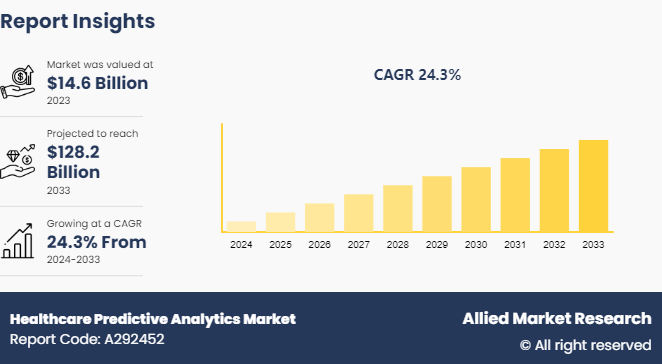
The global healthcare predictive analytics market size was valued at $14.6 billion in 2023, and is projected to reach $128.2 billion by 2033, growing at a CAGR of 24.3% from 2024 to 2033. Rapid advancements in AI and machine learning that make way for accurate forecasting and personalized treatment protocols as well as the rise in focus on population health management and preventive care are major drivers of the market.
The global healthcare predictive analytics market is experiencing growth due to several factors such as convergence of data availability, technological advancements, regulatory imperatives, and collaborative initiatives propels the continued evolution and adoption of predictive analytics in healthcare.
Market Size & Future Outlook
- 2023 Market Size: $14.6 Billion
- 2033 Projected Market Size: $128.2 Billion
- CAGR (2024-2033): 24.3%
- North America: Largest market in 2023
- Asia Pacific: Fastest growing market
What is Healthcare Predictive Analytics?
Healthcare predictive analytics refers to the transformation of data into actionable insights that help healthcare organizations anticipate risks, optimize resources, improve patient outcomes, and reduce costs. It works by analyzing data from multiple sources and identifying patterns to forecast the probability of future events. It is majorly used in risk stratification. Hospitals use predictive models to segment patients based on their risk of developing complications or the ones who need intensive care. High-risk patients can be identified early and provided with tailored interventions, reducing preventable admissions and improving outcomes.
Healthcare predictive analytics is also used to enhance operational efficiency. These tools support financial planning by analyzing billing patterns, identifying duplicate claims, and detecting fraud in revenue cycles. This helps strengthen financial performance for the organization. It helps public health departments and care networks understand trends, identify at-risk populations, and design preventive programs. This approach supports value-based care models. Further, the integration of real-time data from wearable devices and remote monitoring systems expand predictive capabilities. This helps improve quality of life through early intervention.
Key Takeaways
- The healthcare predictive analytics market study covers 20 countries. The research includes a segment analysis of each country in terms of value ($Million) for the projected period 2024-2033.
- More than 1, 500 product literatures, industry releases, annual reports, and other such documents of major healthcare predictive analytics industry participants along with authentic industry journals, trade associations' releases, and government websites have been reviewed for generating high-value industry insights.
- The study integrated high-quality data, professional opinions and analysis, and critical independent perspectives. The research approach is intended to provide a balanced view of global healthcare predictive analytics market and to assist stakeholders in making educated decisions in order to achieve their most ambitious growth objectives.
Key Market Dynamics
The healthcare predictive analytics market is experiencing growth driven by technological innovation, evolving care models, and the increase in need for data-driven decision-making. At the same time, constraints related to data governance, integration hurdles, and regulatory complexities limit the growth of the healthcare predictive analytics market.
Drivers
There is a rise in health date due to digitalization of records and processes. People are using wearable devices and mobile health apps to monitor their health. They are opting for remote monitoring for consultations. This data produced makes way for predictive models to identify trends and provide actionable forecasts. This drives the need for healthcare predictive analytics. Healthcare systems are moving away from fee-for-service toward value-based care models, where reimbursement is linked to patient outcomes. Predictive analytics helps identify high-risk patients for the organizations. Integration of AI in healthcare predictive analytics also help improve accuracy of the prediction and support decision making.
There is a rise in preference for remote patient monitoring and telemedicine among patients. These technologies feed continuous health data into predictive models, enabling early intervention and reducing hospitalizations. This integration supports chronic disease management and population-level monitoring.
Restraints
Healthcare data is extremely sensitive. Regulations and other regional privacy laws impose strict requirements on data use, storage, and sharing. This deters the growth of the healthcare predictive analytics market. Further, predictive analytics tools require data collection and standardization, however poor interoperability slows implementation and reduces data quality. Further, healthcare predictive analytics tools are costly and thus smaller hospitals and clinics may find these costs prohibitive. In addition, effective predictive analytics requires expertise in data science, machine learning, clinical domain knowledge, and healthcare operations. Many organizations lack this combination of skills, leading to reliance on external vendors and consultants, which increases costs.
Opportunities
Advancements in genomic data analysis and personalized medicine create opportunities for tailored predictive models. Predictive analytics can forecast individual treatment responses and disease susceptibility, enabling precision care that improves outcomes. Connected devices and sensors generate rich, real-time health data streams. Further, combination of IoT-derived data with predictive models creates use cases for early alerts, preventive interventions, and seamless chronic care management outside clinical environments. Public health initiatives increasingly rely on data to manage epidemics, chronic conditions, and health disparities. This increases growth opportunities for healthcare predictive analytics during the forecast period.
How Is Artificial Intelligence Transforming This Market?
Artificial intelligence plays a major role in the healthcare predictive analytics market. It helps process datasets and identify complex patterns that humans may overlook. It analyzes medical records, lab results, imaging data, and genetic information which allows early detection of diseases such as cancer, cardiovascular disorders, and neurological conditions. AI models can continuously learn from new data, improving their predictions over time. This dynamic learning capability increases reliability and clinical value.
In hospital settings, AI tools predict patient deterioration in intensive care units. It helps send alerts to notify medical staff before a critical event occurs, which makes way for immediate action. It also supports precision medicine by recommending treatments tailored to individual patient profiles. This reduces trial-and-error approaches and improves recovery rates.
In addition, AI helps streamline scheduling, billing, and claims processing. It also supports drug discovery and clinical trials by predicting potential drug responses and identifying suitable candidates. Overall, AI is shifting healthcare predictive analytics from descriptive reporting to intelligent decision-making. It enhances diagnostic accuracy, operational efficiency, and patient outcomes, making healthcare systems responsive and sustainable.
Healthcare Predictive Analytics Market Segmentation Overview
The healthcare predictive analytics market is segmented into application, component, end-user and region. On the basis of application, the market is bifurcated into clinical analytics, financial analytics, operational analytics and others. On the basis of component, the market is bifurcated into hardware and software. By end user, the market is divided into payers, providers, and others. Region wise, the healthcare predictive analytics market is analyzed across North America, Europe, Asia-Pacific, and LAMEA.
What Technological Innovations Are Creating New Growth Opportunities?
One major innovation in the field of healthcare predictive analytics is the integration of artificial intelligence with Internet of Things (IoT) devices. Connected medical devices generate continuous data streams that enable real-time health monitoring and predictive insights. Further, adoption of genomic and precision medicine analytics is another development in the sector. This uses advanced algorithms to analyze genetic data which helps predict disease risk and personalize treatments. Further, cloud-based analytics platforms enable small and mid-sized healthcare providers to adopt advanced solutions without heavy infrastructure investment. Subscription-based models also help make predictive analytics accessible.
These innovations support personalized care, improve operational efficiency, and expand market reach. They are gaining traction as they attract investments from technology companies, healthcare providers, and venture capital firms. This is anticipated to boost the growth of the healthcare predictive analytics market during the forecast period.
Regional/Country Market Outlook
North America accounted for a major healthcare predictive analytics market share owing to increasing adoption of electronic health records (EHRs) and other healthcare IT systems facilitates the collection and analysis of vast amounts of patient data, enabling predictive analytics. Additionally, the rising prevalence of chronic diseases and the need for effective management of patient outcomes fuel the demand for predictive tools.
- In June 2020, Cleveland Clinic researchers set out to achieve a similar endeavor. The group developed a predictive analytics model to determine an individual patient’s likelihood of testing positive for COVID-19, as well as their potential outcomes from the disease.
- In March 2020, the UK’s National Health Service (NHS) partnered with Microsoft, Amazon Web Services, Google, Faculty and Palantir to build a digital platform based on big data, AI and cloud computing technology.
- In March 2020, The Center for Systems Science and Engineering (CSSE) at Johns Hopkins University has developed an interactive, web-based dashboard that tracks real-time data on confirmed coronavirus cases, deaths, and recoveries for all affected countries.
Industry Trends
- In February 2020, the Chinese government in collaboration with Alipay, a private online payment platform, has also created a smartphone app which gives color codes to the citizens based on the contagion risk, to help authorities track the people’s movement.
- In February 2020, GeTui, a smart data provider, has studied the number of people traveling from Wuhan, the hardest-hit city of the epidemic outbreak in central China, and released their distribution density in a heat map.
- In December 2019, BlueDot, a Toronto-based infectious disease surveillance company, had alerted its clients of a cluster of unusual pneumonia cases in Wuhan. With expertise in infectious diseases, big data analytics and digital technologies, this company found patterns across news reports that indicated the possible outbreak of infectious disease.
Where Are the Most Attractive Investment Opportunities in the Healthcare Predictive Analytics Market?
The rapid growth of the healthcare predictive analytics market highlights multiple attractive investment areas. Software solutions play a central role in deriving insights from large volumes of health data. Predictive analytics software enables clinical risk stratification, disease forecasting, and revenue cycle optimization that play an important role in value-based and preventive care models. Further, AI and machine-learning platforms power predictive models as they help enhance accuracy in clinical forecasting, operational planning, and patient engagement. The integration of AI with predictive analytics help gain insights from unstructured data which eases decision making. Wearables, remote monitoring units, and smart sensors are also gaining traction in the healthcare predictive analytics market. Data generated from these sources helps with early diagnosis and treatment as well as chronic disease management.
Clinical predictive analytics helps identify patients at risk of readmission, complications, or rapid health deterioration. Population health analytics supports public health planning and preventive strategies. These tools are adopted by healthcare providers and payers to reduce costs and improve outcomes.
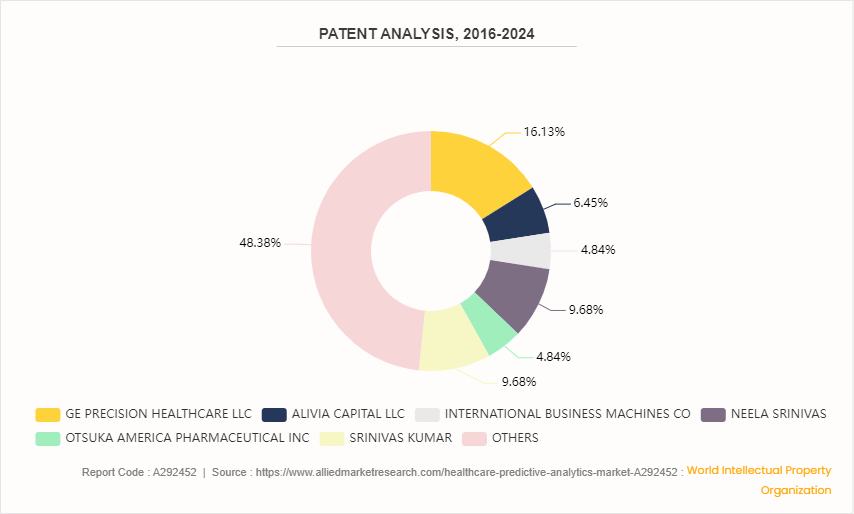
Patent Analysis, By Country, 2016-2024
In the global healthcare predictive analytics, GE precision healthcare LLC dominates with 11.3% of healthcare predictive analytics market share for patents, showcasing their strong innovation focus. Neela Srinivas And Srinivas Kumar follow with 9.7% and 9.7% respectively, indicating their significant presence in the healthcare predictive analytics market. Other key players like EMBECTA CO, BD, GE Company, Manuel Vegas Santiago, Andras Kerekes, Andras Lanczky, Bence Lantos, Elodie Weber, Erazmus Gerencser, Eszter Csernai, Travis Frosch, Alivia Capital LLC, Ge Prec Healthcare LLC, International Business Machines Co, Otsuka America Pharmaceutical Inc also contribute to the innovation landscape. These companies drive innovation in healthcare predictive analytics, offering diverse products to meet the needs to make more effective and efficient clinical and operational decisions.
Competitive Landscape
The major players operating in the healthcare predictive analytics market include IBM, Cerner Corp., Verisk Analytics, Inc., McKesson Corp., SAS Institute, Oracle, Allscripts, Cotiviti, Inc., Citius Tech Inc, and Optum, Inc. Other players in healthcare predictive analytics market includes ExlServices Holdings, Evidation Health, MedeAnalytics, Inc and so on.
What are the Recent Key Strategies and Developments
- In February 2024, Mount Sinai’s dedicated team of researchers were granted $4.1 million by the National Heart, Lung, and Blood Institute (NHLBI) at the esteemed National Institutes of Health (NIH) to pioneer artificial intelligence (AI) models aimed at forecasting adverse outcomes in patients grappling with obstructive sleep apnea.
- In October 2023, Health Data Analytics Institute (HDAI) , an artificial intelligence (AI) company focused on empowering clinicians, optimizing care pathways, and improving patient outcomes announces $31 million funding round to scale predictive risk platform.
- In July 2022, Trilliant Health launches an analytics tool to benchmark healthcare companies against similar markets. These benchmarks can guide an organization's strategies for new specialties and services lines, M&A activity, and expansion into new markets.
- In September 2021, Healthcare analytics company Trilliant Health developed a new predictive analytics tool that enables strategy teams to see a 10-year view of the healthcare market with insights all the way down to the local market level.
Key Sources Referred
- EO Intelligence
- WIPO - World Intellectual Property Organization
- Centers for Disease Control and Prevention
- World Health Organization
- American Medical Informatics Association (AMIA)
- Becker's Health IT & CIO Report
- Journal of Medical Internet Research
- HealthIT.gov
- HIMSS (Healthcare Information and Management Systems Society)
What are the Key Benefits for Stakeholders
- This report provides a quantitative analysis of the market segments, current trends, estimations, and dynamics of the healthcare predictive analytics market analysis from 2024 to 2033 to identify the prevailing predictive analytics in healthcare market opportunity.
- The healthcare predictive analytics market research is offered along with information related to key drivers, restraints, and opportunities.
- Porter's five forces analysis highlights the potency of buyers and suppliers to enable stakeholders make profit-oriented business decisions and strengthen their supplier-buyer network.
- In-depth analysis of the healthcare predictive analytics market segmentation assists to determine the prevailing market opportunities.
- Major countries in each region are mapped according to their revenue contribution to the global healthcare predictive analytics market.
- Market player positioning facilitates benchmarking and provides a clear understanding of the present position of the healthcare predictive analytics market players.
- The report includes the analysis of the regional as well as global healthcare predictive analytics market trends, key players, market segments, application areas, and market growth strategies.
Healthcare Predictive Analytics Market Report Highlights
| Aspects | Details |
 Market Size By 2033 | USD 128.2 Billion |
 Growth Rate | CAGR of 24.3% |
 Forecast period | 2024 - 2033 |
 Report Pages | 260 |
 By Application |
|
 By Component |
|
 By End-User |
|
 By Region |
|
 Key Market Players | IBM, Optum, Inc., Oracle Corp, Citius Tech Inc., SAS Institute Inc, Allscripts, Cotiviti, Inc.,, Verisk Analytics, Inc., McKesson Corporation., Cerner Corporation |
Loading Table Of Content...