
K12 Education Market Overview
The global K12 education market size was valued at USD 103.5 billion in 2021 and is projected to reach USD 525.7 billion by 2031, growing at a CAGR of 17.7% from 2022 to 2031. Virtual online learning in K 12 schools uses a range of electronic communication techniques to conduct the class, including online chat, video conferencing, synchronous conferencing, and specifically built software, with teachers and students geographically separated.
Key Market Insights
- By deployment mode, cloud sub-segment is anticipated to be the fastest-growing during the forecast period.
- By application, middle school sub-segment is predicted to show the fastest growth in the upcoming years.
- By region, the Asia-Pacific is predicted to show the fastest growth in the upcoming years.
Market Size & Forecast
- 2031 Projected Market Size: USD 525.7 Billion
- 2021 Market Size: USD 103.5 Billion
- Compound Annual Growth Rate (CAGR) (2022-2031): 17.7%
K–12 education refers to the structured learning system that covers kindergarten through 12th grade, forming the foundation of a student’s academic and personal development. It provides essential knowledge in subjects such as mathematics, science, language, and social studies while also fostering critical thinking, creativity, and problem-solving skills. K–12 education helps students develop social skills, discipline, and collaboration through classroom interaction and extracurricular activities. In addition, modern K–12 systems increasingly incorporate digital learning tools and personalized instruction, enabling students to learn at their own pace. Overall, K–12 education prepares learners for higher education, career opportunities, and responsible participation in society.
Key Market Dynamics
Millennial parents’ K–12 children are digital natives, generally more comfortable with technology than their parents and teachers. As a result, online education for K–12 students is experiencing rapid growth and transformation. Modern K–12 education systems increasingly integrate digital tools to optimize time and address diverse student needs.
The adoption of learning analytics has grown rapidly due to technological advancements, allowing institutions to deliver personalized learning experiences. AI-powered K–12 platforms provide tailored content based on student profiles, performance, and engagement. Consequently, schools are investing heavily in virtual learning models, a key driver of the global K–12 education market.
However, e-learning platforms face limitations, primarily the lack of social interaction. Students with higher peer engagement achieve better learning outcomes and satisfaction than those with limited interaction. This challenge may hinder platform adoption and slow market growth. Limited access to technology, especially in rural and underserved areas, also remains a barrier, as many students struggle with reliable internet and digital tools.
Despite these challenges, e-learning platforms offer significant advantages. They provide time- and cost-efficient learning, allowing students to study anytime and anywhere. Learners can schedule classes according to their own lifestyles, encouraging adoption across age groups. Schools also save on infrastructure and operational costs, further supporting market growth.
The K–12 online education market presents opportunities for new players. Adoption of Learning Management Systems (LMS) such as Google Classroom, Canvas, and Blackboard helps schools organize lessons, track student progress, and engage students, while streamlining administrative tasks. Increasing smartphone and tablet usage has also fueled mobile learning, enabling students to access educational apps and content anytime.
Interactive and gamified tools, including Kahoot, Quizlet, and Duolingo, make learning more engaging, while adaptive learning solutions customize content based on individual strengths and pace. Hybrid and blended learning models, combining in-person and online instruction, provide flexibility and personalization, opening opportunities for content providers, LMS developers, and educators to design effective learning environments.
For instance, Khan Academy, founded by Sal Khan, is a leading platform in the K–12 market, offering personalized learning and comprehensive content via web and mobile, with over 168.7 million registered users worldwide.
The growing emphasis on mental health and well-being in schools further drives market potential. Products and services promoting emotional intelligence, resilience, stress management, and social-emotional learning (SEL) are gaining traction. Telehealth platforms and digital tools offering virtual counseling, therapy, and emotional support expand these opportunities.
For example, on October 4, 2024, Headstream partnered with The Jed Foundation (JED) and The Meadows Mental Health Policy Institute to launch the K–12 Mental Health Tech Navigator. This free web-based tool assists school administrators in selecting digital mental health products, provides case studies, and offers funding guidance, with a focus on schools serving marginalized students.
Overall, K–12 online education is evolving rapidly, driven by technological integration, personalized learning, and rising focus on student well-being. While challenges like limited social interaction and access disparities persist, opportunities in adaptive learning, gamified content, hybrid models, and mental health support are expected to fuel continued growth in the global K–12 education market.
K-12 Education Market Segment Review
The K12 education market size is segmented on the basis of type, deployment mode, application, spend analysis, and region. By type, the market is classified into public and private. By deployment mode, the market is divided into cloud and on-premise By application, the market is classified into high school, middle school, and pre-primary school and primary school. By spend analysis, the market is divided into hardware, software, and others. By region, the K12 education market is analyzed across North America, Europe, Asia-Pacific, and LAMEA.
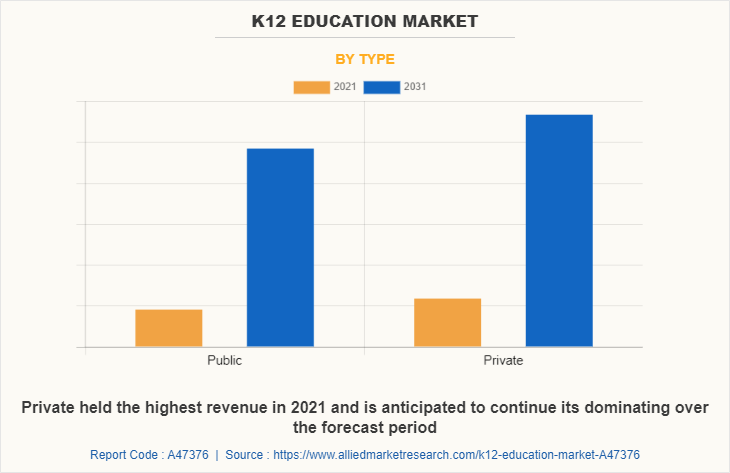
By type, the private sub-segment dominated the K12 education market in 2021. Technology has changed education, such as student information systems (SIS) that simplify attendance tracking and grade books, test prep software, smartboards, and paperless classrooms. These innovations, including AR, VR, machine learning, and digital textbooks, will witness higher growth during the forecast period. Several private educational institutions are focusing on safeguarding confidential data from cybersecurity attacks and how to leverage it to improve student outcomes. All these aforementioned factors are likely to boost the growth of the K12 education market.
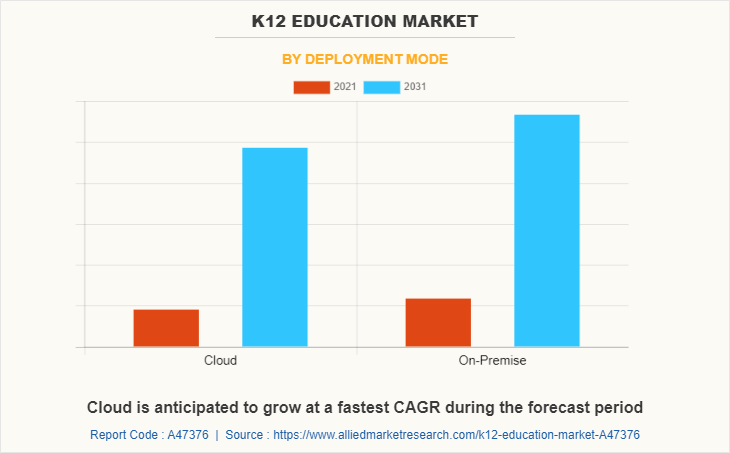
By deployment mode, the on-premise sub-segment dominated the K12 education market in 2021. The adoption of on-premises is expected to grow significantly in the coming years as it runs in a combination of both private and public clouds and provides benefits such as security, cost, control, and speed. Furthermore, on-premises, all generated data is collected and securely stored in the cloud, where it can be accessed from added complexity and can eliminate many securities risks. These factors are propelling the growth of the on-premise sub-segment.
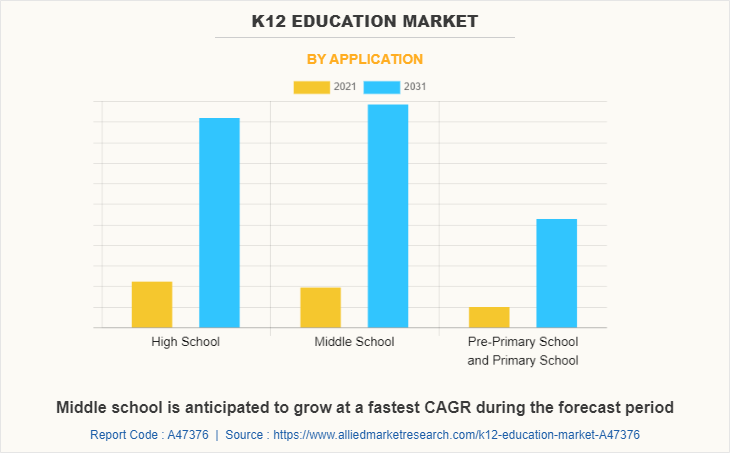
By application, the high school sub-segment dominated the global K12 education market share in 2021. Many educational systems throughout the world has standardized that a child receives at least the primary and secondary levels of education. Within primary and high school education, gamification is one of the most prevalent trends among online education providers to encourage learning through immersive experiences. Simulation of concepts, level advancement badges, and incentive-based learning drive user engagement on online education platforms. Online learning players nowadays are continuously competing to offer differentiated products to the target audiences, mostly by offering value added services with regular courses.
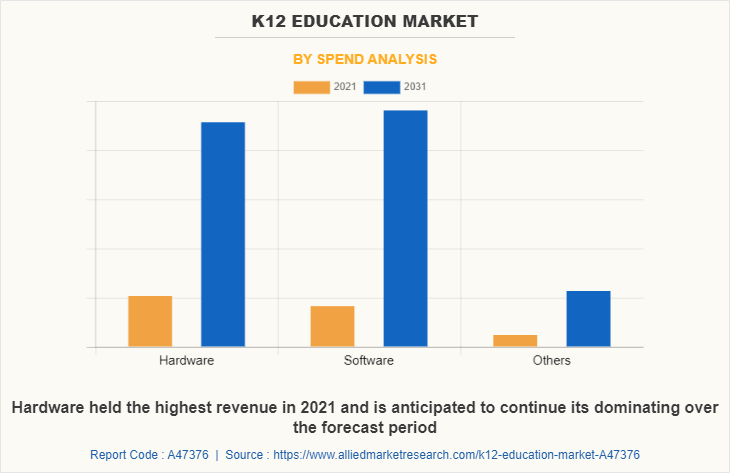
By spend analysis, the hardware sub-segment dominated the global K12 education market share in 2021. E-learning content providers deliver online course libraries and virtual training labs to individuals and enterprises. Course libraries are organized around subjects, commonly leadership and compliance related topics and competencies. Some of the major players in the industry are Udemy, LinkedIn Learning, Coursera, and others.
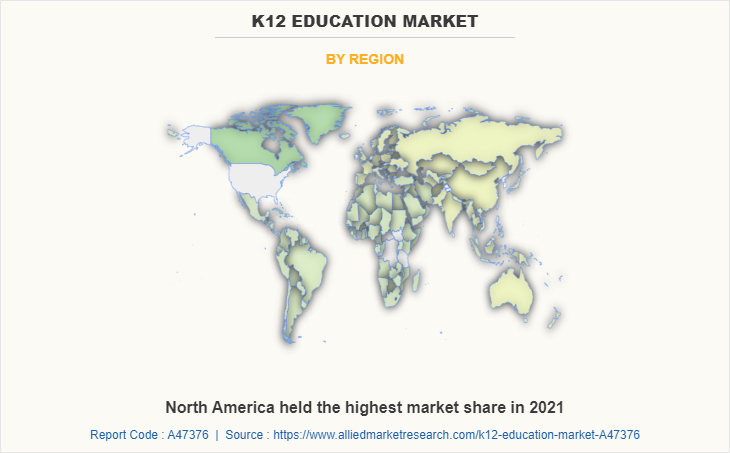
By region, North America dominated the global K12 education market in 2021. North America is dominating region in the K12 education industry owing to the increase in demand for distance learning during the COVID-19 pandemic. In addition, the COVID-19 pandemic has forced various organizations to adopt digital solutions in a bid to train frontline workers, which in turn, fuels the growth of the K12 education market. The U.S. is expected to be a major contributor to the market owing to the availability of high-speed Internet and the advent of the 5G network. In addition, the 5G network enables service provider to improve learning through the incorporation of AR & VR technologies that require a high-speed Internet connection for effective operation. Moreover, technological advancement in digital infrastructure in the U.S. and Canada is likely to boost the North America K12 education market.
Why is Demand Increasing in this Market?
The demand for K–12 education, particularly in online and digital formats, is increasing due to several interrelated factors. Rapid technological advancements, including artificial intelligence, learning analytics, and adaptive learning tools, allow schools to offer personalized instruction that caters to individual student needs. The COVID-19 pandemic accelerated the adoption of distance learning, demonstrating the effectiveness and convenience of virtual classrooms for both students and educators.
Parents and students increasingly prefer flexible learning solutions that allow education to continue regardless of location or schedule, driving the adoption of e-learning platforms. Government initiatives and policies promoting digital literacy and technology integration in schools further boost demand. Additionally, the rise of hybrid and blended learning models, which combine in-person and online instruction, enables more efficient use of classroom time and resources while enhancing learning outcomes.
The growing use of mobile devices, tablets, and cloud-based learning systems also supports anytime, anywhere education. Together, these factors—technological innovation, flexibility, government support, and accessibility—are fueling sustained growth in the K–12 education market globally.
What Role Do Digital Technologies Play in Improving Products and Services?
Digital technologies are playing a transformative role in enhancing K–12 education products and services, making learning more personalized, efficient, and engaging. Advanced technologies such as artificial intelligence (AI), machine learning, and learning analytics enable educators to tailor instruction to individual students’ needs, track progress, and identify knowledge gaps in real time. AI-driven platforms provide customized learning paths, adaptive assessments, and instant feedback, helping students master concepts at their own pace while reducing the administrative burden on teachers.
Interactive tools such as virtual simulations, gamified learning applications, and augmented or virtual reality (AR/VR) create immersive and engaging learning experiences that enhance understanding of complex topics. These technologies allow students to explore concepts beyond traditional textbooks, increasing engagement and retention.
Digital platforms also improve accessibility and inclusion by integrating assistive technologies like speech-to-text programs, screen readers, and specialized learning modules for students with disabilities. Cloud-based Learning Management Systems (LMS) such as Google Classroom and Canvas streamline administrative tasks, centralize educational content, and facilitate collaboration between teachers, students, and parents.
Moreover, mobile learning applications enable education anytime and anywhere, supporting flexible and hybrid learning models. Collectively, these digital innovations not only enhance the quality and accessibility of educational products and services but also empower schools to deliver data-driven, personalized, and future-ready learning experiences that improve student outcomes and engagement.
How Will Emerging Trends Shape the Future of the Market?
Emerging trends in K–12 education are set to reshape the market by driving innovation, personalization, and global accessibility. One of the most significant trends is the integration of artificial intelligence (AI) and adaptive learning technologies, which allow educational platforms to tailor content, assessments, and feedback to individual student needs. This personalized approach improves learning outcomes while enabling teachers to focus on higher-value tasks such as mentorship and critical thinking development.
Gamification, virtual reality (VR), and augmented reality (AR) are also transforming the classroom experience by creating interactive, immersive learning environments. These tools make complex subjects more engaging and facilitate experiential learning, which is likely to increase adoption among students and schools.
Hybrid and blended learning models, combining online and in-person instruction, are expanding flexibility, allowing students to learn at their own pace and on their own schedules. The rise of mobile learning and cloud-based platforms further enables anytime, anywhere education, supporting global accessibility and inclusivity.
Moreover, trends such as inclusive education, multilingual programs, and sustainability-focused curricula are encouraging schools to adopt diverse, equitable, and socially responsible learning approaches.
Which are the Leading Companies K-12 Education
The following are the leading companies in the market. These key players have adopted various strategies, such as product portfolio expansion, mergers & acquisitions, agreements, geographical expansion, and collaborations, to increase their market penetration and strengthen their foothold in the K12 education market.
IBM Corporation
Adobe
Microsoft Corporation
Samsung
D2L Corporation
Oracle Corporation
Pearson Media Company
Knewton
Cengage Group
Smart Technologies.
Market Trends Insights
The K12 education market is expected to witness several noteworthy edtech trends. One of the prominent trends the market is expected to witness is the integration of advanced technology such as artificial intelligence (AI) into educational products to enhance personalization, with AI-driven learning tools providing tailored experiences, personalized feedback, and customized learning paths suited to each student's learning style. In addition, AI is used to automate administrative tasks such as grading assignments and exams, freeing up teachers' time to focus on direct student engagement and teaching. These systems offers real-time feedback, helping students outside the classroom by identifying knowledge gaps and suggesting resources to improve understanding.
As globalization increases, K-12 schools are broadening their international education initiatives through virtual exchange programs, collaborative global tools, and international projects, enabling students to connect with peers around the globe and boost their global awareness. Moreover, there is an increasing focus on teaching multiple languages, with schools utilizing applications, platforms, and immersion techniques to instruct students in languages such as Mandarin, Spanish, and French, equipping them for a global job market.
For instance, on February 11, 2025, Stanford University launched the Generative AI for Education Hub as part of the SCALE initiative to provide research on AI use in K-12 schools. The hub offers a repository of studies to help district leaders make informed decisions about AI tools. Director Chris Agnew emphasized the hub's role in providing evidence, filling research gaps, and offering guidance. The hub aims to identify effective AI tools and simplify the use of ed-tech products in schools. Agnew's team will work with districts and ed-tech innovators to study AI's current and future impact on education.
Another notable K12 education market trend the market is expected to witness is the increase in the integration of inclusive education with assistive technology tools, including speech-to-text programs, screen readers, and tailored learning platforms, to assist students with disabilities and guarantee their complete involvement in the educational experience. In addition, there is shift in preference toward educational institutions, prioritizing the creation of varied learning environments that address the needs of students from different backgrounds, such as ethnic minorities, students with special needs, and English Language Learners (ELL), encouraging diversity in teaching methods, materials, and delivery approaches.
Furthermore, there is growing emphasis on sustainability, with schools adopting green technologies, recycling programs, and sustainable building practices to reduce their environmental footprint. Moreover, schools are incorporating environmental sustainability into their curricula to educate students about climate change, renewable energy, and conservation, empowering the next generation to become environmentally conscious citizens.
For instance, on November 17, 2023, Microsoft and Sanoma Learning announced their collaboration to improve educational tools for teachers and students. They integrated Sanoma’s learning materials into Microsoft Teams to simplify administrative tasks and provide seamless access to digital content. The Primary Education solution Bingel, widely used in Belgium, Finland, and Sweden, was the first to be integrated. Microsoft’s Learning Accelerators, starting with the Immersive Reader, were added to Sanoma’s platforms to enhance learning outcomes and support inclusive education. These tools are available in Sweden, Finland, Poland, Italy, Spain, and the Netherlands.
These edtech trends and innovations, including the integration of science technology such as artificial intelligence, are expected to fuel the growth of the K-12 education technology market in the upcoming years. With data-driven approaches, schools are better equipped to create learning environments that are not only more personalized but also more inclusive, global, and sustainable, ensuring a more dynamic and forward-looking education system.
What are the Key Benefits for Stakeholders
This report provides a quantitative analysis of the market segments, current trends, estimations, and dynamics of the K12 education market analysis from 2021 to 2031 to identify the prevailing K12 education market opportunities.
The K12 education market research is offered along with information related to key drivers, restraints, and opportunities.
Porter's five forces analysis highlights the potency of buyers and suppliers to enable stakeholders make profit-oriented business decisions and strengthen their supplier-buyer network.
In-depth analysis of the K12 education market segmentation assists to determine the prevailing K12 education market opportunities.
Major countries in each region are mapped according to their revenue contribution to the global K12 education market.
Market player positioning facilitates benchmarking and provides a clear understanding of the present position of the K12 education market players.
The report includes the analysis of the regional as well as global K-12 education trends, key players, market segments, application areas, and K12 education market growth strategies.
K12 Education Market Report Highlights
| Aspects | Details |
 Market Size By 2031 | USD 525.7 billion |
 Growth Rate | CAGR of 17.7% |
 Forecast period | 2021 - 2031 |
 Report Pages | 300 |
 By Type |
|
 By Deployment Mode |
|
 By Application |
|
 By Spend Analysis |
|
 By Region |
|
 Key Market Players | Cengage Group, smart technologies, BLACKBOARD MEDIA PRIVATE LIMITED, Microsoft Corporation, D2L corporation, Adobe Systems Inc., International Business Machines Corporation, Samsung Electronics Co Ltd, pearson media company, Oracle Corporation |
Analyst Review
The K12 education industry is anticipated to experience considerable growth in the coming years due to the rise in demand for K12 Education in both private and public education systems. The K12 education system is growing majorly due to the rapid growth in the adoption of portable devices that make it easy to gain knowledge and engage in social activities. Moreover, mobile devices are becoming popular for smart learning. However, for students, e-learning systems are more time- and money-efficient. Learners now have the convenience of education regardless of time or place owing to e-learning systems. These factors are expected to significantly drive the K12 education market growth during the forecast period. In addition, students can arrange their class schedules to suit their needs and lifestyle. This factor motivates people of all ages to adopt e-learning systems. This factor offers enormous growth prospects for the key players operating in the K12 education sector.
Asia-Pacific is anticipated to grow at the fastest CAGR during the forecast period frame. The K–12 education sector is expanding quickly in this region as the students are mostly preferring online learning. The education sector in several countries such as China, India, Indonesia, and Malaysia are making their full K–12 curriculum available online.
The global K12 education market size was valued at USD 103.5 billion in 2021, and is projected to reach USD 525.7 billion in 2031
The global K12 education market is projected grow at a compound annual growth rate of 17.7% from 2021-2031
Some key players such as - McGraw-Hill Education, Pearson Education Inc., Cengage Learning India Pvt. Ltd. are the major players in the K12 education market.
Asia-Pacific will provide more business opportunities for the global K12 education market in the future.
Growth in the adoption of smartphones and digital devices in developing countries has been benefitting the K12 education market. Almost 500 million out of 2.8 billion subscribers in Asia-Pacific were enrolled in less than 5 years. This growth rate is expected to continue further and suggests strong growth potential for related services like e-learning platforms across the globe.
Loading Table Of Content...