
Weight Management Market Research, 2033
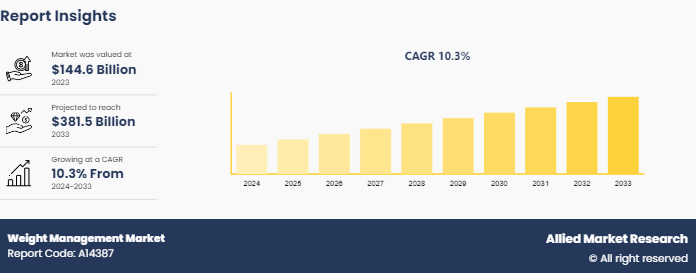
The global weight management market was valued at $144.6 billion in 2023 and is projected to reach $381.5 billion by 2033, growing at a CAGR of 10.3% from 2023 to 2033. The increasing prevalence of obesity, rising health awareness, and the growing demand for weight loss solutions are the major factors driving the growth of the weight management market. In addition, advancements in technology, the rise of personalized nutrition, and the growing trend of fitness and wellness are contributing to market expansion.
Market Introduction and Overview
The weight management market includes products and services designed to help individuals control and reduce body weight, improve overall health, and prevent obesity-related conditions. These solutions encompass weight loss programs, dietary supplements, fitness equipment, mobile apps, and medically supervised treatments. They cater to various weight loss strategies, such as calorie control, exercise regimens, and metabolic boosters.
Dietary supplements, including weight loss pills, protein powders, and meal replacement products, have gained popularity for their convenience and effectiveness. Fitness equipment and smart devices also play a significant role, with products such as wearables, fitness trackers, and home exercise equipment promoting active lifestyles and weight management. In addition, weight loss surgeries and bariatric treatments continue to be an important segment for individuals with severe obesity.
Growing awareness about the health risks associated with excessive weight, such as heart disease, diabetes, and hypertension, has accelerated the adoption of weight management solutions worldwide. Moreover, the expanding availability of digital platforms, offering virtual fitness programs, diet plans, and personalized tracking, is further driving the market. The weight management market is set for robust growth from 2023 to 2033 as more individuals prioritize their health and well-being.
Key Takeaways
- The weight management market was analyzed across 20 countries, with a detailed segment analysis for each nation, presented in terms of value ($ billion) for the projected period from 2024 to 2033.
- To generate valuable industry insights, the research reviewed over 1,500 product literatures, industry reports, annual publications, and other relevant documents from leading players in the weight management sector, alongside authoritative industry journals, trade association releases, and government sources.
- The study combines high-quality data, expert opinions, and independent analyses to offer a comprehensive perspective on global markets. This approach is designed to provide stakeholders with a balanced view, helping them make well-informed decisions and achieve their most ambitious growth goals.
Key Market Dynamics
The weight management market is influenced by a combination of rising health awareness, evolving consumer preferences, technological advancements, and the increasing global prevalence of obesity and related diseases. The growing demand for personalized solutions, expanding digital health platforms, and the increasing focus on preventative healthcare are driving both weight management market growth and innovation.
Drivers
The primary drivers of the weight management market include the rising global prevalence of obesity, particularly in developed and emerging economies, and the increasing awareness of the health risks associated with excess weight. Obesity is linked to numerous chronic conditions such as diabetes, cardiovascular disease, and hypertension, which are creating a high demand for effective weight management solutions. As a result, consumers are seeking diverse products and services, ranging from dietary supplements and fitness programs to mobile apps and medical treatments.
Technological advancements play a pivotal role in the market's expansion. The integration of mobile applications, wearables, and AI-based platforms enables users to track their progress, receive personalized recommendations, and engage in more effective weight management programs. Moreover, the rise of online health and fitness platforms, offering virtual consultations, diet plans, and fitness coaching, is making weight management solutions more accessible.
Another key driver is the growing popularity of personalized nutrition, with more consumers turning to tailored meal plans and supplements designed to meet their specific dietary needs and weight loss goals. This shift toward customized solutions is influencing product development, encouraging companies to innovate in creating more effective and consumer-centric weight management products.
Restraints
Despite the positive growth trends, several factors hinder the weight management market. The high cost of some weight loss solutions, including medical treatments, bariatric surgeries, and personalized nutrition services, can limit accessibility for price-sensitive consumers. In addition, there is a risk of market saturation with the proliferation of weight loss programs, dietary supplements, and fitness equipment, leading to increased competition and challenges in differentiation.
Furthermore, varying levels of awareness and education about effective weight management strategies across different regions can impede the market's full potential. Consumers in some areas may lack access to accurate information, making it harder for them to make informed decisions about weight management products.
Opportunities
The weight management market is poised for growth through opportunities such as the expansion of digital health platforms and the increasing demand for holistic, integrated weight management solutions. The rise of AI-driven, personalized weight loss programs and the growing role of fitness wearables are revolutionizing the way consumers approach weight management. In addition, emerging markets are seeing an increase in demand as disposable incomes rise and health awareness improves. There is also significant potential in developing cost-effective solutions for underserved populations. The integration of functional foods, clean-label products, and supplements into weight management programs represents another avenue for growth. Furthermore, as health-consciousness continues to grow, weight management companies have the opportunity to expand their offerings into new areas, such as mental wellness and stress management, to support comprehensive weight loss efforts.
Global Weight Management Market Analysis
The weight management market encompasses a broad range of products, services, and interventions aimed at helping individuals achieve and maintain a healthy weight. The weight management market offers a diverse array of solutions for achieving and sustaining healthy weight levels. The market is expanding rapidly owing to a rising global awareness regarding obesity-related health risks and a growing emphasis on healthier living. Consumers are increasingly seeking effective strategies to manage weight, driving innovation and competition among providers in the industry. These factors are predicted to drive the weight management market share in the coming years.
Prevalence of Overweight and Obesity in the U.S. Among Adults, 2021, (%)
Factor | All (Men and Women) (%) | Men (%) | Women (%) |
Overweight | 30.7 | 34.1 | 27.5 |
Obesity | 42.4 | 43.0 | 41.9 |
Severe Obesity | 9.2 | 6.9 | 11.5 |
According to the data, provided above by the National Institutes of Health, in 2021, nearly 1 in 3 adults (30.7%) are overweight, with more than 1 in 3 men (34.1%) and over 1 in 4 women (27.5%) falling into this category. Also, more than 2 in 5 adults (42.4%) suffer from obesity, including severe cases affecting about 1 in 11 adults (9.2%) . Moreover, the percentage of overweight men surpasses that of women, while women are disproportionately affected by severe obesity, with 11.5% compared to men's 6.9%. These statistics highlight the pressing need for comprehensive strategies to address weight-related health concerns, emphasizing the need for effective weight management strategies.
Market Segmentation
The weight management industry is segmented into function and region. On the basis of function, the market is divided into diet, fitness equipment, surgical equipment, and services. Region wise, the market is analyzed across North America, Europe, Asia-Pacific, and LAMEA.
The weight management market demonstrates diverse growth trends across segments. By function, the diet segment holds the largest share, driven by the increasing demand for dietary supplements, meal replacements, and weight loss pills. Fitness equipment follows closely, with a growing interest in home-based workout solutions and wearables. Surgical equipment and services, including bariatric surgeries and weight management programs, also contribute significantly to the market.
Regional Insights
North America dominates the weight management market, fueled by high health awareness, advanced healthcare systems, and a strong preference for weight loss solutions. Europe ranks second, supported by a focus on wellness and increasing adoption of digital health platforms. Asia-Pacific is expected to grow the fastest due to rising obesity rates and improving healthcare access. The LAMEA region is gradually emerging, driven by improving healthcare infrastructure and growing weight management market awareness.
Country Market Outlook
- In the U.S., medications like Ozempic and Wegovy are gaining popularity due to hectic lifestyles and limited success with traditional weight loss methods. However, acceptance in other regions may vary depending on cultural views toward pharmaceutical treatments for obesity.
- In 2023, the U.S. weight loss industry was valued at $3.4 billion, with 80% of adults expressing a desire to adopt healthier lifestyles, signaling potential for continued growth. Demographically, 52% of individuals aged 18-34 followed a diet in the past year, with a higher percentage among Hispanics (50%) compared to non-Hispanic whites (34%).
- Attitudes toward weight loss differed, with only 23% reporting significant weight loss in the past three years, while 95% aimed to lose weight for personal well-being. Key motivations for weight loss included improving fitness (84.6%), self-esteem (73.9%), and appearance (70.4%), with 41% seeking professional guidance.
- In 2023, 49% of U.S. adults attempted weight loss, with a higher rate among women (56.4%) compared to men (41.7%). Efforts varied by race, with 41.4% of Asian Americans and 49.4% of white Americans attempting weight loss.
- The most common weight loss strategies were exercise (62.9%) and reducing food intake (62.9%), followed by increasing fruit and vegetable consumption (50.4%). In addition, 15% of U.S. adults reported using weight loss supplements, contributing to annual sales of $2.1 billion.
Who Are the Primary End Users Driving Market Adoption?
In the weight management market, the primary end users driving adoption are individuals seeking personal weight loss and wellness solutions, including those affected by obesity, diabetes, and other related conditions. The growing awareness of the health risks associated with excess weight, such as heart disease, diabetes, and hypertension, has led to a surge in demand for weight management programs and products.
Healthcare providers, including dietitians, nutritionists, and fitness trainers, also play a key role in market adoption, offering personalized guidance and supporting weight loss efforts. Hospitals and specialized clinics are increasingly incorporating weight management programs as part of comprehensive health services, particularly for patients with obesity or other chronic diseases. Fitness centers and gyms are another significant contributor, offering specialized weight loss programs, personal training, and group fitness classes.
What Are the Latest Trends Influencing the Weight Management Market?
One of the key trends in the weight management market is the increasing demand for personalized solutions. Consumers are turning to customized diet plans, meal replacements, and fitness programs tailored to their specific needs. This is being driven by advancements in technology, with AI-powered apps and wearables offering personalized recommendations based on individual health data.
The rise of plant-based and clean-label diets is also influencing the market, as consumers become more conscious of the ingredients and nutritional value of their food. As wellness culture grows, there's a shift toward sustainable, long-term weight management solutions rather than quick-fix diets or extreme weight loss methods.
How Is Technology Revolutionizing the Weight Management Market?
Technology is playing a transformative role in the weight management market. Artificial intelligence (AI) is being used to develop personalized weight loss solutions, with AI-powered apps analyzing user data to offer tailored diet plans and exercise regimens. Wearables and fitness trackers are becoming increasingly advanced, providing real-time data on calories burned, steps taken, and overall physical activity, which help users stay on track with their goals.
In addition, the integration of machine learning algorithms into weight loss apps is enhancing the accuracy of tracking, identifying patterns, and offering adaptive recommendations.
What Innovations Are Transforming the Weight Management Industry?
Innovation in the weight management market is centered on developing effective, sustainable, and personalized solutions for consumers. One of the key innovations is the growth of smart wearables and fitness trackers that offer real-time monitoring of physical activity, calories, and heart rate, providing valuable insights to users aiming for weight loss.
Dietary supplements are also evolving, with brands offering more scientifically backed formulations and functional foods that support weight management and fat metabolism. Personalized nutrition, driven by advancements in genetic testing and microbiome research, is gaining traction, with companies offering meal plans based on individual metabolic rates and nutrient needs.
Competitive Landscape
The weight management market is characterized by a mix of global players and regional participants offering a wide range of products and services aimed at weight loss, fitness, and wellness. Key companies in the market include Herbalife Nutrition Ltd., Weight Watchers International Inc., Johnson & Johnson, SlimFast, and Nutrisystem, which provide a broad portfolio of dietary supplements, meal replacements, weight loss programs, and fitness equipment. These companies focus on developing effective, science-backed solutions and expanding their global presence through both direct-to-consumer and retail channels.
In addition to these major players, regional brands such as MyFitnessPal, Beachbody, and Noom are gaining traction with innovative digital health platforms, mobile apps, and online fitness programs. Many of these firms emphasize personalized solutions, leveraging AI and data analytics to offer tailored weight management services. Companies in the market prioritize continuous innovation, customer-centric offerings, and expanding access to fitness and weight management solutions globally.
Recent Key Strategies and Developments
- In April 2024, Herbalife, a global leader in health and wellness, signed a sponsorship agreement with LA Galaxy midfielder Riqui Puig through the 2025 MLS season. Puig joins Herbalife’s extensive network of over 150 sponsored athletes worldwide, supporting community initiatives, sports nutrition education, and global marketing campaigns such as #ImWithYou.
- In November 2023, Herbalife’s Lifestyle Intervention Program was recognized by the U.S. Centers for Disease Control and Prevention (CDC) as a Certified Diabetes Prevention Program. To mark Diabetes Prevention Month, Herbalife highlighted the importance of proactive measures against diabetes.
- In December 2022, Amway opened its Singapore Business Innovation Hub in the heart of the Central Business District. The initiative, in partnership with the Singapore Economic Development Board (EDB), aims to expand Amway’s global reach by tapping into Singapore’s skilled talent pool.
Industry Trends
- Recent developments in the weight management have led to an increase in the use of prescription medications like Wegovy and Ozempic, reshaping both the health and fitness industries. These drugs, known as GLP-1 agonists, have shown promising results in aiding weight loss when combined with diet and exercise. However, concerns have been raised about the proliferation of clinics dispensing these medications without sufficient expertise, as well as the high cost and potential side effects associated with them as stated in April 2024, in Hindustan Times, India’s leading news platform.
- On April 29, 2024, the University of Southern Denmark, conducted a breakthrough research in brown fat that has uncovered a protein responsible for switching off brown fat activity, limiting its effectiveness in weight management. Researchers suggest that blocking this ‘off switch’ could offer a promising strategy for safely activating brown fat, potentially aiding in tackling obesity and related health problems. The discovery opens up new avenues for therapeutic interventions aimed at supporting weight loss and improving metabolic health.
- On April 25, 2024, the Francis Crick Institute, a biomedical discovery institute in London, conducted a new research study that suggests a link between vitamin D and improved immunity to cancer in mice by promoting the growth of beneficial gut bacteria. Mice on a vitamin D-rich diet showed enhanced resistance to experimentally transplanted tumors and better responses to immunotherapy. However, more studies are needed to determine if this effect translates to humans. Understanding how vitamin D influences the microbiome could offer insights into cancer prevention and treatment strategies that will also aid in weight management.
- On April 24, 2024, the research study conducted by University of Warwick, recognized as international center of research excellence, highlighted he profound connection between dietary choices and brain health. Published in Nature, the study involving over 180, 000 participants found that a balanced diet is linked to superior cognitive function and mental wellbeing. Gradual dietary modifications, particularly reducing sugar and fat intake, were suggested for fostering healthier food choices that will lead to efficient weight management.
Key Sources Referred
- National Institutes of Health
- Global Weight Management Federation
- Rethink Obesity
- CHARLTON MEDIA GROUP.
- Nexira
- Obesity Medicine Association
- World Obesity Federation
- Department of Health, State Government of Victoria, Australia
Key Benefits For Stakeholders
- This report presents a quantitative analysis of the weight management market segments, current trends, forecasts, and dynamics from 2024 to 2033, highlighting key market opportunities. The research includes detailed insights on key drivers, challenges, and weight management market growth prospects.
- Porter’s Five Forces analysis examines the bargaining power of buyers and suppliers, helping stakeholders make informed, profit-driven business decisions and strengthen their supplier-buyer relationships.
- A thorough analysis of the weight management market segmentation helps identify existing opportunities, while mapping major countries by their revenue contribution to the global market provides valuable regional insights.
- In addition, the report includes a weight management market player positioning analysis, which facilitates benchmarking and offers a clear view of the current standings of market participants.
Weight Management Market Report Highlights
| Aspects | Details |
 Market Size By 2033 | USD 381.5 Billion |
 Growth Rate | CAGR of 10.3% |
 Forecast period | 2024 - 2033 |
 Report Pages | 320 |
 By Function |
|
 By Region |
|
 Key Market Players | Nature's Sunshine Products, Inc., Amway, GNC Holdings Inc., NOW Health Group, Inc., Melaleuca Inc., Nature's Way Products, LLC, Vitaco Health Limited, Nu Skin Enterprises, Inc., Herbalife Nutrition Ltd., Arbonne International, LLC, Forever Living |
Analyst Review
The trends in weight management market include shift towards personalized nutrition plans, digital health platforms for tracking and coaching, plant-based diets, meal replacements, and the integration of wearable technology for fitness monitoring.
North America is the largest regional market for weight management.
The global weight management market is estimated to reach $381.5 billion by 2033
The top companies to hold majority of the market share in weight management market are Amway, Vitaco Health Limited, Forever Living, Nature's Way Products, LLC, GNC Holdings Inc., Nu Skin Enterprises, Inc., Nature's Sunshine Products, Inc., Arbonne International, LLC, Herbalife Nutrition Ltd, NOW Health Group, INC, and Melaleuca Inc.
Loading Table Of Content...