
Interior Design Market Overview
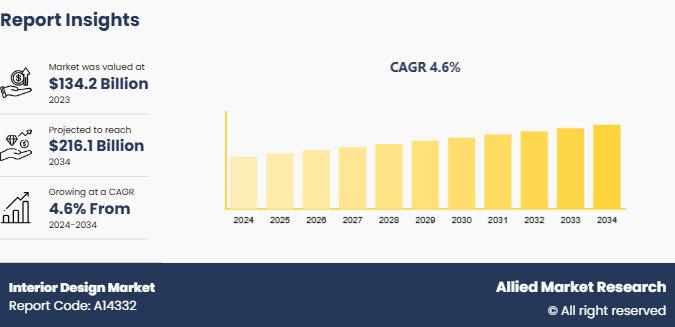
The global interior design market size was valued at $134.2 billion in 2023, and is projected to reach $216.1 billion by 2034, growing at a CAGR of 4.6% from 2024 to 2034. Interior design is the art and practice of planning and creating functional, aesthetically pleasing indoor spaces. It involves selecting and arranging furniture, color schemes, lighting, textures, and materials to improve the visual attraction and functionality of space.
Key Market Insights
- By type, the newly decorated segment accounted for the highest market share in 2023.
- By price, the economy segment accounted for the highest interior design market share in 2023.
- By end user, the commercial segment accounted for the highest market share in 2023.
- By region, North America generated the highest revenue in 2023.
Market Size & Forecast
- 2034 Projected Market Size: USD 216.1 Billion
- 2023 Market Size: USD 134.2 Billion
- Compound Annual Growth Rate (CAGR) (2024–2034): 4.6%
The interior design market comprises the planning, designing, and execution of interior spaces for residential, commercial, and institutional environments. Interior design involves creating aesthetically pleasing, functional, and safe spaces through the selection of materials, furniture, fixtures, lighting, color schemes, and decorative elements. The market includes interior design firms, freelance designers, online design platforms, and turnkey solution providers serving sectors such as homes, offices, hotels, restaurants, healthcare facilities, and retail spaces.
Interior design processes involve conceptual planning, space optimization, material selection, 3D modeling, project management, and post-implementation evaluation to ensure client satisfaction and design efficiency. Advanced design software, visualization tools, smart home integration, and sustainable material sourcing play a critical role in maintaining quality standards and meeting modern consumer expectations. Innovation in modular furniture, eco-friendly materials, smart interiors, and personalized design solutions has led to the emergence of niche services, including luxury design, minimalist interiors, biophilic design, and virtual interior consultations.
Growing disposable income, rising awareness of interior aesthetics, and expansion of real estate and hospitality sectors in regions such as Asia-Pacific and North America are contributing to market growth. Strategic collaborations, acquisitions, and partnerships among leading design firms, along with sustainability and smart home initiatives, are shaping competitive dynamics.
As consumer preferences continue to evolve toward personalized, multifunctional, and sustainable living spaces, the interior design market is projected to witness steady growth between 2024 and 2034, supported by technological innovation, service diversification, and expanding global client networks.
Key Takeaways
The interior design market study covers 20 countries. The research includes a segment analysis of each country in terms of value ($Billion) for the projected period 2024-2034.
More than 1, 500 product literatures, industry releases, annual reports, and other such documents of major interior design industry participants along with authentic industry journals, trade associations' releases, and government websites have been reviewed for generating high-value industry insights.
The study integrated high-quality data, professional opinions and analysis, and critical independent perspectives. The research approach is intended to provide a balanced view of global markets and to assist stakeholders in making educated decisions in order to achieve their most ambitious growth objectives.
Key Market Dynamics
The interior design market is influenced by evolving consumer lifestyles, rising demand for personalized and premium spaces, expanding service delivery channels, and continuous innovation in design concepts and materials. Increasing urbanization, growth in residential and commercial real estate, and the expansion of hospitality, retail, and co-working sectors are significantly shaping market growth. In addition, the growing popularity of sustainable, smart, and modular interior solutions, along with digital design platforms and e-commerce penetration, is accelerating adoption across diverse consumer segments.
Drivers
The interior design market is primarily driven by changing consumer preferences and the trend toward premium, customized spaces. Consumers increasingly seek unique, functional, and aesthetically appealing interiors, encouraging the growth of boutique design firms, freelance designers, and specialized service providers. Product and service diversification—including modular furniture, eco-friendly materials, smart home integration, and virtual consultations—further supports market demand.
Technological advancements in design software, 3D visualization tools, and project management platforms are also key growth drivers. Tools enabling virtual reality walkthroughs, AI-assisted layouts, and augmented reality furniture placement enhance design accuracy and client satisfaction. Marketing strategies leveraging social media, influencer collaborations, and digital portfolios, along with strategic partnerships between global and regional design firms, are expanding brand reach. Moreover, rising disposable incomes, growing awareness of interior aesthetics, and the expanding middle-class population in regions such as Asia-Pacific and North America are contributing to increased spending on design services.
Restraints
Despite strong growth prospects, the interior design market faces certain constraints. High project costs, especially for luxury or large-scale commercial projects, can limit client adoption. Regulatory challenges, such as building codes, zoning laws, and licensing requirements, may affect project timelines and execution. In addition, economic slowdowns or fluctuations in real estate development can impact demand. Limited availability of skilled professionals in some regions may also constrain market expansion.
Opportunities
The interior design market presents significant opportunities driven by innovation, sustainability, and digital transformation. Growing interest in sustainable interiors, eco-friendly materials, and energy-efficient designs is attracting environmentally conscious consumers. Emerging markets with expanding urban infrastructure, rising residential and commercial construction, and increasing disposable incomes offer untapped growth potential. Strategic collaborations, mergers, and acquisitions among design firms can enhance service capabilities and accelerate entry into new regions. As consumer preferences continue to evolve toward personalized, multifunctional, and smart spaces, the interior design market is expected to witness steady growth between 2024 and 2034.
PESTLE Analysis of Global Interior Design Market
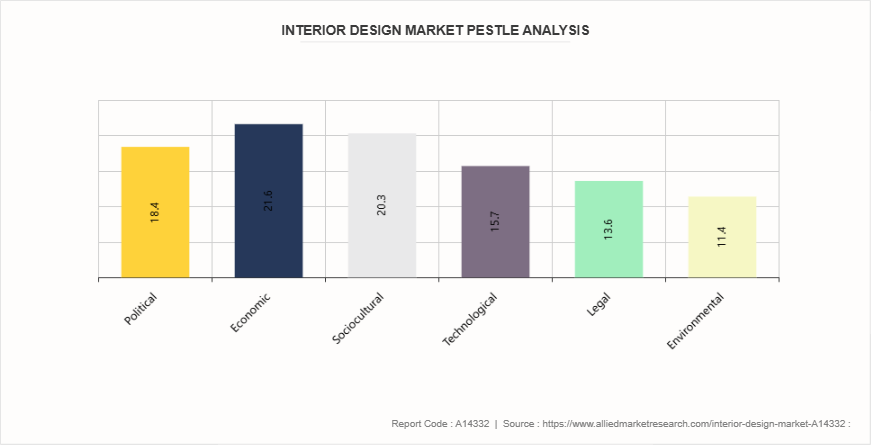
Political: Government regulations on construction, zoning laws, and sustainability standards influence interior design projects. Policies promoting green building and energy efficiency also impact design choices.
- Economic: Economic growth increases disposable income, driving demand for residential and commercial interior design. Recessionary periods, however, may reduce spending on luxury design services and home renovations.
- Sociocultural: Changing consumer preferences for personalized, functional, and sustainable interiors are reshaping the interior design market. The rise in demand for wellness-focused designs and eco-conscious living influences design trends in recent years.
- Technological: Advancements in 3D printing, virtual reality, and smart home technologies are transforming the market. These technologies allow for more innovative, efficient, and customized designs.
- Legal: Intellectual property laws, safety regulations, and labor standards affect design practices. Compliance with building codes and environmental regulations is crucial for interior design projects.
- Environmental: Increased focus on sustainability drives demand for eco-friendly materials and energy-efficient designs. The increased demand for reducing waste and incorporating green design principles is growing in popularity, thus influencing interior design market trends.
Market Segmentation
The interior design market is segmented into type, price, end user, and region. By type, the market is classified into newly decorated and repeated decorated. By price, it is bifurcated into economy and luxury. By end user, the market is divided into commercial and residential. Region wise, the market is analyzed across North America, Europe, Asia-Pacific, and LAMEA.
The interior design market exhibits varied growth patterns across its key segments. By type, newly decorated spaces account for the largest market share due to strong demand in residential and commercial new constructions, while repeated or renovation projects are gaining traction as consumers increasingly invest in refurbishing existing spaces to reflect modern aesthetics, functionality, and sustainability trends. The growing popularity of modular interiors, smart home integration, and eco-friendly design solutions is supporting steady demand across both newly decorated and repeated decoration segments.
By price, the luxury segment leads market growth, driven by rising consumer preference for high-quality materials, bespoke designs, and exclusive services that emphasize aesthetics, functionality, and brand prestige. The economy segment maintains a strong volume share, particularly in cost-sensitive markets, offering standardized design solutions and ready-made furnishings. Premiumization trends are reshaping consumer choices, with an increasing number of clients willing to invest in curated, high-end interiors across both developed and emerging economies.
By end user, the residential segment holds a dominant share, fueled by growing urbanization, rising disposable incomes, and demand for personalized living spaces. Meanwhile, the commercial segment—including offices, hotels, retail outlets, and co-working spaces—is expanding steadily as businesses increasingly prioritize employee experience, brand image, and customer engagement through thoughtfully designed interiors.
Regional/Country Market Outlook
North America and Europe continue to lead the market due to mature real estate sectors, high consumer awareness, and adoption of advanced design solutions. Asia-Pacific is witnessing rapid growth driven by urban development, rising middle-class populations, and increasing investments in hospitality and commercial infrastructure. LAMEA (Latin America, Middle East, and Africa) presents emerging opportunities with expanding real estate projects and growing demand for affordable yet stylish interior solutions.
In addition, regional trends are increasingly influenced by cultural preferences, climate considerations, and local material availability. For instance, Scandinavian-inspired minimalism and eco-friendly design dominate parts of Europe, while vibrant, multifunctional interiors are gaining popularity in Asia-Pacific urban centers. In LAMEA, luxury hospitality projects and government-driven infrastructure developments are creating demand for high-end commercial and public space design services, providing growth opportunities for international and local interior design firms.
Industry Trends:
Circular design principles are influencing the market by promoting the use of recycled materials and adaptable furniture with extended lifespans. Designers are focusing on creating interiors where components can be disassembled, repaired, or repurposed, reducing waste and supporting sustainability goals. For instance, the Buy Back & Resell program of IKEA encourages customers to return used furniture, which is then refurbished and resold, minimizing waste and extending product lifecycles.
Similarly, Herman Miller incorporates recycled materials into its iconic furniture designs, such as the Aeron chair, crafted using ocean-bound plastics. These initiatives demonstrate how companies are actively aligning with circular design concepts, catering to environmentally conscious consumers, and promoting sustainable practices within the market.
In addition, modular furniture designs are gaining traction, allowing clients to reconfigure pieces to meet changing needs. Software tools are being utilized to assess material efficiency and environmental impact during the design phase. The increase in adoption of such practices reflects growing consumer interest in ethical and sustainable interiors, driving the popularity of circular design in the industry.
Which consumer segments are driving growth in the interior design market?
The growth of the global interior design market is primarily driven by urban homeowners, young professionals, and commercial establishments. Urban populations and younger demographics increasingly seek personalized, functional, and aesthetically appealing living and working spaces, making residential renovations, office fit-outs, and hospitality projects key channels for interior design services. Businesses in the hospitality, retail, and corporate sectors are expanding interior offerings to enhance customer experience, employee satisfaction, and brand image. Retail consumers accessing design services through online platforms, virtual consultations, and DIY design tools are also contributing significantly to market demand. The collective preference for premium, sustainable, and innovative interior solutions is accelerating adoption and encouraging design firms to diversify service offerings, introduce modular and smart designs, and create unique, trend-driven spaces.
What key trends are shaping the interior design industry?
A major trend in the interior design market is the increasing demand for sustainable, wellness-oriented, and smart interiors. Consumers are seeking eco-friendly materials, energy-efficient solutions, and designs that promote health, productivity, and comfort. Another trend is the growing adoption of modular, multifunctional, and customizable furniture and layouts to suit changing lifestyles and smaller urban living spaces. Digital solutions, including virtual reality, 3D visualization, and online design consultations, are transforming how clients interact with designers and experience spaces before implementation. In addition, luxury and boutique designs, along with culturally inspired or region-specific aesthetics, are gaining popularity as consumers pursue highly personalized environments.
How is technology influencing the interior design market?
Technology is reshaping design, planning, and project execution across the interior design industry. Advanced 3D modeling, virtual reality walkthroughs, and AI-assisted layouts allow for accurate visualization, faster revisions, and improved client engagement. Smart home integration, IoT-enabled appliances, and automated lighting and climate control are enhancing functionality in modern spaces. Project management software, digital procurement platforms, and online marketplaces streamline workflows, optimize resource allocation, and improve cost efficiency. Technology also supports innovation in materials, construction techniques, and modular furniture, enabling scalable, high-quality, and sustainable solutions.
What innovations are driving growth in the interior design market?
Innovations in the interior design market focus on sustainability, modularity, customization, and digital engagement. Eco-friendly materials, energy-efficient lighting, and low-waste construction practices are increasingly in demand. Modular furniture, multifunctional spaces, and smart home systems allow flexibility and personalization. Digital platforms, VR-based design experiences, and AI-assisted planning tools are transforming client interactions and improving project efficiency. Strategic collaborations among designers, material suppliers, and technology providers are fostering innovation in design methods, construction processes, and client services, helping firms differentiate themselves and remain competitive in global markets.
Competitive Landscape
The global interior design market comprises a mix of multinational design firms, regional studios, and boutique design innovators. Major players include Gensler, Perkins and Will, Inc., HOK Group, Inc., AECOM Technology Corporation, Shawmut Design and Construction, Inc., Hirsch Bedner Associates, LLC, Foster and Partners LLP, IA Interior Architects, Inc., Wilson Associates, Inc., and Rockwell Group, LLC. These companies focus on design innovation, project diversification, sustainability, and the adoption of advanced technologies to enhance market presence and meet evolving client preferences worldwide. Their strategies include offering customized solutions for residential, commercial, and hospitality projects, integrating smart and eco-friendly designs, and expanding regional and global operations to capture growth opportunities across emerging and mature markets.
Recent Industry Developments????????
In May 2022, Havenly enhanced its service offerings by introducing in-person interior design consultations, enabling professional designers to visit client spaces directly. This expansion allows designers to take precise measurements, assess existing layouts, and provide highly tailored virtual design solutions, bridging the gap between traditional on-site services and digital design platforms. By combining personalized in-home assessments with advanced virtual design tools, Havenly aims to improve client experience, accuracy, and satisfaction while maintaining the flexibility and convenience of its online platform.
Similarly, in March 2022, Modsy launched a virtual remodeling service leveraging 3D technology, giving customers the ability to visualize, experiment with, and explore complete redesigns of their spaces before committing to any physical changes. This service integrates realistic 3D renderings with interactive design tools, enabling clients to experiment with furniture layouts, color schemes, and décor elements in a highly immersive digital environment. Modsy not only enhances user engagement but also reduces design errors, streamlines decision-making, and empowers consumers to take an active role in shaping their living spaces by offering this innovative approach.
Key Benefits for Stakeholders????????
This report delivers a comprehensive quantitative analysis of the interior design market, covering market segments, current trends, forecasts, and dynamics from 2024 to 2034, with the goal of identifying key growth opportunities.
The study includes detailed insights into market drivers, challenges, and potential opportunities, providing a clear understanding of the forces shaping the industry.
A Porter’s Five Forces analysis evaluates the influence of buyers and suppliers, helping stakeholders make profit-oriented decisions and strengthen their supplier-buyer relationships.
An in-depth examination of market segmentation allows for the identification of prevailing opportunities across different types, price ranges, end users, and regions.
Major countries within each region are analyzed based on their revenue contributions to the global market, offering insights into geographic growth potential.
Market player positioning facilitates benchmarking and delivers a clear view of the competitive landscape, highlighting the current standing of key industry participants.
The report encompasses both regional and global trends, profiles of leading players, market segmentation analysis, application areas, and strategies for market growth, making it a comprehensive resource for stakeholders and decision-makers.
Interior Design Market Report Highlights
| Aspects | Details |
 Market Size By 2034 | USD 216.1 Billion |
 Growth Rate | CAGR of 4.6% |
 Forecast period | 2024 - 2034 |
 Report Pages | 243 |
 By Type |
|
 By Price |
|
 By End User |
|
 By Region |
|
 Key Market Players | Wilson Associates, Inc., Hirsch Bedner Associates, LLC, IA Interior Architects, Inc., Shawmut Design and Construction, Inc., HOK Group, Inc., Perkins and Will, Inc., Rockwell Group, LLC, AECOM Technology Corporation, Gensler, Foster and Partners LLP |
Upcoming trends in the global interior design market include sustainability, smart home integration, biophilic design, minimalism, and personalized spaces.
The leading application of the interior design market is commercial design for offices, hotels, and retail spaces.
Based on region, North America held the highest market share in terms of revenue in 2023.
The global interior design market was valued at $134.2 billion in 2023.
The major players operating in the interior design market include Gensler, Perkins and Will, Inc., HOK Group, Inc., AECOM Technology Corporation, Shawmut Design and Construction, Inc., Hirsch Bedner Associates, LLC, Foster and Partners LLP, IA Interior Architects, Inc., Wilson Associates, Inc., and Rockwell Group, LLC.
Loading Table Of Content...