
Microfluidics Market Research, 2033
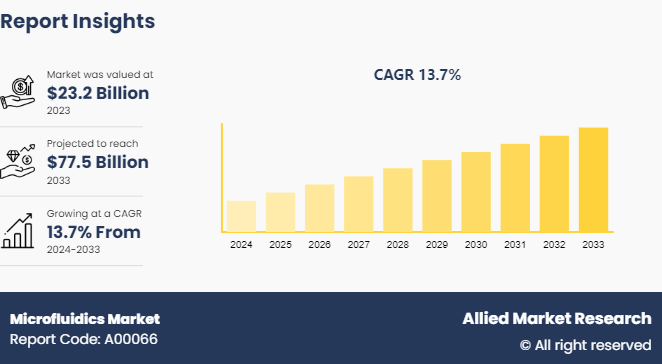
The global microfluidics market was valued at $23.2 billion in 2023 and is projected to reach $77.5 billion by 2033, growing at a CAGR of 13.7% from 2024 to 2033. Increase in demand for point-of-care diagnostics, growing adoption in pharmaceutical and biotechnology research, rising prevalence of chronic diseases, and advancements in lab-on-a-chip technologies are key factors driving the growth of the microfluidics market.
Market Introduction
The microfluidics market encompasses technologies, devices, and systems that manipulate and control small volumes of fluids, typically in the microliter to picoliter range, within microscale channels. These systems integrate multiple laboratory functions onto a single chip, commonly referred to as lab-on-a-chip devices, enabling rapid analysis, reduced reagent consumption, and enhanced experimental precision. Microfluidic platforms are widely used across applications such as clinical diagnostics, drug discovery, genomics, proteomics, and environmental testing.
Microfluidics technology relies on components including microchannels, micropumps, microneedles, and microvalves, fabricated using materials such as glass, silicon, and polymers. The technology enables automation, high-throughput screening, and real-time monitoring of biological and chemical processes. It plays a critical role in polymerase chain reaction (PCR) testing, cell sorting, DNA sequencing, and biomarker detection. Its ability to deliver fast, cost-effective, and accurate results makes it highly valuable in modern healthcare and life sciences research.
In recent years, there has been substantial surge in demand for point-of-care testing solutions, particularly in developed regions such as North America and Europe, where strong research infrastructure and funding support innovation. Expanding applications in personalized medicine, organ-on-chip models, and wearable biosensors are further accelerating market expansion. As miniaturization and integration technologies continue to advance, the microfluidics market is projected to witness strong growth between 2024 and 2033, driven by technological innovation and increasing demand for rapid diagnostic and analytical solutions.
Key Takeaways
- The microfluidics market report provides detailed coverage across 20 countries, offering comprehensive segment-level analysis for each nation in terms of market value (in $ billion) over the forecast period from 2024 to 2033.
- To develop robust and reliable industry insights, the study examines more than 1,500 product brochures, company publications, press releases, annual reports, and related documents from leading participants in the microfluidics industry. In addition, credible industry journals, trade association publications, and official government sources have been extensively reviewed to ensure accuracy and depth of analysis.
- The research methodology combines high-quality quantitative data, expert opinions, and in-depth analytical assessments with independent viewpoints. This integrated approach is designed to present a well-rounded perspective of the global microfluidics market, enabling stakeholders to make strategic, data-driven decisions and successfully pursue their long-term growth ambitions.
Key Market Dynamics
The microfluidics market is influenced by the growing demand for rapid and accurate diagnostic solutions, expanding applications in life sciences research, and continuous technological advancements in miniaturization and lab-on-a-chip platforms. Increasing focus on personalized medicine, rising prevalence of chronic and infectious diseases, and the need for cost-effective analytical tools are collectively shaping market expansion. Additionally, strong investments in biotechnology and pharmaceutical R&D, coupled with government support for advanced healthcare technologies, are accelerating product innovation. The integration of automation, artificial intelligence, and high-throughput screening capabilities into microfluidic systems is further strengthening the overall market landscape.
Drivers
The microfluidics market is primarily driven by the increasing adoption of point-of-care (POC) diagnostics and decentralized testing solutions. Healthcare systems worldwide are emphasizing rapid disease detection and early diagnosis, particularly for conditions such as cancer, infectious diseases, and metabolic disorders. Microfluidic devices enable precise fluid control, reduced reagent consumption, and faster turnaround times, making them highly suitable for portable and bedside diagnostic applications.
Another key growth driver is the expanding use of microfluidics in drug discovery and development. Pharmaceutical and biotechnology companies rely on microfluidic platforms for high-throughput screening, cell analysis, organ-on-chip modeling, and toxicity testing. These technologies improve experimental accuracy while reducing time and operational costs associated with conventional laboratory methods. Furthermore, advancements in materials such as polymers and biocompatible substrates have enhanced device performance and scalability.
The increasing focus on personalized medicine and genomics also supports market growth. Microfluidic systems play a crucial role in DNA sequencing, PCR amplification, and biomarker detection, enabling tailored treatment strategies. Continuous innovation in chip design and integration with digital monitoring systems has improved reliability and broadened clinical adoption.
Restraints
Despite strong growth prospects, the microfluidics market faces certain challenges. High initial development costs and complex fabrication processes can limit adoption, particularly among small-scale laboratories and research institutions. The need for specialized expertise in device design, integration, and operation may also hinder widespread implementation.
Additionally, standardization issues and regulatory uncertainties related to diagnostic device approvals can delay commercialization. Variability in performance across different materials and platforms may affect reproducibility, creating concerns for clinical applications. Limited awareness and infrastructure constraints in emerging economies further restrict market penetration.
Opportunities
The microfluidics market presents substantial opportunities driven by emerging applications and technological convergence. The development of organ-on-chip and lab-on-chip platforms for disease modeling and drug testing offers significant growth potential. Integration with artificial intelligence and data analytics can enhance automation and real-time decision-making capabilities.
Emerging markets in Asia-Pacific, Latin America, and the Middle East provide untapped potential due to expanding healthcare infrastructure and research investments. Strategic partnerships between academic institutions, biotechnology firms, and medical device manufacturers, along with increased funding for innovation, are expected to accelerate product development and global adoption of microfluidic technologies.
Global Microfluidics Market Patent Analysis
The patent landscape of the microfluidics market reflects sustained innovation aimed at enhancing system performance, integration, and application scope. Industry participants consistently invest in intellectual property to strengthen technological capabilities, secure competitive positioning, and accelerate the development of differentiated products. Such patent activities play a significant role in advancing microfluidic solutions and supporting overall market growth.
- In March 2022, Hewlett Packard Development Co. introduced a microfluidics measurement system incorporating multiple pumps and sensors. Within this system, each pump and sensor is connected to a transistor, and each transistor is linked to a flip-flop. These flip-flops are arranged sequentially in a chain configuration, a design that may reduce the number of control pads required to manage numerous pumps and sensors, thereby improving system efficiency and compactness.
- In January 2022, BOE Technology Group Co., Ltd., in collaboration with Beijing BOE Sensing Technology Co., Ltd., developed a microfluidics chip designed for biological detection. The chip features a central region encircled by a peripheral area. The central region contains both a liquid storage zone and a reaction zone, formed by two opposing substrates, each comprising a base and an electrode layer. The first substrate includes a liquid storage slot and a liquid intake opening positioned within the storage region. The structural configuration of the slot—particularly its inclined edge orientation relative to the intake hole—is engineered to optimize fluid direction toward the reaction area, enhancing detection precision and analytical performance.
- In May 2020, the University of Bristol introduced a microfluidics analysis system integrating a microfluidic cell with a microscope. The system includes an objective lens that captures light from selected areas of the microfluidic cell, along with a secondary lens and an actuator. The actuator adjusts the objective lens across multiple viewing positions without moving the secondary lens, allowing accurate imaging across different points while maintaining system stability.
Market Segmentation
The microfluidics market share is segmented into application, material, technology, and region. On the basis of application, the market is divided into medical/healthcare and non-medical. On the basis of material, the market is classified into silicone, glass, polymer, PDMS, and others. On the basis of technology, the market is divided into lab-on-a-chip, organs-on-chips, continuous flow microfluidics, optofluidics & microfluidics, acoustofluidics & microfluidics, and electrophoresis & microfluidics. Region wise, the market is analyzed across North America, Europe, Asia-Pacific, and LAMEA.
The microfluidics market demonstrates varied growth across segments. By application, medical/healthcare accounts for the largest share due to strong demand for diagnostics and life sciences research, followed by non-medical uses. By material, polymers and PDMS dominate owing to flexibility and cost-efficiency, with glass and silicone also contributing. By technology, lab-on-a-chip leads, followed by organs-on-chips and continuous flow microfluidics.
Regional Market Outlook
The North American microfluidics market is experiencing strong growth, supported by continuous technological advancements and increasing demand for miniaturized medical and diagnostic solutions. The market spans diverse applications, including molecular diagnostics, drug delivery systems, and point-of-care testing. Robust healthcare infrastructure, substantial investments in research and development, and the growing burden of chronic diseases that require advanced diagnostic and therapeutic approaches are key factors fueling market expansion.
However, challenges such as stringent regulatory requirements and high production costs may restrain growth to some extent. Despite these limitations, the market in North America is projected to witness considerable expansion, driven by sustained innovation and the broader integration of microfluidic technologies across biomedical and clinical applications.
Which End Users Are Driving Growth in the Microfluidics Market?
The primary end users contributing to growth in the microfluidics market include pharmaceutical and biotechnology companies, academic and research institutes, diagnostic laboratories, and hospitals. Pharmaceutical and biotech firms account for a significant share due to their extensive use of microfluidic platforms in drug discovery, high-throughput screening, toxicity testing, and organ-on-chip modeling. These organizations rely on microfluidics to accelerate research timelines, reduce reagent consumption, and improve experimental precision.
Academic and research institutions are also major contributors, leveraging microfluidic systems for genomics, proteomics, cell biology studies, and advanced molecular analysis. Diagnostic laboratories and hospitals are increasingly adopting lab-on-a-chip technologies for rapid disease detection, point-of-care testing, and biomarker analysis. The growing emphasis on decentralized healthcare and personalized medicine continues to strengthen demand across these end-user segments.
What Key Trends Are Shaping the Microfluidics Industry?
A prominent trend in the microfluidics market is the expanding adoption of lab-on-a-chip and organ-on-chip platforms for biomedical research and clinical diagnostics. These miniaturized systems integrate multiple laboratory functions onto a single chip, enabling faster and more cost-effective testing. The increasing focus on personalized medicine and precision diagnostics is further accelerating this trend.
Another important development is the convergence of microfluidics with digital health technologies, including automation, data analytics, and connected diagnostic platforms. Wearable biosensors and portable diagnostic devices powered by microfluidic components are gaining traction. Additionally, growing applications in environmental monitoring, food safety testing, and chemical analysis are broadening the industry’s scope beyond traditional healthcare settings.
- In April 2023, researchers at the University of Manitoba leveraged microfluidics technologies provided by Dolomite Microfluidics to develop and assess innovative nanoparticle-based drug delivery systems. These systems were designed to enhance the safety and efficacy of treatments administered during pregnancy.
- In January 2022, uFluidix reported that it had successfully doubled its manufacturing capacity over the preceding year. The company also announced ongoing optimization of new process parameters to improve the production efficiency and quality of thermoplastic microfluidic chips.
How Is Artificial Intelligence Impacting the Microfluidics Market?
Artificial intelligence (AI) is playing an increasingly transformative role in the microfluidics sector by enhancing data interpretation, system automation, and experimental optimization. AI-driven image analysis and pattern recognition tools are improving the accuracy of cell sorting, biomarker detection, and molecular diagnostics.
Machine learning algorithms are also being integrated into microfluidic platforms to optimize fluid dynamics, predict experimental outcomes, and improve chip design efficiency. In pharmaceutical research, AI-supported microfluidic systems enable rapid analysis of complex biological datasets, supporting faster decision-making in drug development. The combination of AI and microfluidics is driving smarter, more autonomous laboratory systems.
What Technological Innovations Are Advancing the Microfluidics Market?
Innovation in the microfluidics market centers on improved chip fabrication techniques, advanced materials, and enhanced integration capabilities. Developments in polymer-based fabrication and 3D printing are enabling scalable and cost-effective production. Advances in continuous flow microfluidics, acoustofluidics, and optofluidics are expanding functional capabilities.
Furthermore, the integration with real-time sensing technologies, multiplexed detection systems, and compact portable devices is enhancing performance and accessibility. Collectively, these technological advancements are improving analytical accuracy, reducing operational complexity, and expanding global adoption of microfluidic solutions across diverse industries.
Competitive Landscape
The microfluidics market comprises a mix of globally established life sciences corporations and specialized technology providers focused on advanced analytical and diagnostic solutions. Major players operating in this market include Illumina, Inc., Bio-Rad Laboratories, Inc., F. Hoffmann-La Roche Ltd, PerkinElmer, Inc., Thermo Fisher Scientific, Agilent Technologies, Inc., Standard BioTools, Danaher Corporation, and Abbott. These companies offer extensive product portfolios spanning lab-on-a-chip systems, PCR and sequencing platforms, microfluidic consumables, reagents, and integrated diagnostic solutions for applications in genomics, proteomics, and clinical testing.
In addition to these leading organizations, several emerging and regional participants contribute to the competitive landscape. Market players are increasingly emphasizing technological innovation, product launches, strategic partnerships, mergers and acquisitions, and geographic expansion to strengthen their market position and address the growing demand for rapid, miniaturized, and high-precision analytical solutions.
Recent Key Strategies and Developments
- In October 2022, Standard BioTools introduced the X9 Real-Time PCR System, a high-throughput genomics platform powered by microfluidics technology, designed to deliver enhanced flexibility and productivity for advanced molecular analysis.
- In March 2022, Miroculus unveiled Miro Canvas, a compact and intuitive digital microfluidics platform developed to automate complex next-generation sequencing (NGS) sample preparation workflows on demand.
- In November 2021, Fluidigm Corporation, a biotechnology tools company focused on advancing health through comprehensive biological insights, announced the release of Biomark X, the newest generation of its Biomark microfluidics platform, offering improved performance and expanded capabilities.
Industry Trends
- In April 2023, a research group at the University of Manitoba used microfluidics technologies from Dolomite Microfluidics to design and evaluate novel nanoparticle drug delivery systems aimed at the safe and effective treatment of diseases during pregnancy.
- In January 2022, uFluidix announced that they successfully doubled their manufacturing capacity over the previous 12 months and were optimizing for new process variables in the production of thermoplastic microfluidic chips.
Key Sources Referred
- Microfluidics Association
- National Research Council Canada
- Elveflow
- INDIAN MICROFLUIDICS ASSOCIATION
- Microfluidics Innovation Center
- Royal Society of Chemistry
- uFluidix
Key Benefits For Stakeholders
- This report delivers a comprehensive quantitative assessment of the microfluidics market, analyzing market segments, current trends, forecasts, and dynamics from 2023 to 2033 to identify emerging growth opportunities.
- The study incorporates detailed insights into key market drivers, restraints, and potential opportunities shaping industry expansion. Porter’s Five Forces analysis is included to evaluate the bargaining power of buyers and suppliers, enabling stakeholders to make profit-driven strategic decisions and strengthen their supplier–buyer relationships.
- A thorough segmentation analysis of the microfluidics market helps identify high-potential areas and emerging revenue streams. Major countries across each region are evaluated based on their contribution to global market revenue.
- Additionally, competitive positioning analysis supports benchmarking by offering a clear view of the current standing of key market participants. Beyond these insights, the report also examines regional and global market trends, leading companies, application segments, and strategic initiatives adopted to drive market growth.
Microfluidics Market Report Highlights
| Aspects | Details |
 Market Size By 2033 | USD 77.5 Billion |
 Growth Rate | CAGR of 13.7% |
 Forecast period | 2024 - 2033 |
 Report Pages | 320 |
 By Application |
|
 By Material |
|
 By Technology |
|
 By Region |
|
 Key Market Players | Agilent Technologies, Inc., PerkinElmer, Inc., Illumina, Inc., bioMerieux, Bio-Rad Laboratories, Inc., Danaher Corporation, F. Hoffmann-La Roche Ltd, Thermo Fisher Scientific Inc., Abbott, Standard BioTools |
Upcoming trends in the global microfluidics market include advancements in lab-on-a-chip technologies, increased integration with AI and IoT, and expanding applications in diagnostics, drug delivery, and personalized medicine.
The leading application of the microfluidics market is in healthcare industry.
Asia-Pacific is the largest regional market for microfluidics
The microfluidics market was valued at $23.2 billion in 2023 and is estimated to reach $77.5 billion by 2033, exhibiting a CAGR of 13.7% from 2024 to 2033.
The major players operating in the microfluidics market include Illumina, Inc., Bio-Rad Laboratories, Inc., F. Hoffmann-La Roche Ltd, PerkinElmer, Inc., Thermo Fisher Scientific, Agilent Technologies, Inc., Standard BioTools, Danaher Corporation, Abbott, and others.
Loading Table Of Content...