
Intragastric Balloons Market Summary
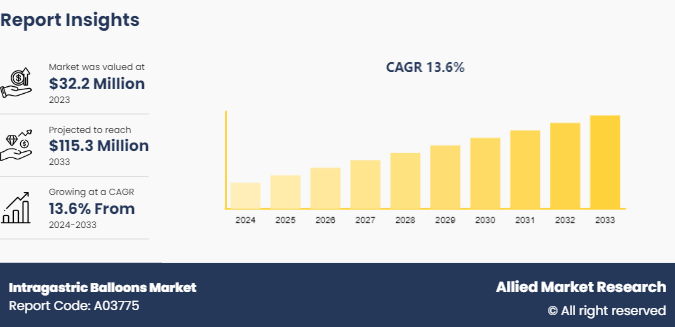
The global intragastric balloons market size was valued at $32.2 million in 2023, and is projected to reach $115.3 million by 2033, growing at a CAGR of 13.6% from 2024 to 2033. Increase in number of cases of cardiovascular diseases, diabetes, and certain types of cancer drives the demand for intragastric balloons in the surgical procedures.
Market Introduction and Definition
Intragastric balloons are non-surgical devices designed to assist with weight loss by occupying space in the stomach for inducing a feeling of fullness and reducing food intake. These balloons are inserted into the stomach endoscopically and filled with saline or gas to occupy a portion of the stomach, limiting its capacity for food intake. This approach helps individuals adhere to reduced-calorie diets and adopt healthier eating habits, facilitating weight loss. Intragastric balloons are particularly beneficial for individuals struggling with obesity who may not qualify for or wish to avoid surgical interventions such as gastric bypass or sleeve gastrectomy, offering a less invasive alternative with potential for significant weight loss and improved metabolic health.
Key Takeaways
- The intragastric balloons market share study covers 20 countries. The research includes a segment analysis of each country in terms of value for the projected period.
- More than 1, 500 product literatures, industry releases, annual reports, and other such documents of major intragastric balloons industry participants along with authentic industry journals, trade associations' releases, and government websites have been reviewed for generating high-value industry insights.
- The study integrated high-quality data, professional opinions and analysis, and critical independent perspectives. The research approach is intended to provide a balanced view of global intragastric balloons marketand to assist stakeholders in making educated decisions in order to achieve their most ambitious growth objectives.
What are Intragastric Balloons?
Intragastric balloons are medical device designed to assist with weight loss in individuals who are overweight or obese. These are placed inside the stomach and filled with saline or gas. They, thus, occupy space and reduce the capacity of the stomach. This helps decrease food intake and make patients adopt healthier eating habits and achieve meaningful weight reduction. They are indicated for individuals with a body mass index (BMI) of 30–40 who have not achieved adequate weight loss through diet and exercise. Intragastric balloons are less invasive, reversible, and do not permanently alter gastrointestinal anatomy. This makes them appealing to patients who are not candidates for surgery or who prefer a temporary, non-surgical option. Further, the recovery time associated with intragastric balloon is minimal, which allows patients to resume normal activities quickly.
Intragastric balloon placement is performed endoscopically and takes about 20 to 30 minutes. A deflated balloon is inserted through the mouth into the stomach using an endoscope. The patient is kept under mild sedation during the procedure. Once correctly positioned, it is filled with sterile saline solution or gas, depending on the system. The balloon remains in the stomach for a prescribed duration—usually six months. After the duration, it is removed endoscopically. The presence of the balloon may decrease gastric emptying and influence hormonal responses related to hunger. This, combined with structured lifestyle counseling, contribute to weight loss outcomes.
Clinical studies show that patients using intragastric balloons can lose an average of 10–15% of their total body weight over six months. Importantly, the therapy is most effective when combined with a supervised nutrition and behavioral modification program. The balloon is intended as a tool to start weight loss and help patients establish long-term habits. Common side effects during the first few days after placement include nausea, vomiting, abdominal discomfort, and reflux. These symptoms are usually transient and manageable with medications.
Key Market Dynamics
Drivers
Rise in prevalence of obesity is one of the major factors driving the growth of the intragastric balloons market. Further, surge in awareness about obesity-related comorbid conditions. Healthcare providers increasingly recognize the value of early intervention to reduce long-term complications and associated healthcare costs. Intragastric balloons serve as an attractive option for patients who are not yet eligible for or willing to undergo bariatric surgery. Technological advancements also contribute toward the market growth. Innovations in balloon materials, designs, and placement techniques have improved safety profiles and patient comfort. The development of swallowable or adjustable balloon systems attracts patients towards the procedure. Moreover, increase in regulatory approvals in various regions also foster the intragastric balloons market growth.
Restraints
The intragastric balloons treatment procedure is temporary in nature as balloons are removed after six months. This can lead to weight regain after removal, which limits its adoption among the people. Also, sustained weight loss depends heavily on patient adherence to lifestyle changes, which is difficult. Further, the procedure is costly and many insurance companies do not cover the cost for the individuals. These factors are projected to limit the growth of the intragastric balloons market.
Opportunities
There is an observed increase in demand for minimally invasive weight-loss solutions with developments in healthcare infrastructure and surge in disposable income. Integration with digital health platforms offers another promising growth opportunity for the market. Also, ongoing research into longer-duration balloons and combination therapies is opportunistic for the growth of the intragastric balloons market during the forecast period.
Market Segmentation
The intragastric balloons industry is segmented into type, filling material, end user, and region. By type, the intragastric balloons market is segmented into single, dual, and triple. By filling material, it is bifurcated into gas filled and saline filled. By end user, it is categorized into hospitals, ambulatory surgical centers (ASC), and others. By region, it is analyzed across North America, Europe, Asia-Pacific, and LAMEA.
Regional/Country Market Outlook
In North America, the intragastric balloons market share is expected to witness robust growth driven by increasing obesity rates, rising healthcare expenditure, and favorable reimbursement policies. Technological advancements and growing acceptance of minimally invasive weight loss treatments further contribute to market expansion. Similarly, Europe exhibits significant market potential with supportive regulatory frameworks and a growing emphasis on preventive healthcare measures. In the Asia-Pacific region, rapid urbanization, change in lifestyles, and increase in awareness of obesity-related health risks fuel intragastric balloons market growth, while emerging economies in Latin America and the Middle East & Africa present untapped opportunities for market penetration and growth.
- Allurion Technologies, Inc. continued its worldwide expansion with the launch of the Allurion Program in Canada, Mexico, Australia, and Brazil. In the U.S., Allurion launched the AUDACITY trial, an open-label, pivotal study to evaluate the safety and efficacy of the Allurion Balloon plus Moderate Intensity Lifestyle Modification Therapy Program (or “MILMTP”) versus MILMTP alone in the U.S. patients.
- According to a report published by the Trust for America's Health Organization in 2021, the U.S. adult obesity rate represents more than 42.4%, and it is the first time the national rate has passed the 40.0% mark. The national adult obesity rate has increased by 26.0% in previous years.
- In September 2023, ReShape Lifesciences Inc., the premier physician-led weight loss and metabolic health solutions company, announced the signing of an exclusive, royalty-bearing license agreement with Biorad Medysis, Pvt. Ltd. (Biorad) to manufacture, commercialize and distribute the Obalon Gastric Balloon System in India, Pakistan, Bangladesh, Nepal, Bhutan, Sri Lanka, and the Maldives.
What Is the Current Market Size and How Is the Market Expected to Grow?
As per Allied Market Research, the intragastric balloons market was valued at $32.2 million in 2023. From 2024 to 2033, the market is expected to grow at a CAGR of 13.6%, reaching an estimated $115.3 million by 2033.
This growth is attributed to increase in adoption of minimally invasive weight-loss treatments and surge in global awareness of obesity-related health risks. The single balloon segment is projected to maintain a leading share by type. The saline-filled balloons segment is anticipated to remain dominant by filling material.
What Are the Key Factors Driving and Restraining Market Growth?
Healthcare providers and patients are increasingly seeking non-surgical alternatives to bariatric surgery due to lower risk profiles, shorter recovery times, and reduced costs. Rise in healthcare expenditure and developments in medical facilities in regions such as North America and Asia-Pacific support intragastric balloons market expansion.
The intragastric balloon is a temporary device; therefore, sustained weight loss depends on behavioral changes after removal. Patient reluctance due to side effects, such as nausea, discomfort, or the need for endoscopic procedures, can also restrain adoption.
How Is the Market Performing Compared to Previous Years?
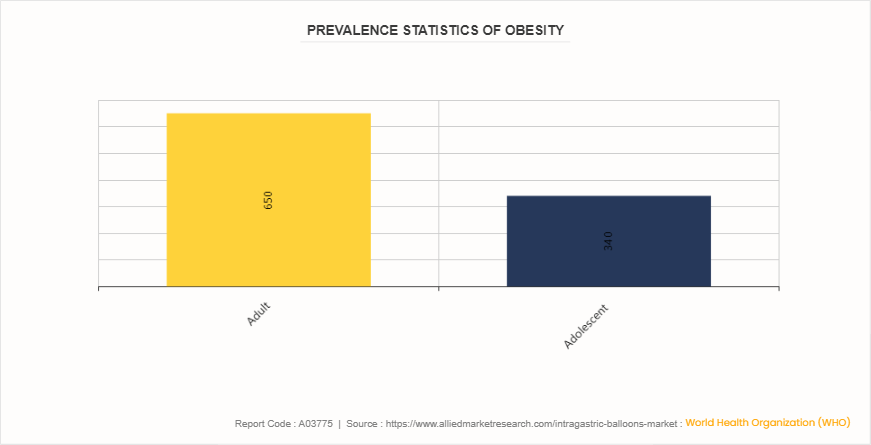
Compared to past performance, the intragastric balloons market has shown steady and progressive growth. Obesity prevalence continues to rise globally, creating stable demand for weight-loss devices. North America held the highest market share due to developments in healthcare infrastructure, surge in healthcare spending, and early regulatory approvals. Emerging markets in Asia-Pacific, Latin America, and Middle Eastern regions have witnessed faster relative growth due to increase in awareness and development in medical services.
This trend reflects a shift from traditional surgical interventions toward patient-friendly, minimally invasive options. Continuous improvements in balloon technology and patient management protocols contribute to greater clinician confidence and increased market uptake compared to previous years.
Who Are the Primary End Users Driving Market Adoption?
The hospital segment dominates the intragastric balloon market. Hospitals account for the largest share of procedures because they offer advanced endoscopic facilities, trained gastroenterologists, bariatric specialists, and comprehensive post-procedure support. These balloons are majorly used by gastrointestinal surgery and bariatric departments within hospitals. They are used for patients who are either not eligible for bariatric surgery or prefer non-surgical weight-loss treatments. Hospitals provide a structured clinical environment that can monitor and support patients throughout the treatment cycle.
Further, ambulatory surgical centers and specialty weight-loss clinics also adopt intragastric balloons. These centers provide outpatient settings where balloon placement and follow-up care can be delivered efficiently and at lower costs. This attracts the patients. Gastroenterology clinics and bariatric specialty centers also adopt intragastric balloon therapy. These facilities often integrate balloon treatment into weight-management protocols to improve treatment outcomes. This multidisciplinary approach supports long-term adoption of intragastric balloons.
Industry Trends
- In February 2022, an article published in the National Institute of Health, stated that in the studied population, about 57.0% of the patients who preferred minimally invasive treatment made their decision under the influence of the healthcare professionals as they recommended minimally invasive treatment and reported less perceived disadvantages following their treatment.
- In 2020, Allurion Technologies Inc. raised $34 million to facilitate the launch of its swallowable weight loss balloon.
What Is the Market Growth Forecast and CAGR Outlook?
Looking ahead, the intragastric balloons market is expected to maintain strong growth through 2033, with an estimated CAGR of 13.6% from 2024 to 2033. This projected growth outlook is supported by rise in global obesity rates, increase in preference for non-surgical weight-loss solutions, and continuous innovation in device design and clinical application. Adoption is expected to witness traction in Asia-Pacific markets as awareness and healthcare access gain popularity.
What Role Do Digital Technologies Play in Improving Products and Services?
Digital technologies play a significant role in improving intragastric balloon products and related healthcare services. One major contribution of digital technologies is remote patient monitoring. Mobile health applications allow patients to log meals, hydration, weight changes, and physical activity. Healthcare providers can access this data through cloud-based dashboards, enabling continuous monitoring without frequent in-person visits. This improves patient compliance and supports consistent weight-loss progress.
Telemedicine platforms also enhance service delivery. Patients undergoing intragastric balloon therapy often require counseling and nutritional guidance. Virtual consultations reduce travel time and increase convenience, particularly in regions where specialist centers are limited. This expands access to treatment and supports intragastric balloons market growth.
Competitive Landscape
The major players operating in the intragastric balloons market size include Obalon Therapeutics, Apollo Endosurgery Inc., Allurion Technologies Inc., Spatz Medical, ReShape Lifesciences, Lexel Medical, Endalis, MEDSIL, and Silimed. Other players in intragastric balloons market includes Districlass Medical, Helioscopie, and so on.
Recent Key Strategies and Developments
- In September 2022, Allurion Technologies, the U.S.-based medical device manufacturer, launched its weight loss solution, a swallowable gastric balloon, in India. The product claims to reduce weight by 10-15% on average within 16 weeks
- In November 2022, Boston Scientific Corporation announced it has entered into a definitive agreement to acquire Apollo Endosurgery, Inc. for a cash price of $10 per share, reflecting an enterprise value of approximately $615 million.
- In June 2023, Allurion, a company dedicated to ending obesity, today announced a pilot collaboration agreement with Medtronic, a global leader in healthcare technology, to expand access to Allurion’s AI-powered weight loss program through a sales agency agreement in the Central and Eastern Europe, Middle East, and Africa (CEMA) region. The partnership enables Allurion to offer the Allurion Balloon and accelerate utilization of the Allurion Iris Artificial Intelligence (AI) Platform in the management of bariatric surgery patients by leveraging Medtronic channels during the collaboration.
Key Sources Referred
- World Health Organization (WHO)
- National Center for Biotechnology and Information (NCBI)
- Centers for Medicare & Medicaid Services (CMS)
- National Health Service (NHS)
- Ministry of Health and Family Welfare (MoHFW)
- National Health Mission (NHM)
- Allurion Technologies
- Medtronic Plc
- Centers for Disease Control and Prevention (CDC)
- Food and Drug Administration (FDA)
- National Institutes of Health (NIH)
Key Benefits for Stakeholders
- This report provides a quantitative analysis of the market segments, current trends, estimations, and dynamics of the intragastric balloons market analysis from 2024 to 2033 to identify the prevailing intragastric balloons market opportunity.
- The market research is offered along with information related to key drivers, restraints, and opportunities.
- Porter's five forces analysis highlights the potency of buyers and suppliers to enable stakeholders make profit-oriented business decisions and strengthen their supplier-buyer network.
- In-depth analysis of the intragastric balloons market segmentation assists to determine the prevailing market opportunities.
- Major countries in each region are mapped according to their revenue contribution to the global intragastric balloons market.
- Market player positioning facilitates benchmarking and provides a clear understanding of the present position of the market players.
- The report includes the analysis of the regional as well as global intragastric balloons market trends, key players, market segments, application areas, and intragastric balloons marketgrowth strategies.
Intragastric Balloons Market Report Highlights
| Aspects | Details |
 Market Size By 2033 | USD 115.3 Million |
 Growth Rate | CAGR of 13.6% |
 Forecast period | 2024 - 2033 |
 Report Pages | 216 |
 By Type |
|
 By Filling Material |
|
 By End User |
|
 By Region |
|
 Key Market Players | Lexel Medical, ReShape Lifesciences, Silimed Indústria de Implantes Ltda., Endalis, MEDSIL, Spatz Medical, Obalon Therapeutics, Allurion Technologies Inc., Apollo Endosurgery Inc. |
Loading Table Of Content...